Blockbuster asked: Is this movie worth $4.99 tonight?
Netflix answered: You already paid. Just watch.
That single shift in mental framing — from purchase decision to access decision — is what separates transactional businesses from subscription empires.
Decision fatigue is a growth killer. Remove the question before the customer asks it.
Read the slides as text
Slide 1
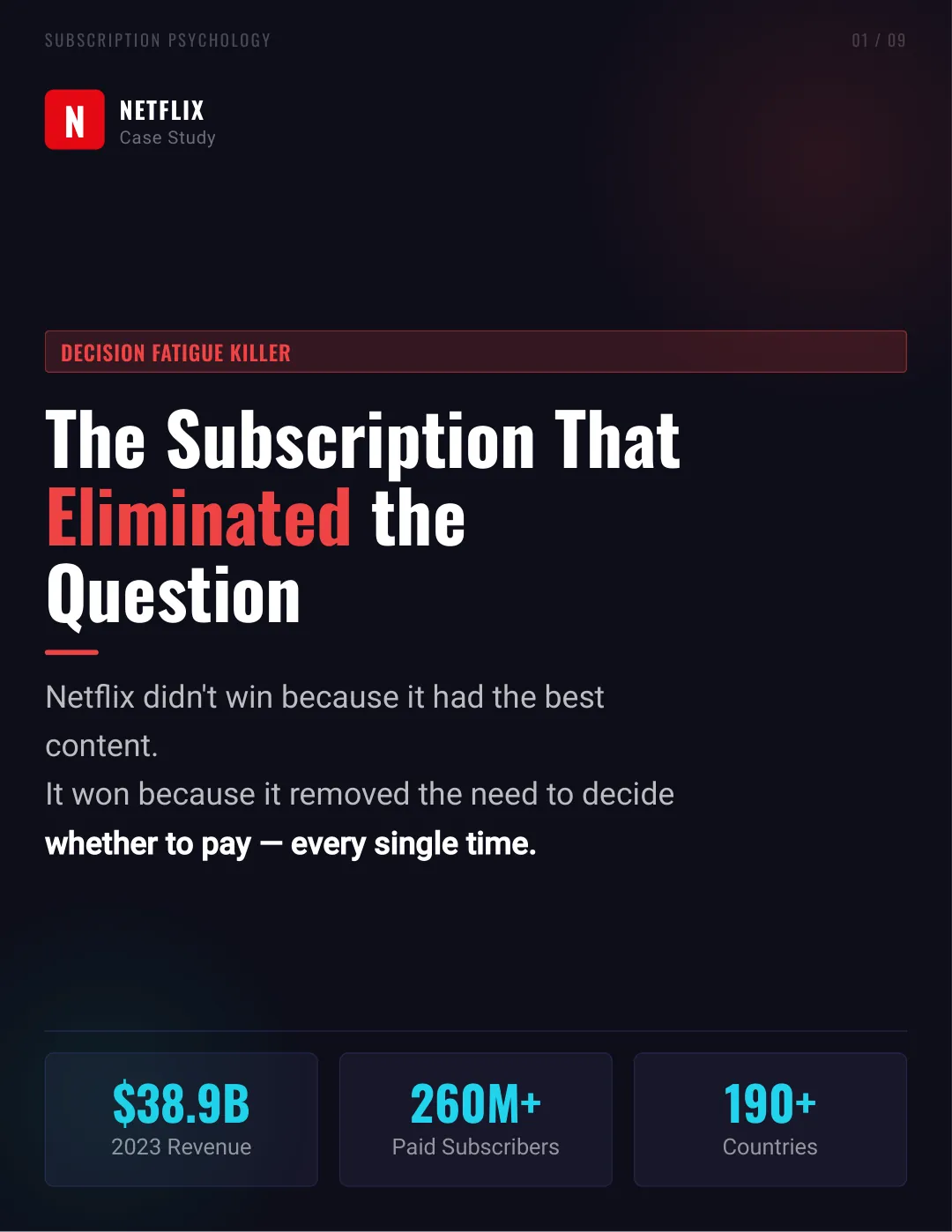
SUBSCRIPTION PSYCHOLOGY
01 / 09
N
NETFLIX
Case Study
DECISION FATIGUE KILLER
The Subscription That
Eliminated the
Question
Netflix didn't win because it had the best
content.
It won because it removed the need to decide
whether to pay — every single time.
$38.9B
2023 Revenue
260M+
Paid Subscribers
190+
Countries
Slide 2
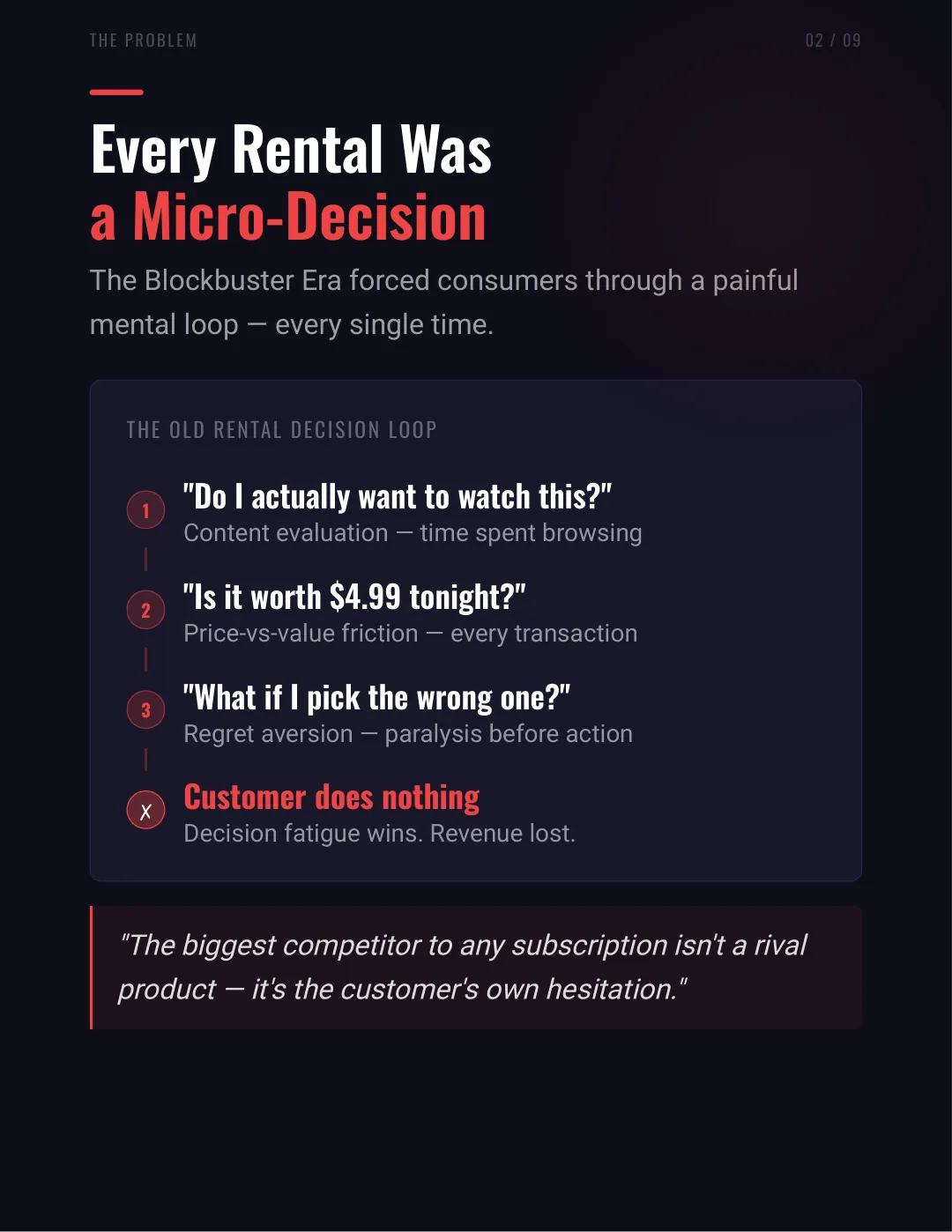
THE PROBLEM
02 / 09
Every Rental Was
a Micro-Decision
The Blockbuster Era forced consumers through a painful
mental loop — every single time.
THE OLD RENTAL DECISION LOOP
"The biggest competitor to any subscription isn't a rival
product — it's the customer's own hesitation."
1
"Do I actually want to watch this?"
Content evaluation — time spent browsing
2
"Is it worth $4.99 tonight?"
Price-vs-value friction — every transaction
3
"What if I pick the wrong one?"
Regret aversion — paralysis before action
✗
Customer does nothing
Decision fatigue wins. Revenue lost.
Slide 3
THE SHIFT
03 / 09
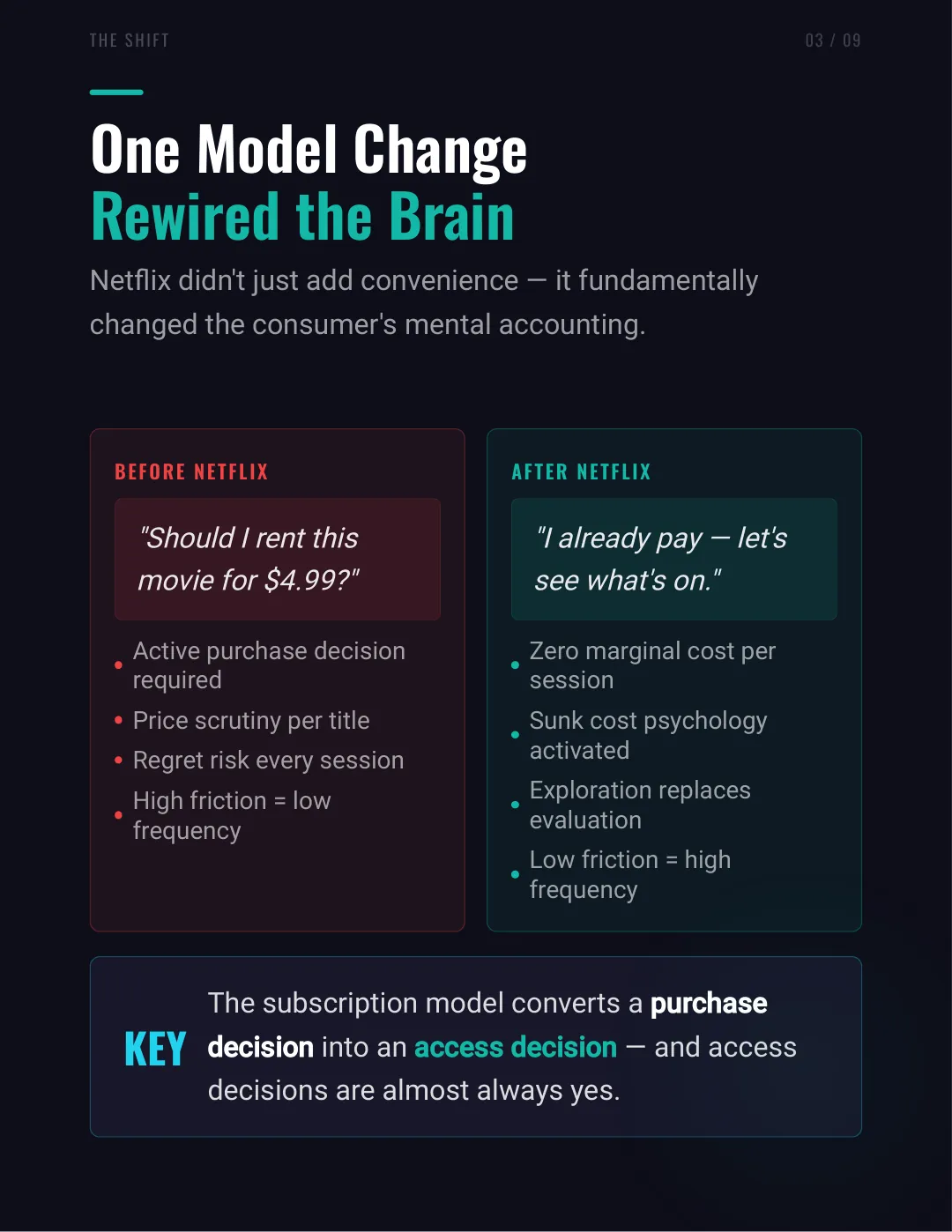
One Model Change
Rewired the Brain
Netflix didn't just add convenience — it fundamentally
changed the consumer's mental accounting.
BEFORE NETFLIX
"Should I rent this
movie for $4.99?"
Active purchase decision
required
Price scrutiny per title
Regret risk every session
High friction = low
frequency
AFTER NETFLIX
"I already pay — let's
see what's on."
Zero marginal cost per
session
Sunk cost psychology
activated
Exploration replaces
evaluation
Low friction = high
frequency
KEY
The subscription model converts a purchase
decision into an access decision — and access
decisions are almost always yes.
Slide 4
THE MECHANISM
04 / 09
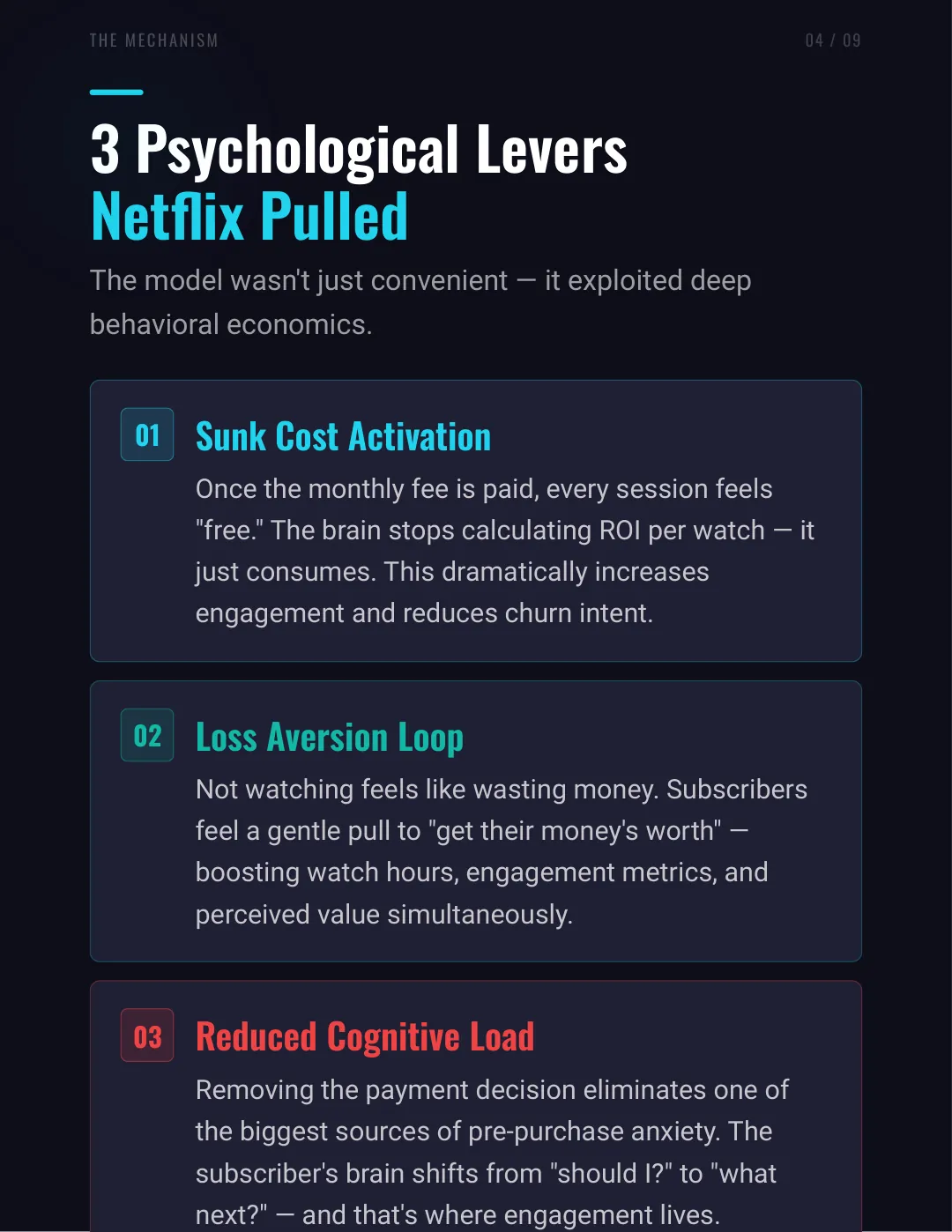
3 Psychological Levers
Netflix Pulled
The model wasn't just convenient — it exploited deep
behavioral economics.
01
Sunk Cost Activation
Once the monthly fee is paid, every session feels
"free." The brain stops calculating ROI per watch — it
just consumes. This dramatically increases
engagement and reduces churn intent.
02
Loss Aversion Loop
Not watching feels like wasting money. Subscribers
feel a gentle pull to "get their money's worth" —
boosting watch hours, engagement metrics, and
perceived value simultaneously.
03
Reduced Cognitive Load
Removing the payment decision eliminates one of
the biggest sources of pre-purchase anxiety. The
subscriber's brain shifts from "should I?" to "what
next?" — and that's where engagement lives.
Slide 5
PERFORMANCE DATA
05 / 09
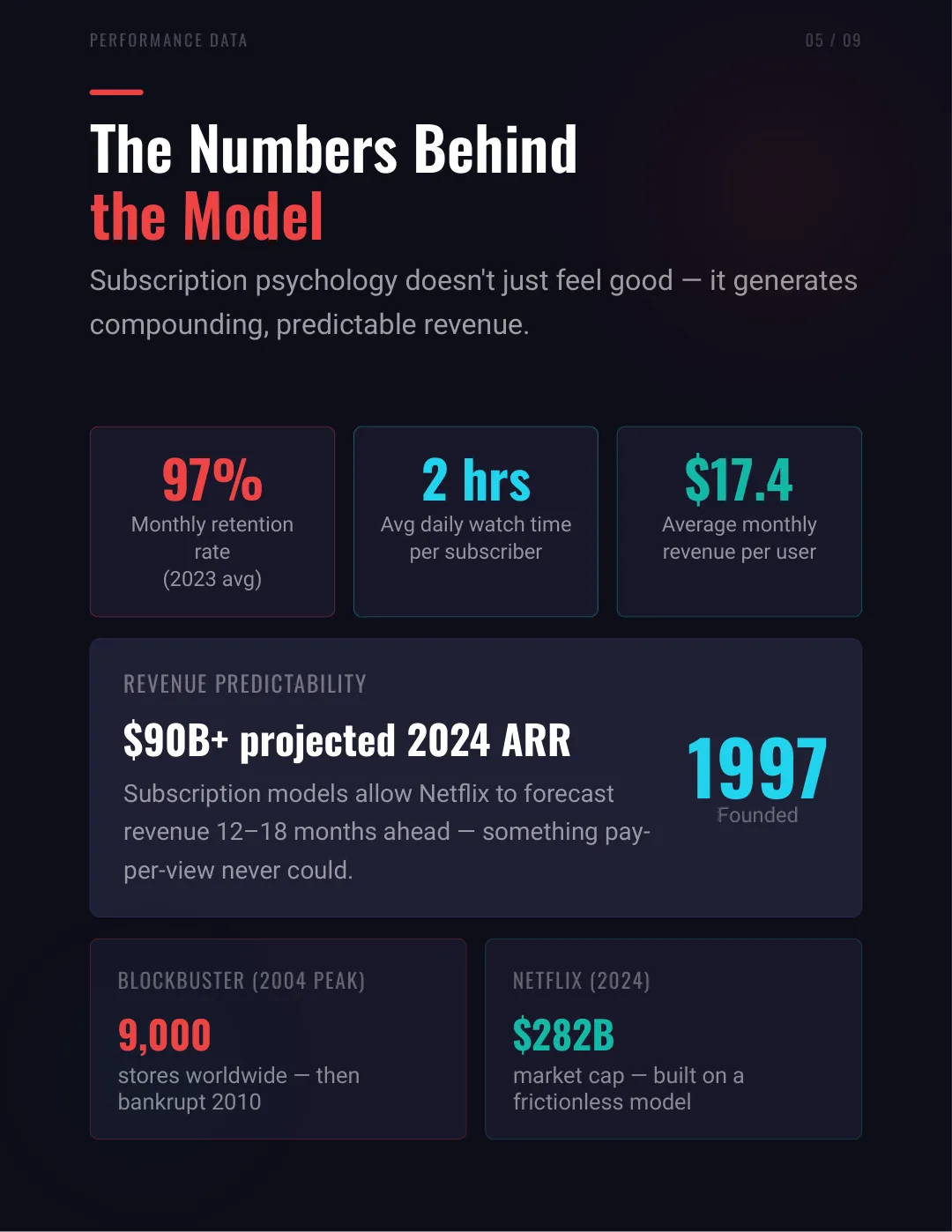
The Numbers Behind
the Model
Subscription psychology doesn't just feel good — it generates
compounding, predictable revenue.
97%
Monthly retention
rate
(2023 avg)
2 hrs
Avg daily watch time
per subscriber
$17.4
Average monthly
revenue per user
REVENUE PREDICTABILITY
$90B+ projected 2024 ARR
Subscription models allow Netflix to forecast
revenue 12–18 months ahead — something pay-
per-view never could.
1997
Founded
BLOCKBUSTER (2004 PEAK)
9,000
stores worldwide — then
bankrupt 2010
NETFLIX (2024)
$282B
market cap — built on a
frictionless model
Slide 6
BEHAVIORAL PSYCHOLOGY
06 / 09
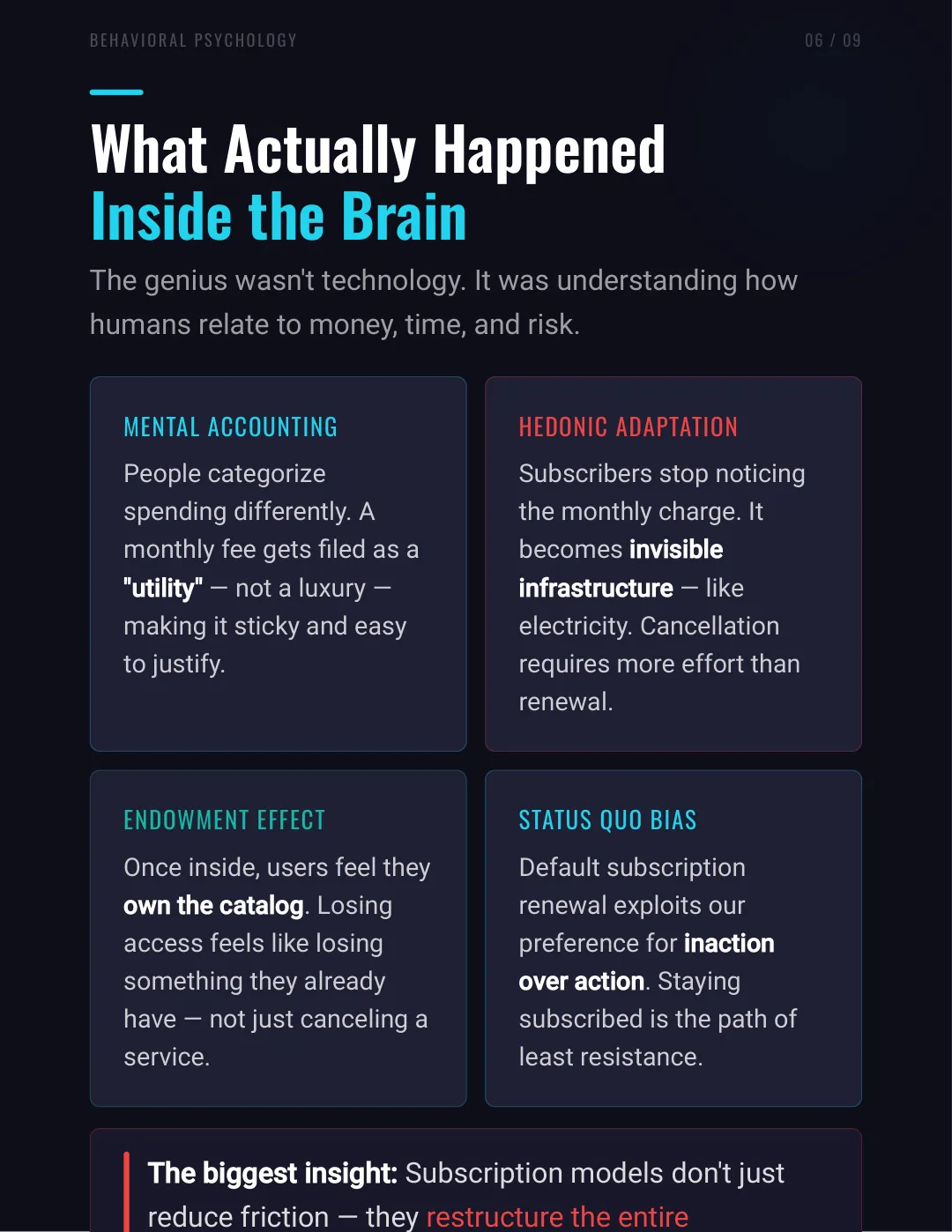
What Actually Happened
Inside the Brain
The genius wasn't technology. It was understanding how
humans relate to money, time, and risk.
MENTAL ACCOUNTING
People categorize
spending differently. A
monthly fee gets filed as a
"utility" — not a luxury —
making it sticky and easy
to justify.
HEDONIC ADAPTATION
Subscribers stop noticing
the monthly charge. It
becomes invisible
infrastructure — like
electricity. Cancellation
requires more effort than
renewal.
ENDOWMENT EFFECT
Once inside, users feel they
own the catalog. Losing
access feels like losing
something they already
have — not just canceling a
service.
STATUS QUO BIAS
Default subscription
renewal exploits our
preference for inaction
over action. Staying
subscribed is the path of
least resistance.
The biggest insight: Subscription models don't just
reduce friction — they restructure the entire
Slide 7
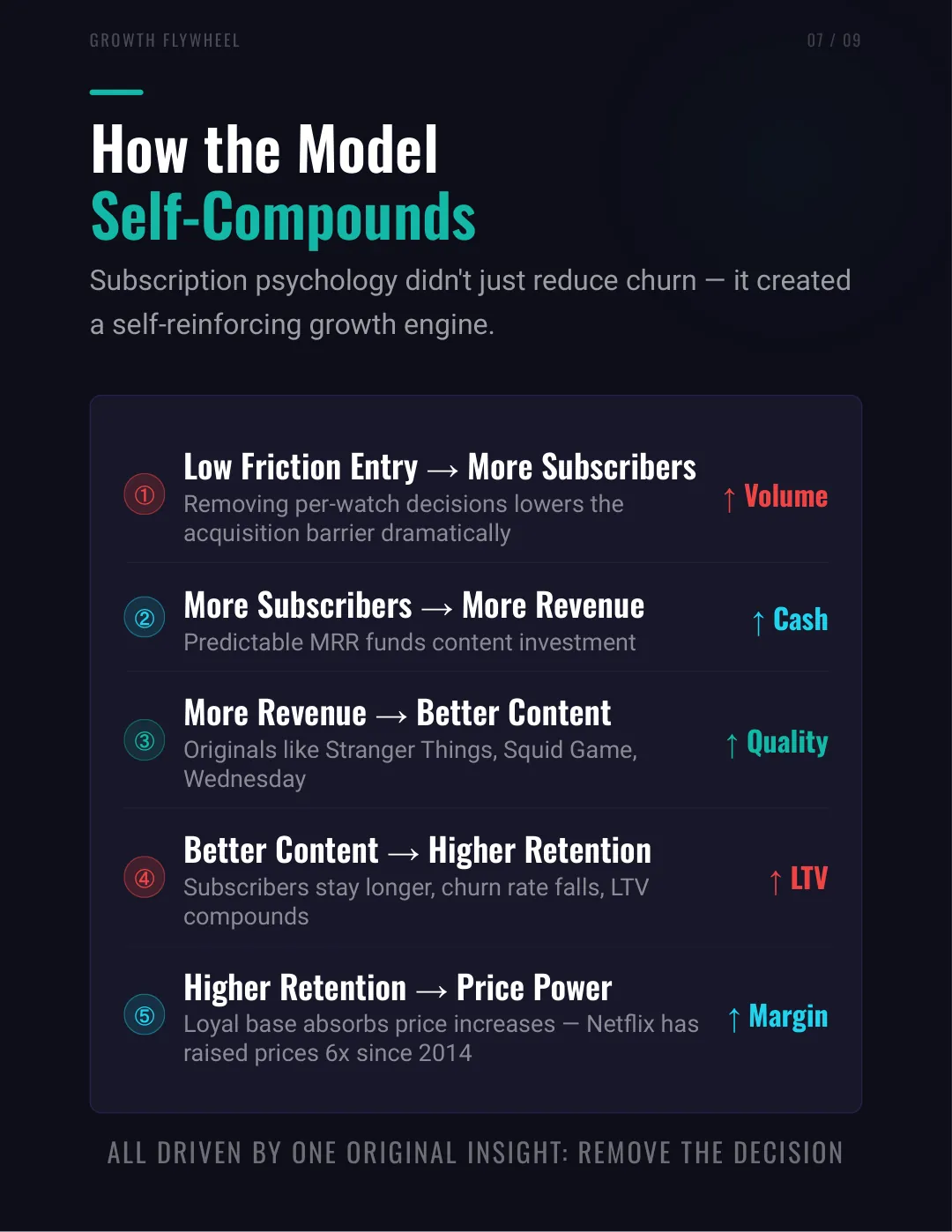
GROWTH FLYWHEEL
07 / 09
How the Model
Self-Compounds
Subscription psychology didn't just reduce churn — it created
a self-reinforcing growth engine.
①
Low Friction Entry → More Subscribers
Removing per-watch decisions lowers the
acquisition barrier dramatically
↑ Volume
②
More Subscribers → More Revenue
Predictable MRR funds content investment
↑ Cash
③
More Revenue → Better Content
Originals like Stranger Things, Squid Game,
Wednesday
↑ Quality
④
Better Content → Higher Retention
Subscribers stay longer, churn rate falls, LTV
compounds
↑ LTV
⑤
Higher Retention → Price Power
Loyal base absorbs price increases — Netflix has
raised prices 6x since 2014
↑ Margin
ALL DRIVEN BY ONE ORIGINAL INSIGHT: REMOVE THE DECISION
Slide 8
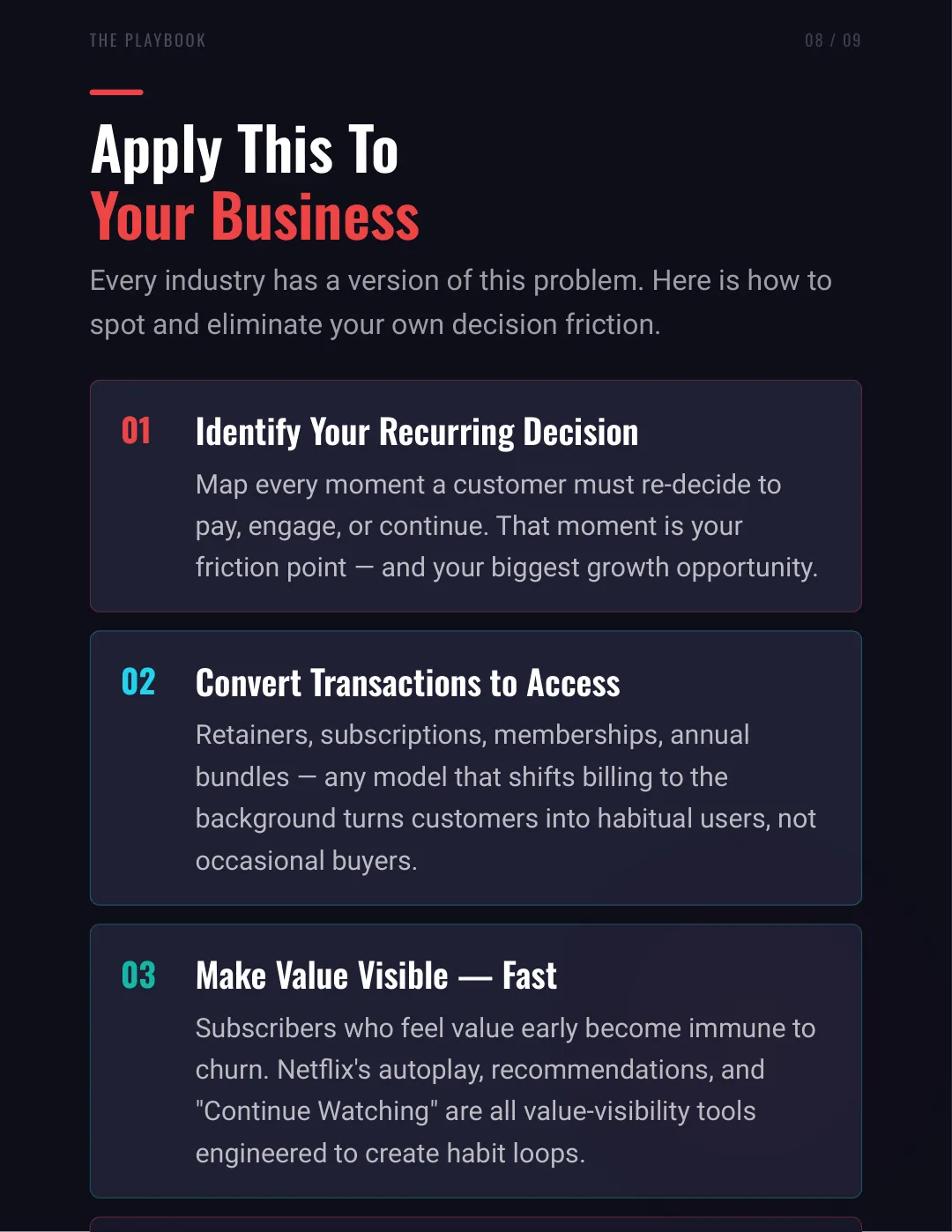
THE PLAYBOOK
08 / 09
Apply This To
Your Business
Every industry has a version of this problem. Here is how to
spot and eliminate your own decision friction.
01
Identify Your Recurring Decision
Map every moment a customer must re-decide to
pay, engage, or continue. That moment is your
friction point — and your biggest growth opportunity.
02
Convert Transactions to Access
Retainers, subscriptions, memberships, annual
bundles — any model that shifts billing to the
background turns customers into habitual users, not
occasional buyers.
03
Make Value Visible — Fast
Subscribers who feel value early become immune to
churn. Netflix's autoplay, recommendations, and
"Continue Watching" are all value-visibility tools
engineered to create habit loops.
Slide 9
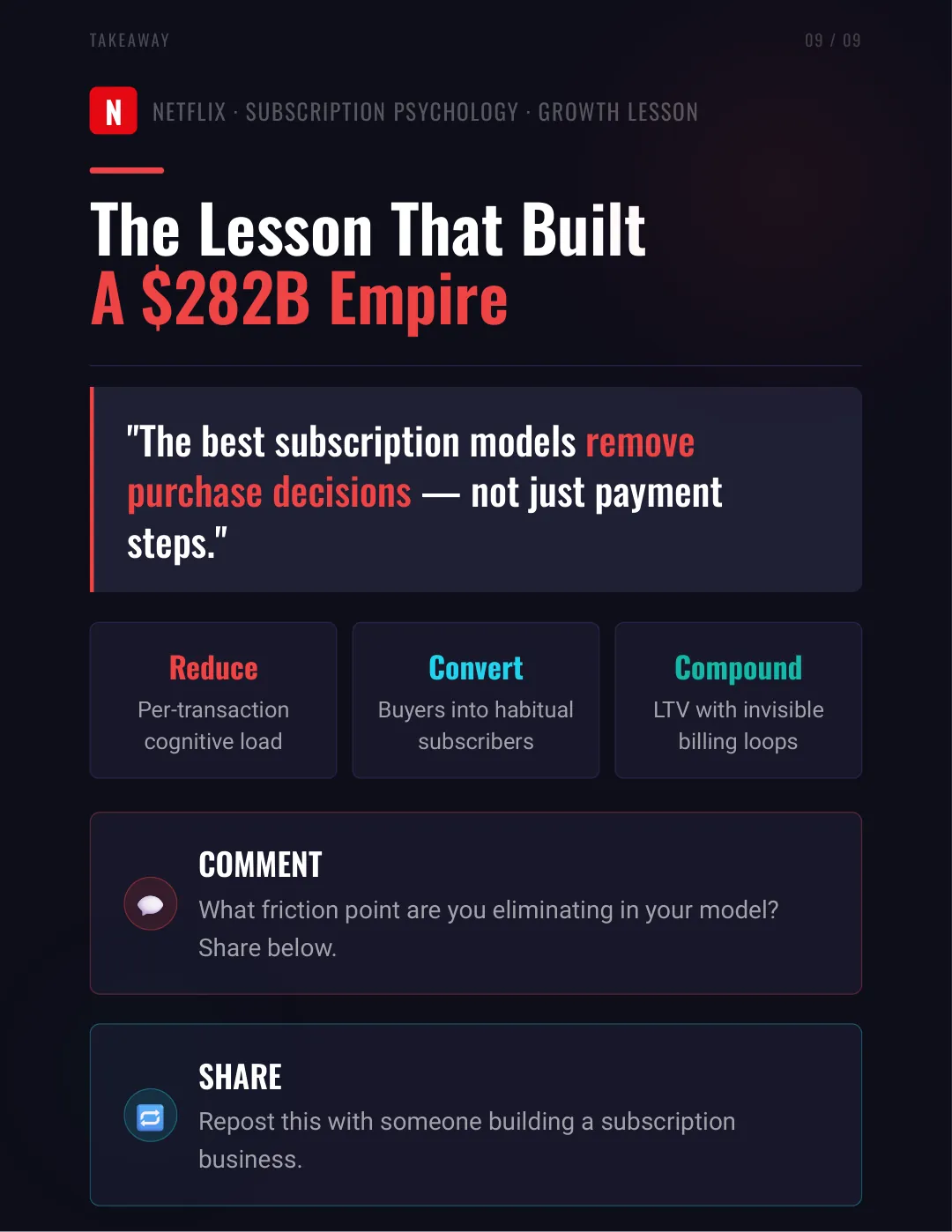
TAKEAWAY
09 / 09
N
NETFLIX · SUBSCRIPTION PSYCHOLOGY · GROWTH LESSON
The Lesson That Built
A $282B Empire
"The best subscription models remove
purchase decisions — not just payment
steps."
Reduce
Per-transaction
cognitive load
Convert
Buyers into habitual
subscribers
Compound
LTV with invisible
billing loops
💬
COMMENT
What friction point are you eliminating in your model?
Share below.
🔁
SHARE
Repost this with someone building a subscription
business.