1991: a website was a text file that sat still. 2005: it learned to talk back without reloading
2016: it panicked because phones took over.
2022: it started reading visitors before they scrolled.
The page never once asked permission to evolve.
Read the slides as text
Slide 1
ENGINEERING BEHIND BIG SYSTEMS
SLIDE 01 / 09
WEB ARCHITECTURE TIMELINE
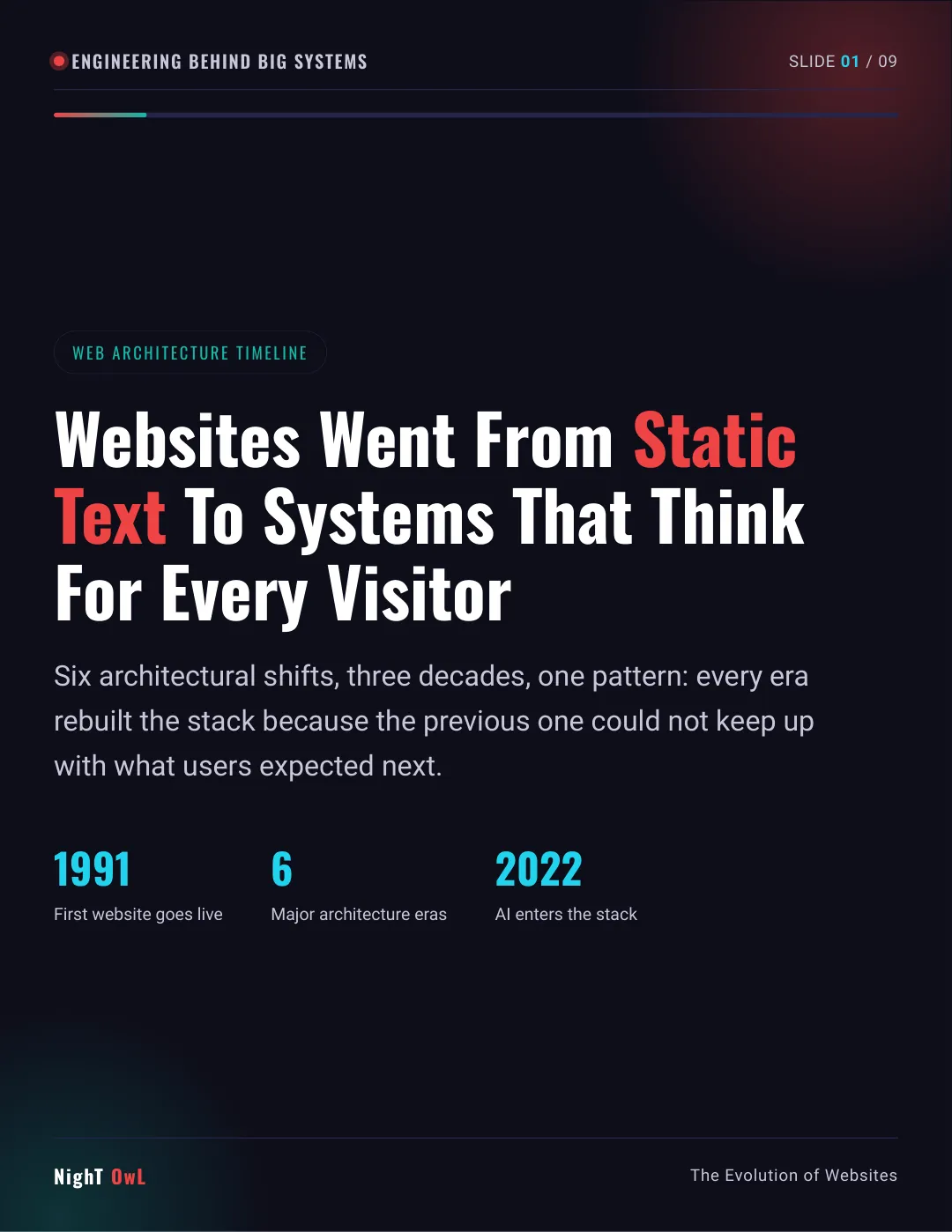
Websites Went From Static
Text To Systems That Think
For Every Visitor
Six architectural shifts, three decades, one pattern: every era
rebuilt the stack because the previous one could not keep up
with what users expected next.
1991
First website goes live
6
Major architecture eras
2022
AI enters the stack
NighT OwL
The Evolution of Websites
Slide 2
ENGINEERING BEHIND BIG SYSTEMS
SLIDE 02 / 09
ERA 01 · 1991 - 1995
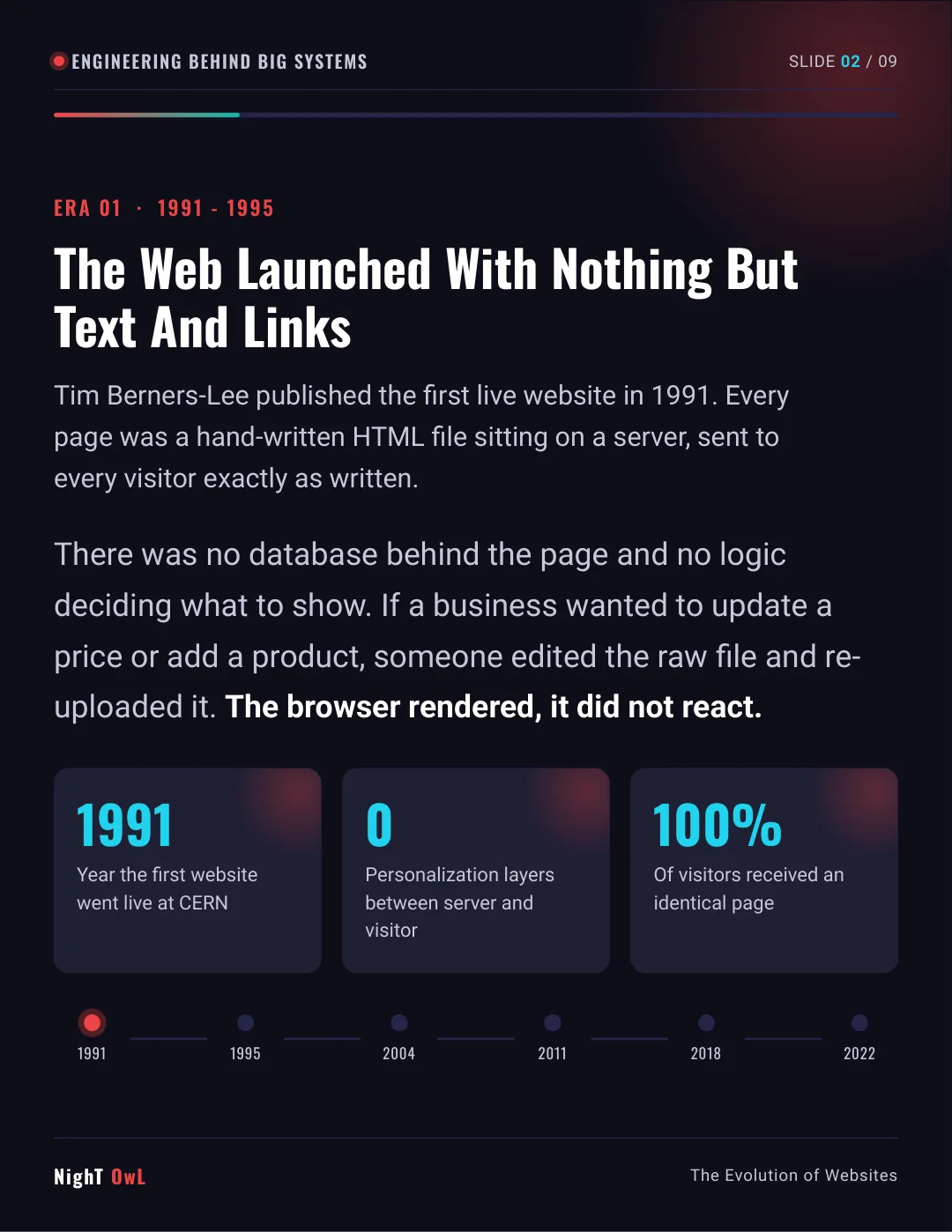
The Web Launched With Nothing But
Text And Links
Tim Berners-Lee published the first live website in 1991. Every
page was a hand-written HTML file sitting on a server, sent to
every visitor exactly as written.
There was no database behind the page and no logic
deciding what to show. If a business wanted to update a
price or add a product, someone edited the raw file and re-
uploaded it. The browser rendered, it did not react.
1991
1995
2004
2011
2018
2022
1991
Year the first website
went live at CERN
0
Personalization layers
between server and
visitor
100%
Of visitors received an
identical page
NighT OwL
The Evolution of Websites
Slide 3
ENGINEERING BEHIND BIG SYSTEMS
SLIDE 03 / 09
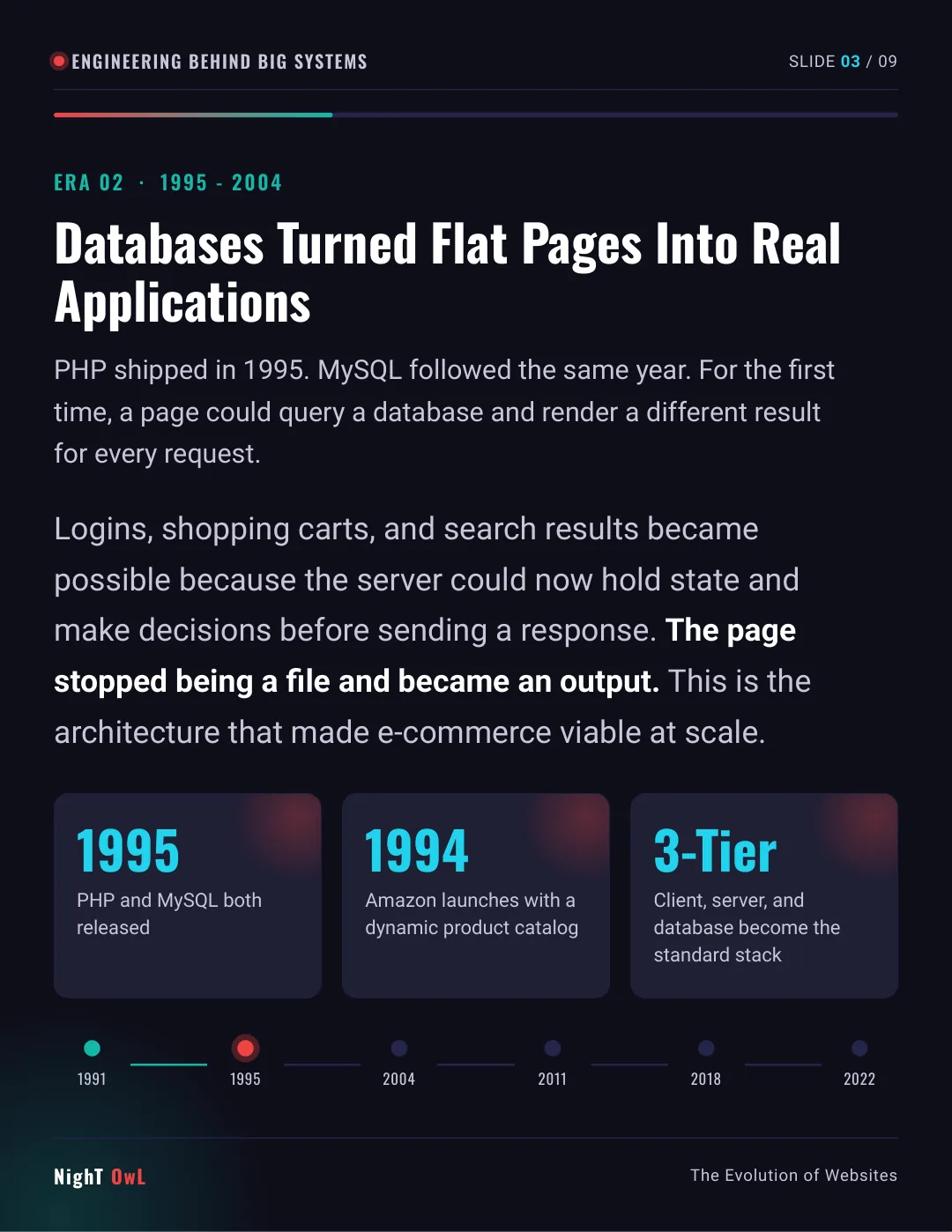
ERA 02 · 1995 - 2004
Databases Turned Flat Pages Into Real
Applications
PHP shipped in 1995. MySQL followed the same year. For the first
time, a page could query a database and render a different result
for every request.
Logins, shopping carts, and search results became
possible because the server could now hold state and
make decisions before sending a response. The page
stopped being a file and became an output. This is the
architecture that made e-commerce viable at scale.
1991
1995
2004
2011
2018
2022
1995
PHP and MySQL both
released
1994
Amazon launches with a
dynamic product catalog
3-Tier
Client, server, and
database become the
standard stack
NighT OwL
The Evolution of Websites
Slide 4
ENGINEERING BEHIND BIG SYSTEMS
SLIDE 04 / 09
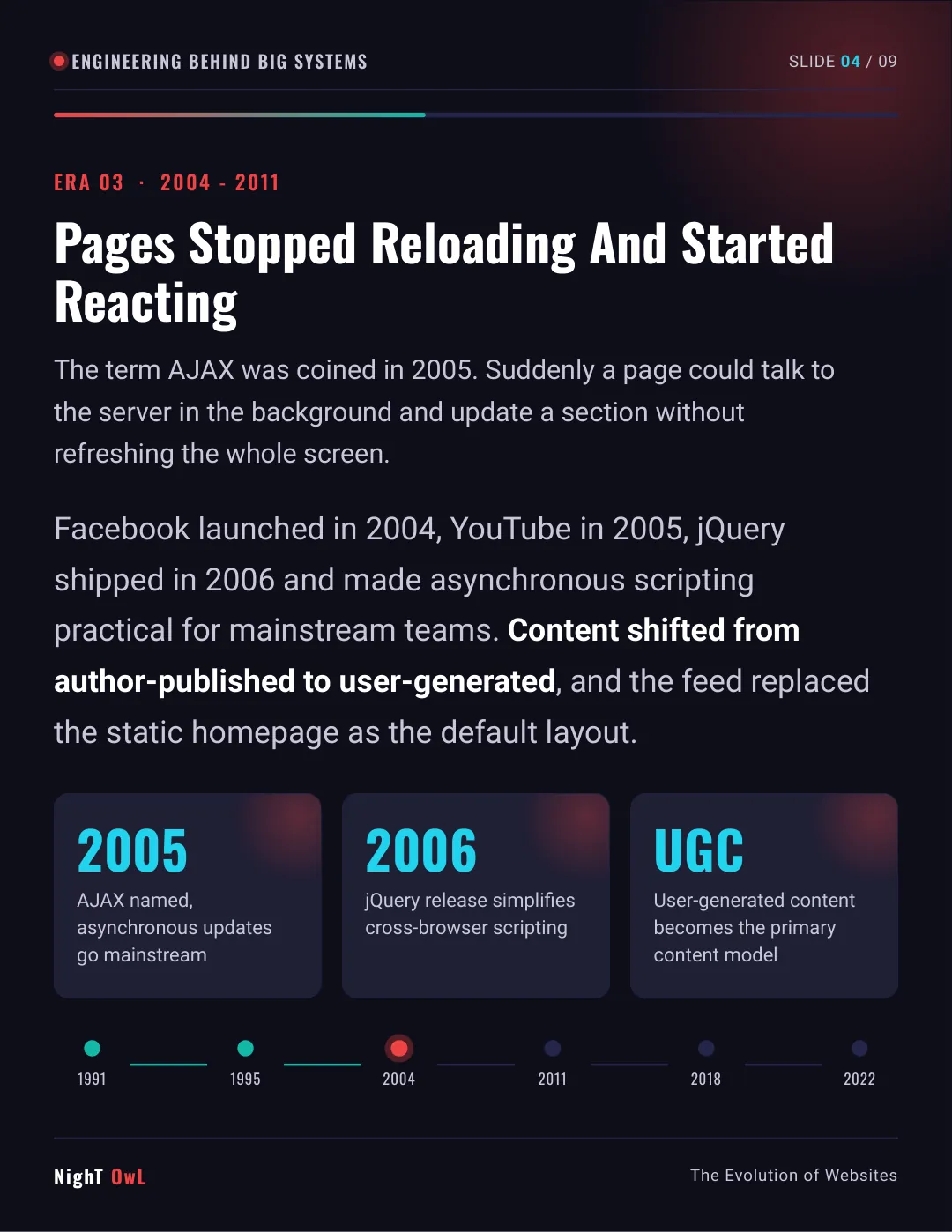
ERA 03 · 2004 - 2011
Pages Stopped Reloading And Started
Reacting
The term AJAX was coined in 2005. Suddenly a page could talk to
the server in the background and update a section without
refreshing the whole screen.
Facebook launched in 2004, YouTube in 2005, jQuery
shipped in 2006 and made asynchronous scripting
practical for mainstream teams. Content shifted from
author-published to user-generated, and the feed replaced
the static homepage as the default layout.
1991
1995
2004
2011
2018
2022
2005
AJAX named,
asynchronous updates
go mainstream
2006
jQuery release simplifies
cross-browser scripting
UGC
User-generated content
becomes the primary
content model
NighT OwL
The Evolution of Websites
Slide 5
ENGINEERING BEHIND BIG SYSTEMS
SLIDE 05 / 09
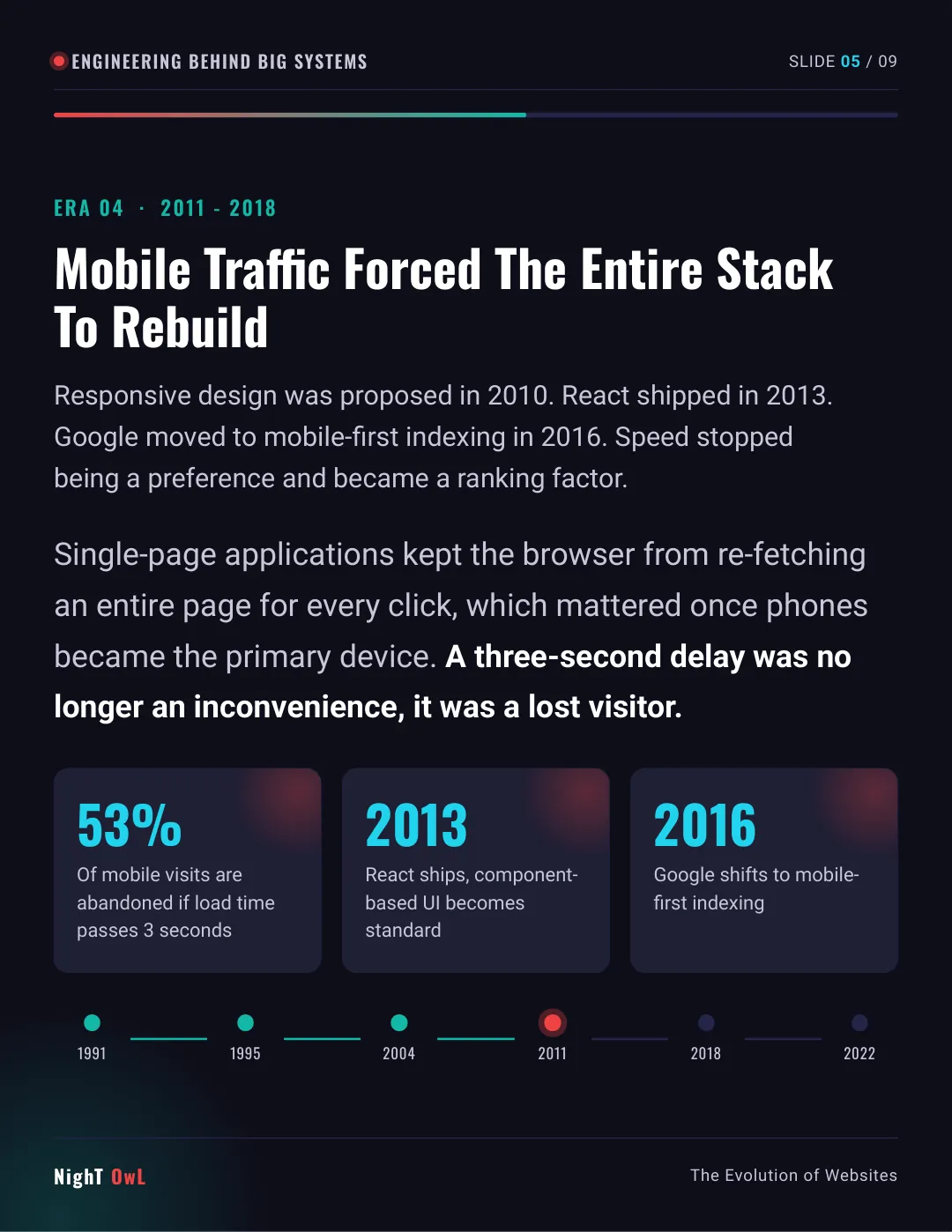
ERA 04 · 2011 - 2018
Mobile Traffic Forced The Entire Stack
To Rebuild
Responsive design was proposed in 2010. React shipped in 2013.
Google moved to mobile-first indexing in 2016. Speed stopped
being a preference and became a ranking factor.
Single-page applications kept the browser from re-fetching
an entire page for every click, which mattered once phones
became the primary device. A three-second delay was no
longer an inconvenience, it was a lost visitor.
1991
1995
2004
2011
2018
2022
53%
Of mobile visits are
abandoned if load time
passes 3 seconds
2013
React ships, component-
based UI becomes
standard
2016
Google shifts to mobile-
first indexing
NighT OwL
The Evolution of Websites
Slide 6
ENGINEERING BEHIND BIG SYSTEMS
SLIDE 06 / 09
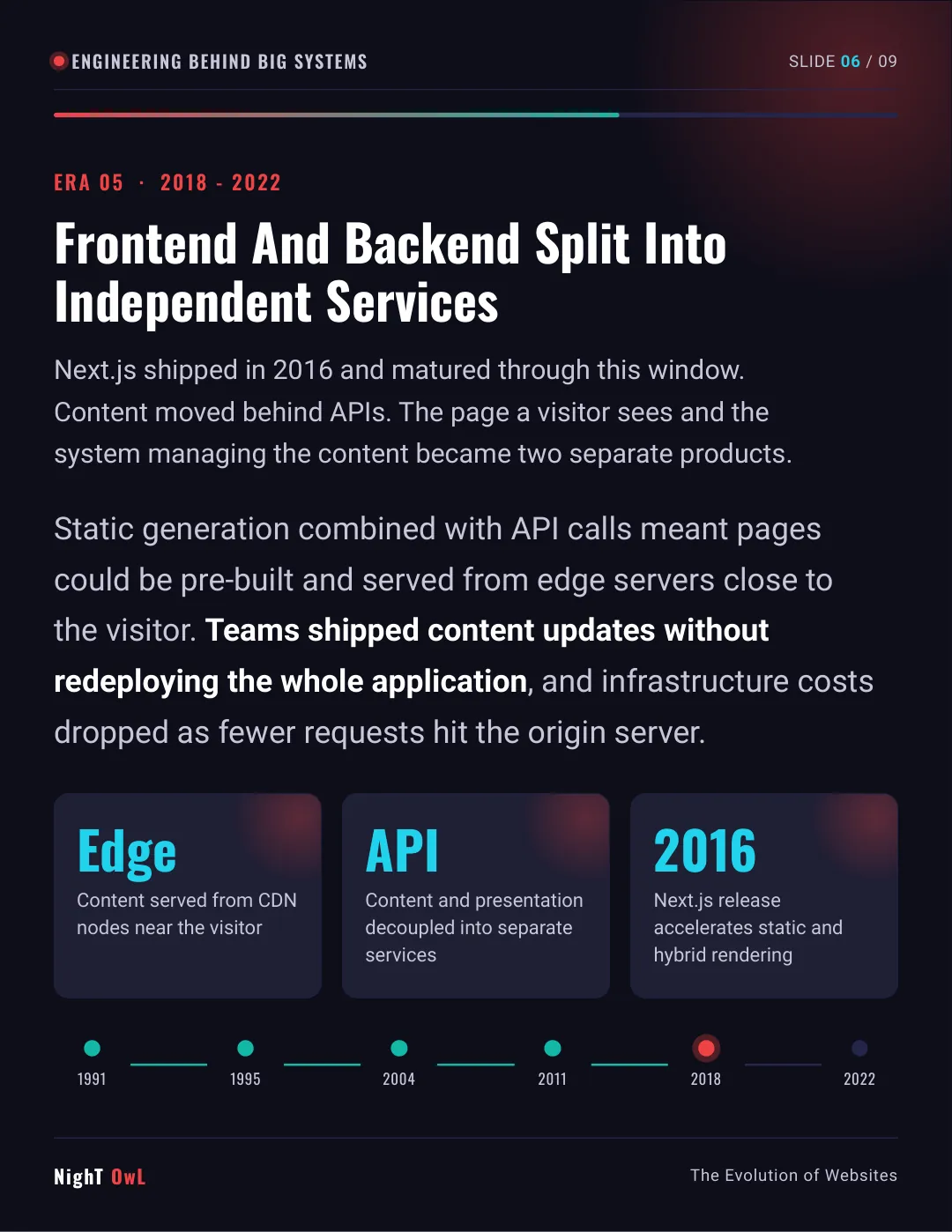
ERA 05 · 2018 - 2022
Frontend And Backend Split Into
Independent Services
Next.js shipped in 2016 and matured through this window.
Content moved behind APIs. The page a visitor sees and the
system managing the content became two separate products.
Static generation combined with API calls meant pages
could be pre-built and served from edge servers close to
the visitor. Teams shipped content updates without
redeploying the whole application, and infrastructure costs
dropped as fewer requests hit the origin server.
1991
1995
2004
2011
2018
2022
Edge
Content served from CDN
nodes near the visitor
API
Content and presentation
decoupled into separate
services
2016
Next.js release
accelerates static and
hybrid rendering
NighT OwL
The Evolution of Websites
Slide 7
ENGINEERING BEHIND BIG SYSTEMS
SLIDE 07 / 09
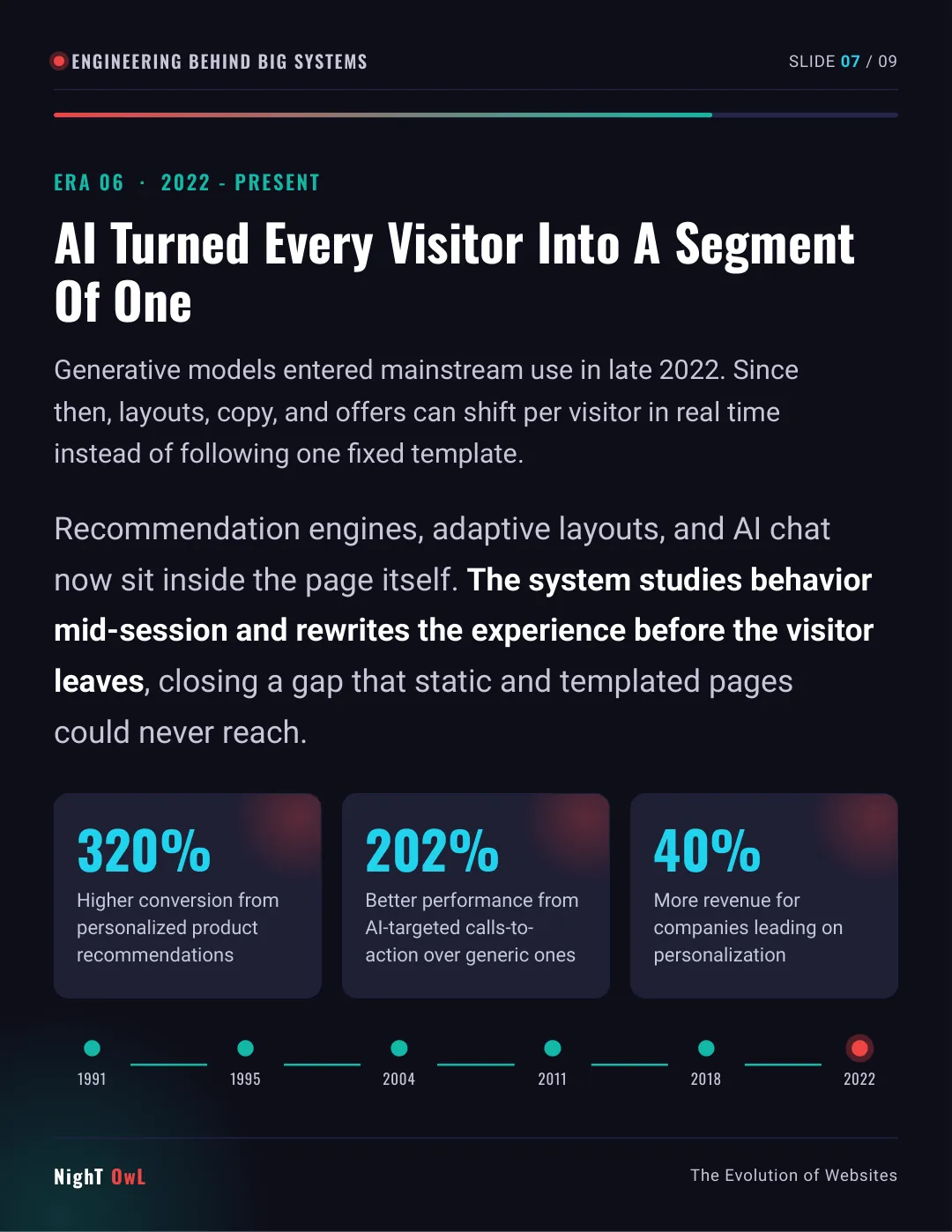
ERA 06 · 2022 - PRESENT
AI Turned Every Visitor Into A Segment
Of One
Generative models entered mainstream use in late 2022. Since
then, layouts, copy, and offers can shift per visitor in real time
instead of following one fixed template.
Recommendation engines, adaptive layouts, and AI chat
now sit inside the page itself. The system studies behavior
mid-session and rewrites the experience before the visitor
leaves, closing a gap that static and templated pages
could never reach.
1991
1995
2004
2011
2018
2022
320%
Higher conversion from
personalized product
recommendations
202%
Better performance from
AI-targeted calls-to-
action over generic ones
40%
More revenue for
companies leading on
personalization
NighT OwL
The Evolution of Websites
Slide 8
ENGINEERING BEHIND BIG SYSTEMS
SLIDE 08 / 09
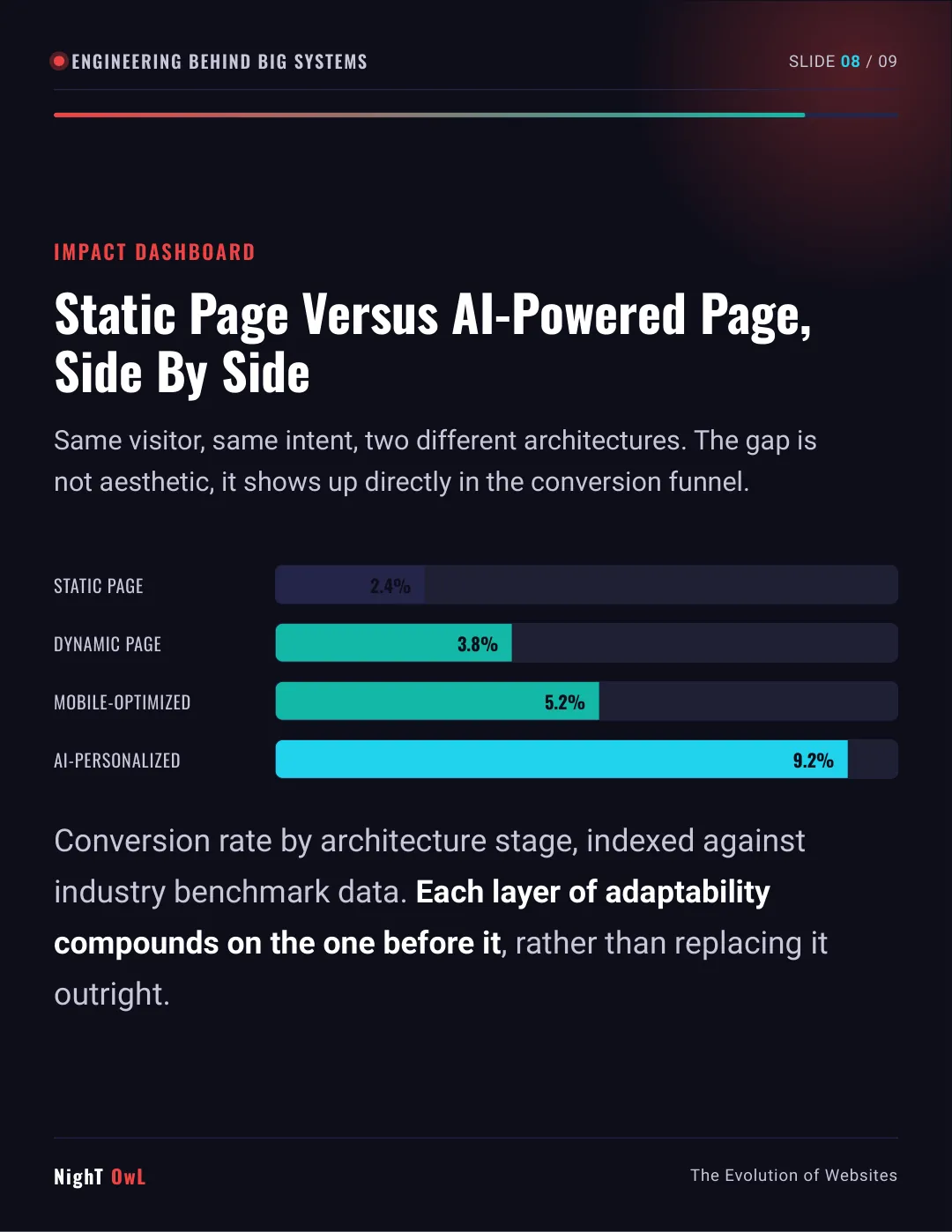
IMPACT DASHBOARD
Static Page Versus AI-Powered Page,
Side By Side
Same visitor, same intent, two different architectures. The gap is
not aesthetic, it shows up directly in the conversion funnel.
STATIC PAGE
2.4%
DYNAMIC PAGE
3.8%
MOBILE-OPTIMIZED
5.2%
AI-PERSONALIZED
9.2%
Conversion rate by architecture stage, indexed against
industry benchmark data. Each layer of adaptability
compounds on the one before it, rather than replacing it
outright.
NighT OwL
The Evolution of Websites
Slide 9
ENGINEERING BEHIND BIG SYSTEMS
SLIDE 09 / 09
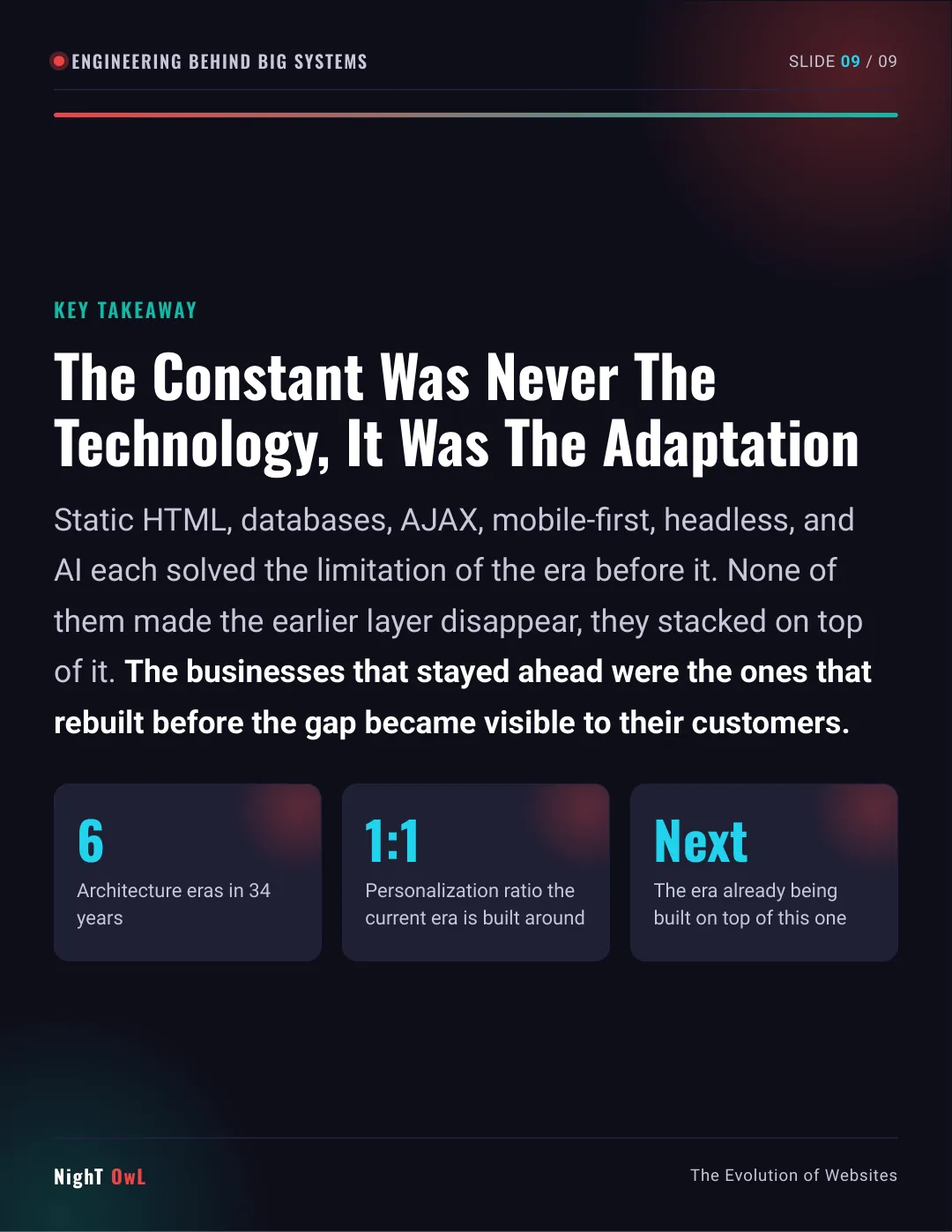
KEY TAKEAWAY
The Constant Was Never The
Technology, It Was The Adaptation
Static HTML, databases, AJAX, mobile-first, headless, and
AI each solved the limitation of the era before it. None of
them made the earlier layer disappear, they stacked on top
of it. The businesses that stayed ahead were the ones that
rebuilt before the gap became visible to their customers.
6
Architecture eras in 34
years
1:1
Personalization ratio the
current era is built around
Next
The era already being
built on top of this one
NighT OwL
The Evolution of Websites