7 Quiet Conversion Leaks in Online Stores, and How to Fix Them
Most online stores do not lose sales in one big failure. They lose them in small, quiet leaks: a slow page, a search that returns nothing, a good customer declined at checkout, an item that was never really in stock.
Over the past months I wrote short posts on each of these. This article brings them together into one checklist of seven conversion leaks, with the numbers behind each one and what to do about it.
1. A slow site
A Deloitte study for Google linked a 0.1-second faster mobile site with an 8.4% lift in retail conversions. It is a correlation across 37 brands, not a guarantee, but speed is one of the cheapest conversion wins you can buy.
A CDN is the usual way to buy it. It keeps copies of your pages and images close to shoppers, takes load off your servers and blocks many attacks before they reach you. Before a big sale, test it on real traffic: check the cache hit ratio and time how long a price change takes to show everywhere.
More in A Faster Site Is the Cheapest Conversion Win Before Peak.
2. Peak traffic you did not plan for
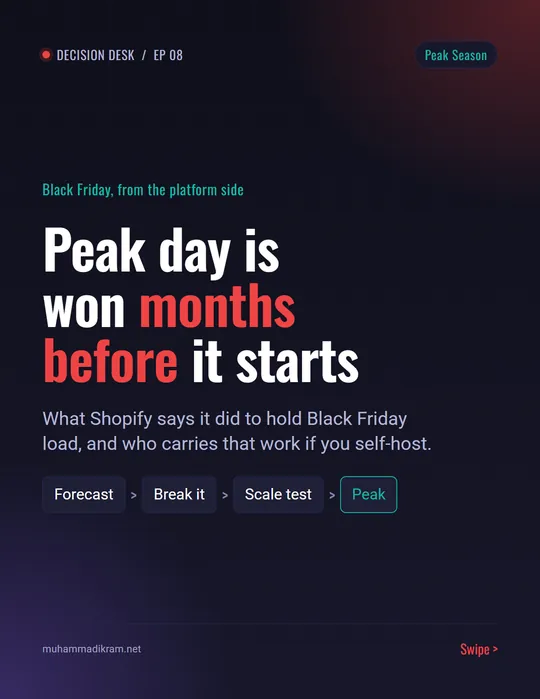
Shopify reported a peak of about $5.1 million in sales per minute on Black Friday 2025. It handled that because of work done months earlier: capacity forecasts, drills that broke checkout on purpose, and repeated load tests.
If you are on a hosted platform like Shopify, the platform carries most of that load. If you host your own store, your team does. Either way, your apps, integrations and ERP sync are yours to test before peak.
More in Black Friday Conversions Are Won in March, Not November.
3. Search that does not understand your shoppers
Shoppers who search know what they want, which makes the search box the highest-intent part of your store. Yet Baymard's 2026 benchmark rated search on 56% of e-commerce sites as "mediocre or worse".
The technology is not the hard part. Tuning it is: synonyms, typo tolerance, sensible ranking and filters that match how your customers actually type. A good first step is to pull the list of searches that returned zero results and fix the top twenty.
More in Your Search Box Is the Highest-Intent Funnel You Own.
4. A fraud filter that blocks good customers
Merchants reject about 5% of orders on average, according to the Merchant Risk Council's 2025 survey. Some of those are real customers who simply looked unusual.
Rule-based filters are easy to read but brittle. Machine-learning models adapt but are harder to explain. Most teams end up with a mix: a model scores each order, clear rules act on the score, and people review the grey zone. Track how many declined orders were actually good, not just how much fraud you stopped.
More in Your Fraud Filter Is Also a Conversion Filter.
5. Pay later that costs more than it earns
Buy-now-pay-later can lift conversion and basket size, especially in the UAE where Tabby and Tamara are common. But it is not free. The US Consumer Financial Protection Bureau found that pay-later providers charged merchants an average fee of 3.08% in 2021.
It pays when it wins orders you would have lost. It leaks margin when it simply moves orders you would have got anyway onto a more expensive payment method. Compare basket size and conversion with and without it, not just total pay-later sales.
More in Pay Later Can Lift Conversion or Quietly Eat Margin.
6. A returns policy that drives customers away
In the 2025 Retail Returns Landscape report by the NRF and Happy Returns, 57% of US shoppers said they had stopped buying from a retailer after it started charging for returns. Yet 72% of merchants now charge for at least one return option.
Treat returns as a business decision, not a warehouse chore. Decide on purpose which return methods stay free, whether to offer an exchange before a refund, and where each returned item goes next.
More in Return Fees Can Quietly Kill Your Repeat Customers.
7. Stock counts you cannot trust
One unit on the shelf can already belong to someone else. It might be paid for, held in another shopper's checkout or damaged. If your store sells from the shelf count, you will oversell, cancel orders and lose customers.
Accurate stock comes from selling what is actually available, keeping a small safety buffer, syncing fast sellers more often, and having one system decide which warehouse ships each order. Once you add marketplaces, shops or a second warehouse, that decision belongs in an order management system, not in someone's spreadsheet.
More in Overselling Kills Conversion. Your Stock Count Is Why and Growth Breaks in the Layer Between Checkout and Warehouse.
Where to start
You do not need to fix all seven at once. Start with the leak you can measure fastest:
- Run a speed test on your top three landing pages.
- Export last month's zero-result searches.
- Count how many orders your fraud filter declined.
- Check how many orders were cancelled for being out of stock.
I build and fix Shopify and custom e-commerce stores for brands in the UAE, UK, USA, Canada and Australia. If one of these leaks sounds familiar, see my Shopify development service or send me a message.
Sources: Deloitte for Google, Milliseconds Make Millions (2020). Shopify BFCM 2025 data and engineering blog. Baymard Institute e-commerce search benchmark (2026). Merchant Risk Council Global Fraud Survey (2025). CFPB report on buy now, pay later (2022). NRF and Happy Returns, 2025 Retail Returns Landscape.