Muhammad Ikram Let's talk

The Fastest Growth Test Is the Feature You Cut

An MVP is defined by what it leaves out, not by what it ships.

A method that works in scope meetings:
1. Name the one job. One user, one problem, one finish line.
2. Write the cut list. Every feature that job doesn't need goes on it, in writing.
3. Give "later" a trigger. "When 50 users ask" or "when we sign a second market". No trigger means it stays cut.

An MVP that isn't minimal delays feedback and blurs what the test proved.

What was the hardest feature you ever cut?
01 / 01MVP scope

A method for cutting MVP scope

An MVP is defined by what it leaves out

1

Name the one job

One user, one problem, one finish line
2

Write the cut list

Every feature that doesn't serve that job
3

Give "later" a trigger

A signal that brings it back, or it stays cut

If nothing on the cut list hurts, it isn't minimal yet.

More insights

Keep reading

All posts
Carousel

Startups & Product 1 min read

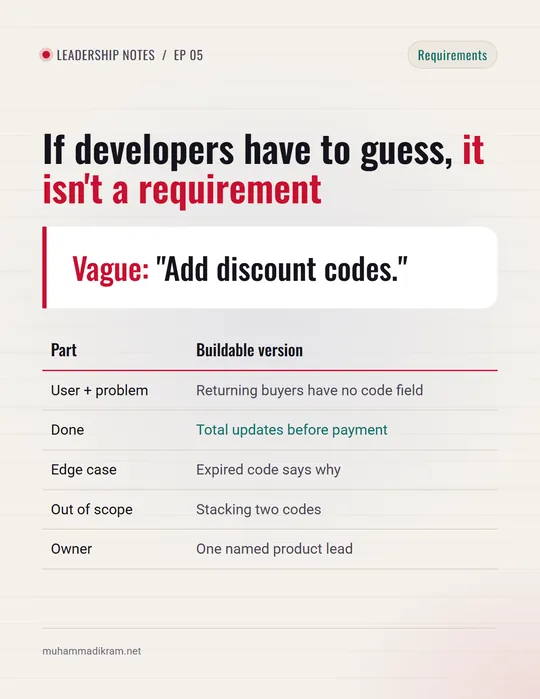
Vague Requests Cost More Than Slow Launches

A common trap: a growth idea lands in the backlog as "add discount codes". No user, no definition of done, no edge cases, no owner. The team guesses, ships late, reworks. A spec with those five parts is the cheapest conversion tactic.

Carousel

Startups & Product 1 min read

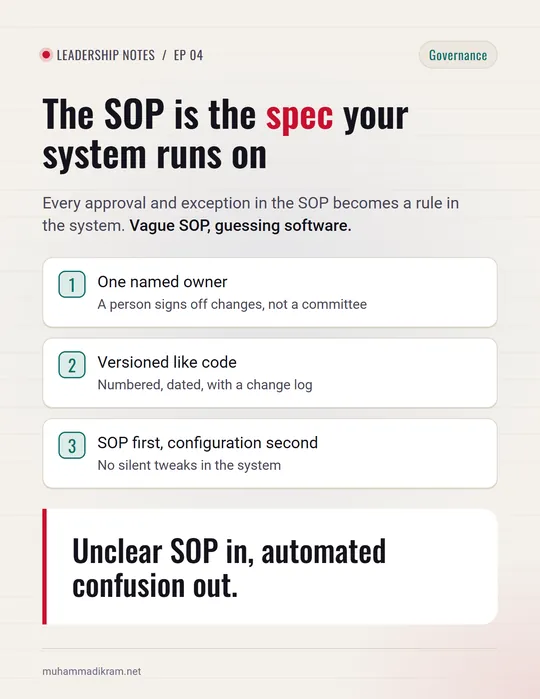
The SOP Is the Spec Your Growth Stack Runs On

A common trap: buying a new CRM to fix a messy lead process. The system then routes the mess faster. Write the SOP first, give it one owner, version every change, and only then configure the funnel. Clean process, cleaner data.

Carousel

Startups & Product 1 min read

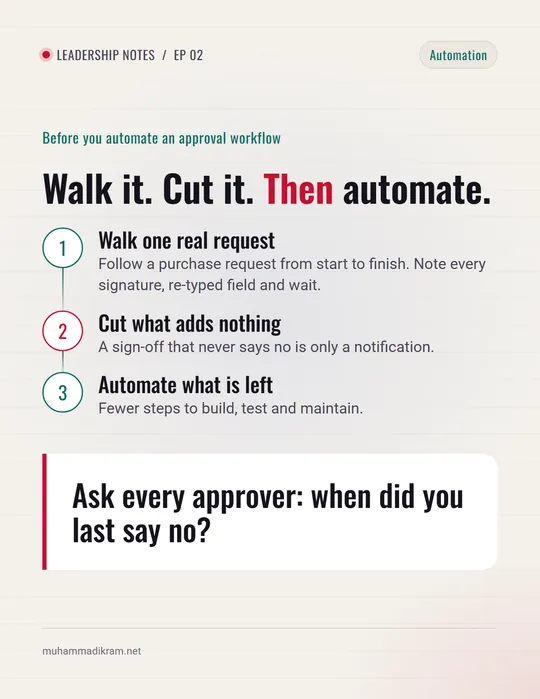
Automating a Broken Process Just Breaks It Faster

A common trap: a slow approval gets automated, and it is still slow. Every sign-off just moved into the tool. Walk one real request first, cut the steps that never say no, then automate. Every step removed is one less place for work to stall.