DoorDash didn't start with an app
It started with a PDF menu, a Google Form, and four Stanford students who wanted to know one thing, do people actually want restaurant food delivered?
The answer came within hours of launch.
No algorithms. No dispatch system. The founders took the orders themselves and drove the food across Palo Alto. Every delivery was a live research session.
That weekend experiment became the foundation of a $20B company.
The lesson: logistics pain is worth solving but only after the market tells you it wants to be served.
Build the hypothesis first. Build the product second.
Read the slides as text
Slide 1
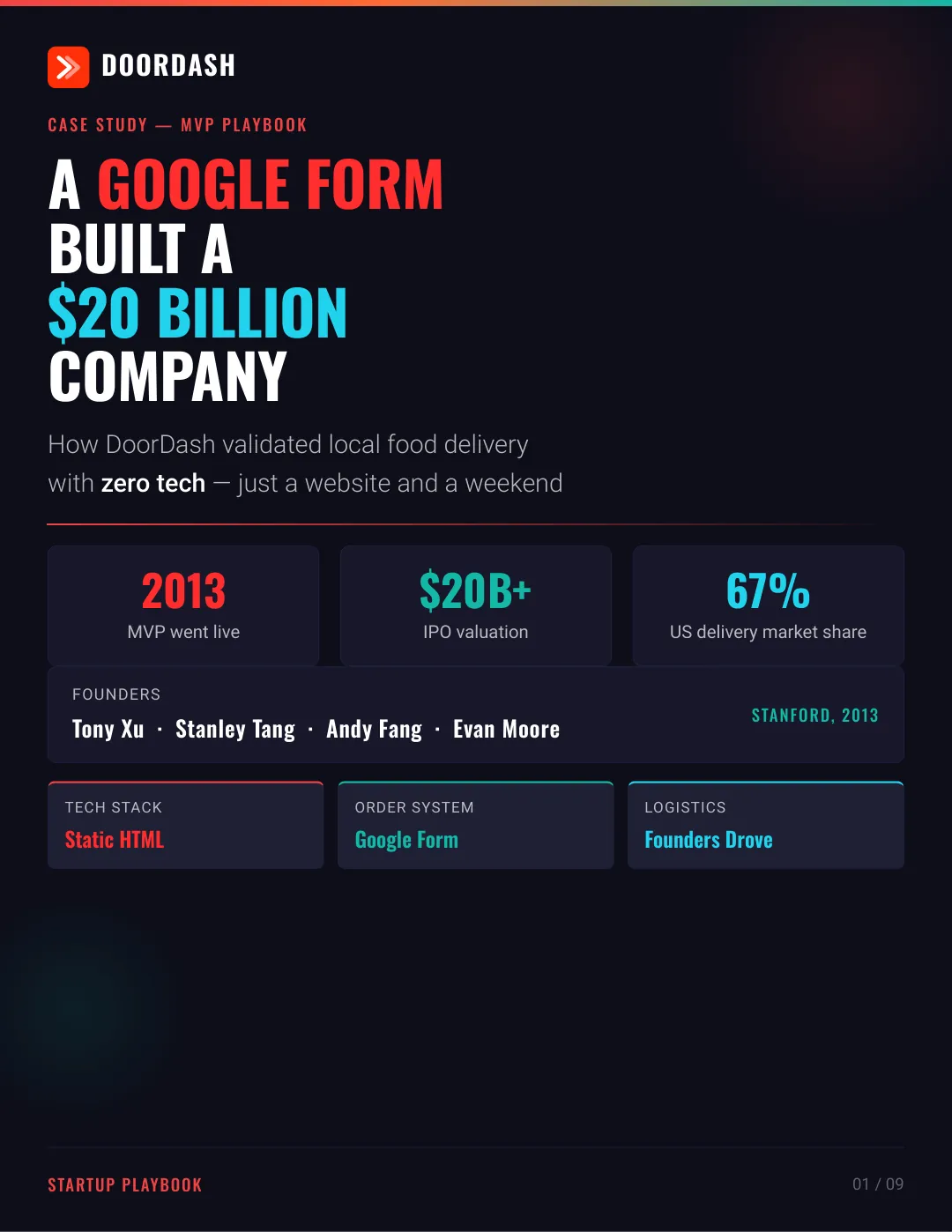
DOORDASH
CASE STUDY — MVP PLAYBOOK
A GOOGLE FORM
BUILT A
$20 BILLION
COMPANY
How DoorDash validated local food delivery
with zero tech — just a website and a weekend
2013
MVP went live
$20B+
IPO valuation
67%
US delivery market share
FOUNDERS
Tony Xu · Stanley Tang · Andy Fang · Evan Moore
STANFORD, 2013
TECH STACK
Static HTML
ORDER SYSTEM
Google Form
LOGISTICS
Founders Drove
STARTUP PLAYBOOK
01 / 09
Slide 2
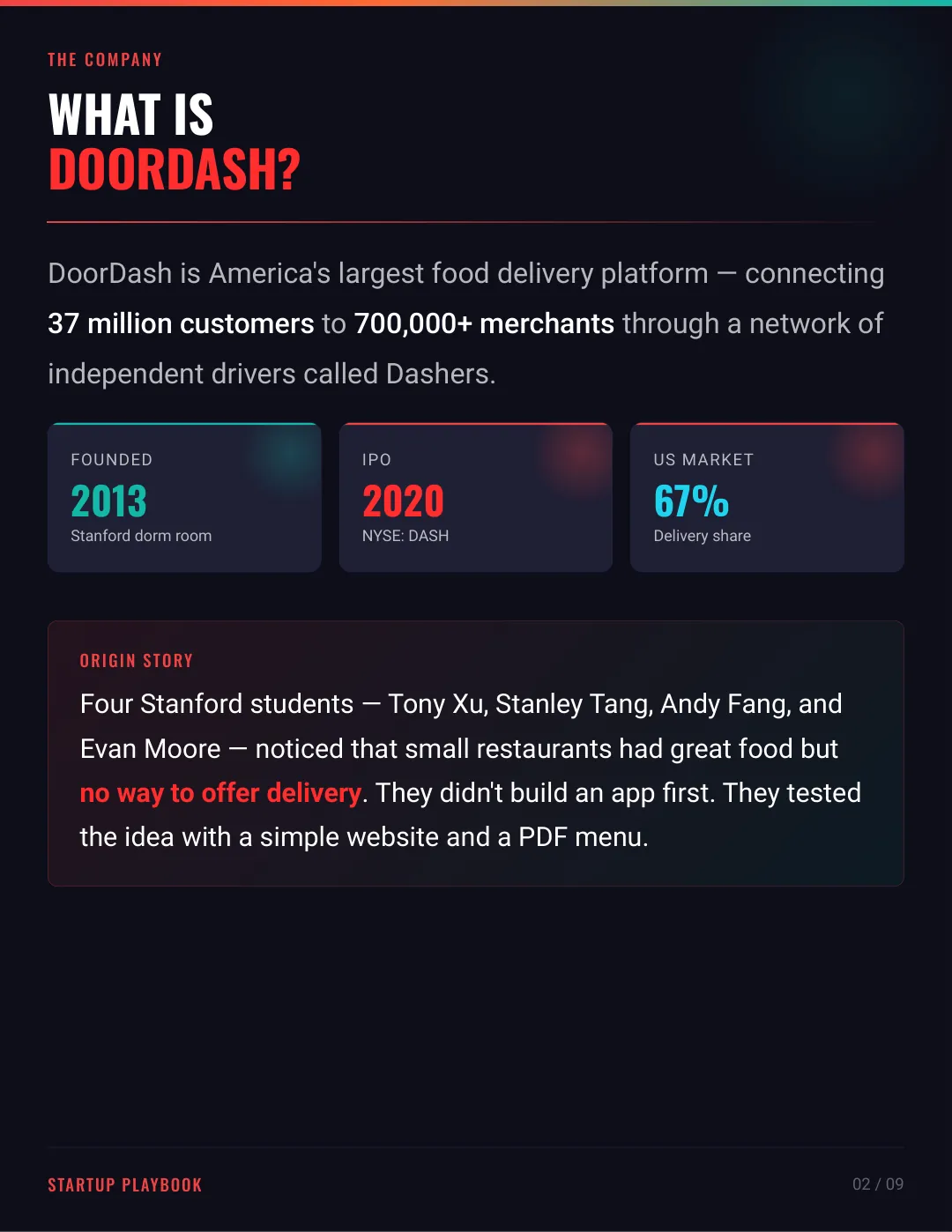
THE COMPANY
WHAT IS
DOORDASH?
DoorDash is America's largest food delivery platform — connecting
37 million customers to 700,000+ merchants through a network of
independent drivers called Dashers.
ORIGIN STORY
Four Stanford students — Tony Xu, Stanley Tang, Andy Fang, and
Evan Moore — noticed that small restaurants had great food but
no way to offer delivery. They didn't build an app first. They tested
the idea with a simple website and a PDF menu.
STARTUP PLAYBOOK
FOUNDED
2013
Stanford dorm room
IPO
2020
NYSE: DASH
US MARKET
67%
Delivery share
02 / 09
Slide 3
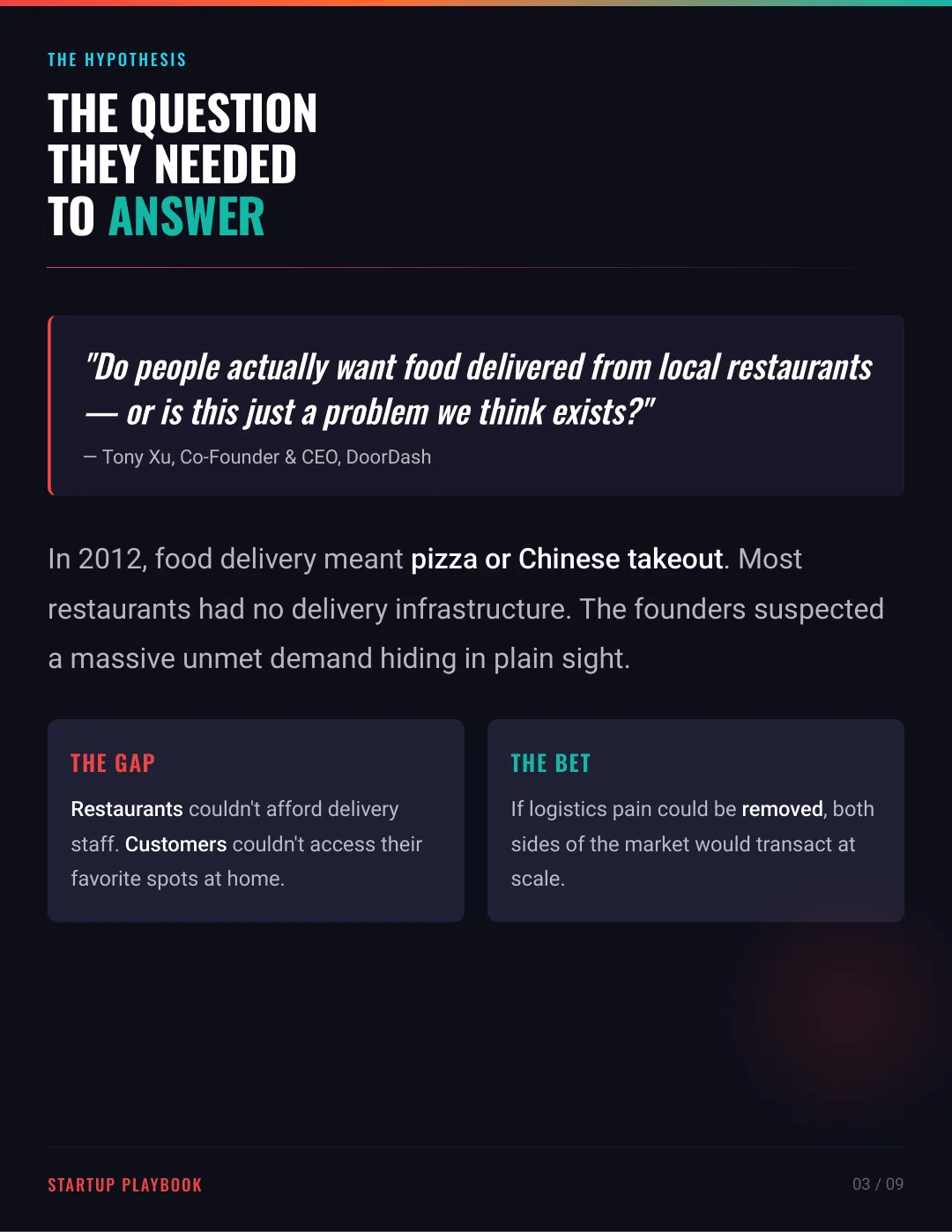
THE HYPOTHESIS
THE QUESTION
THEY NEEDED
TO ANSWER
"Do people actually want food delivered from local restaurants
— or is this just a problem we think exists?"
— Tony Xu, Co-Founder & CEO, DoorDash
In 2012, food delivery meant pizza or Chinese takeout. Most
restaurants had no delivery infrastructure. The founders suspected
a massive unmet demand hiding in plain sight.
THE GAP
Restaurants couldn't afford delivery
staff. Customers couldn't access their
favorite spots at home.
THE BET
If logistics pain could be removed, both
sides of the market would transact at
scale.
STARTUP PLAYBOOK
03 / 09
Slide 4
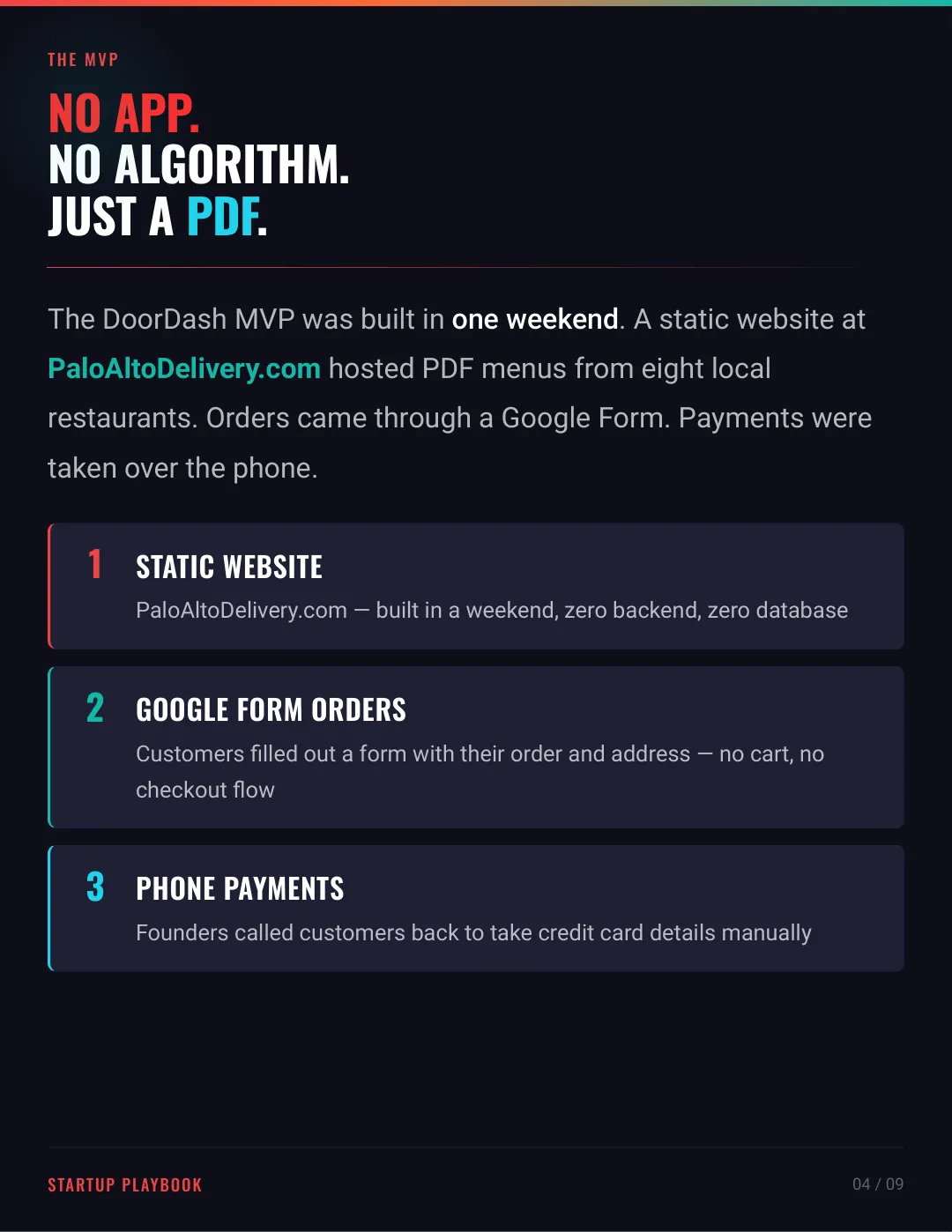
THE MVP
NO APP.
NO ALGORITHM.
JUST A PDF.
The DoorDash MVP was built in one weekend. A static website at
PaloAltoDelivery.com hosted PDF menus from eight local
restaurants. Orders came through a Google Form. Payments were
taken over the phone.
1
STATIC WEBSITE
PaloAltoDelivery.com — built in a weekend, zero backend, zero database
2
GOOGLE FORM ORDERS
Customers filled out a form with their order and address — no cart, no
checkout flow
3
PHONE PAYMENTS
Founders called customers back to take credit card details manually
STARTUP PLAYBOOK
04 / 09
Slide 5
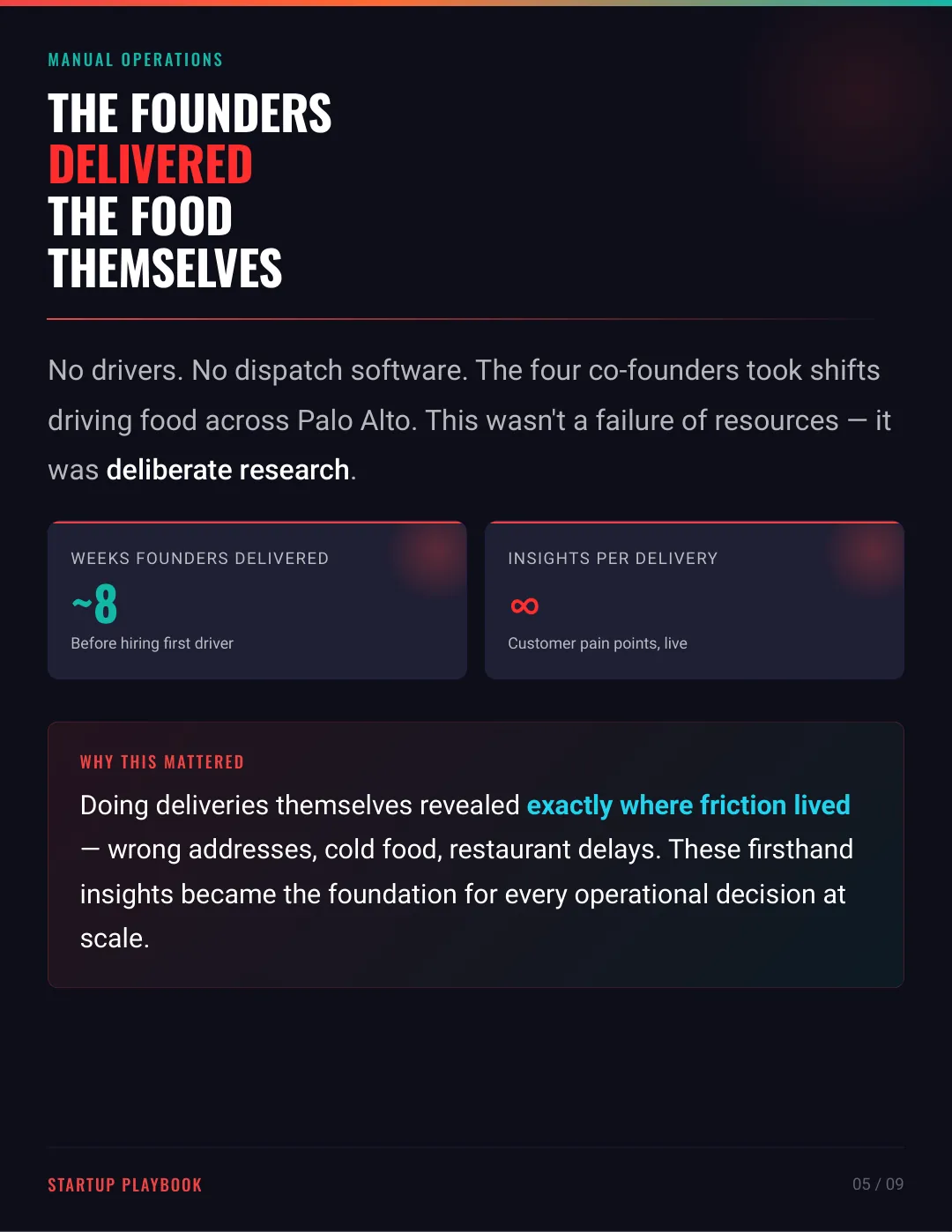
MANUAL OPERATIONS
THE FOUNDERS
DELIVERED
THE FOOD
THEMSELVES
No drivers. No dispatch software. The four co-founders took shifts
driving food across Palo Alto. This wasn't a failure of resources — it
was deliberate research.
WHY THIS MATTERED
Doing deliveries themselves revealed exactly where friction lived
— wrong addresses, cold food, restaurant delays. These firsthand
insights became the foundation for every operational decision at
scale.
STARTUP PLAYBOOK
WEEKS FOUNDERS DELIVERED
~8
Before hiring first driver
INSIGHTS PER DELIVERY
∞
Customer pain points, live
05 / 09
Slide 6
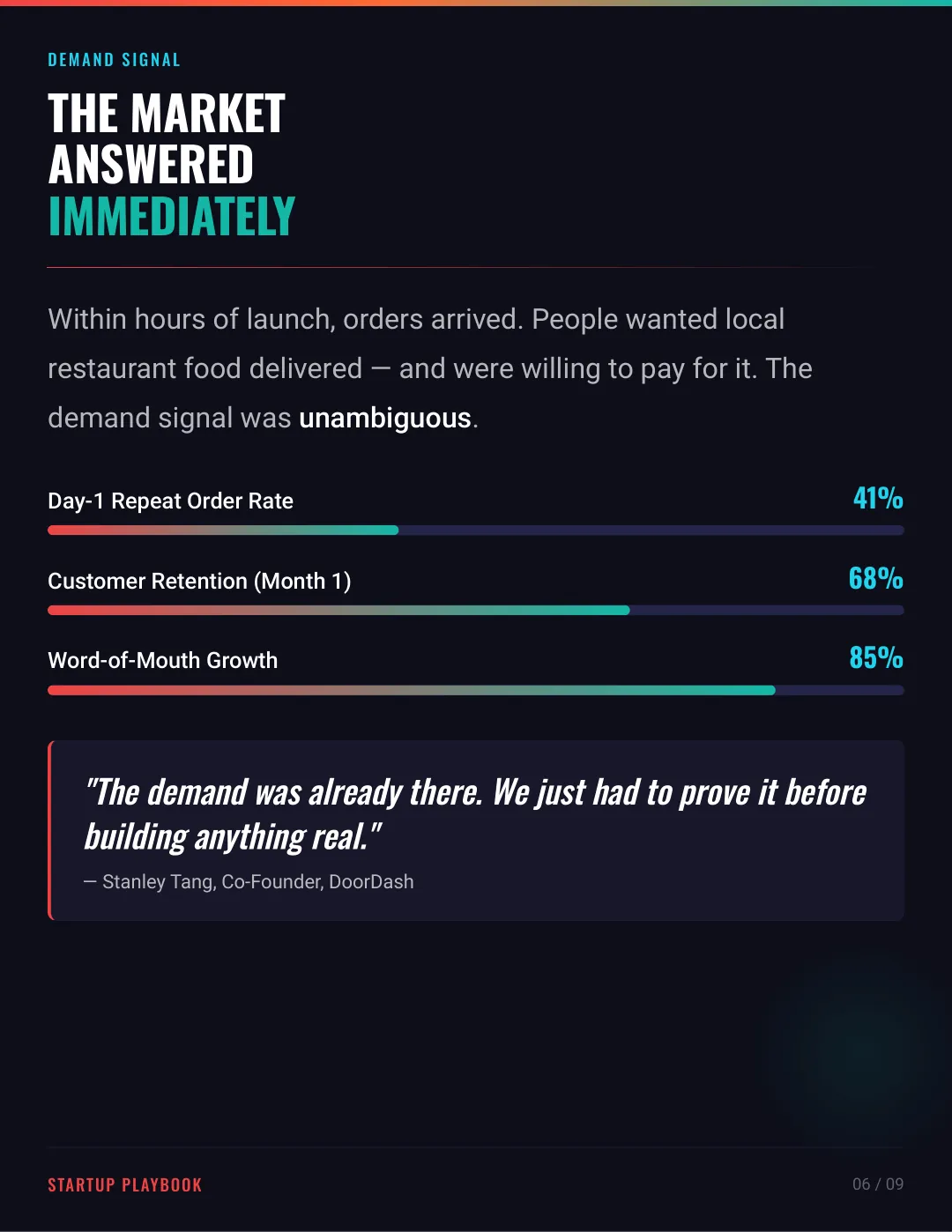
DEMAND SIGNAL
THE MARKET
ANSWERED
IMMEDIATELY
Within hours of launch, orders arrived. People wanted local
restaurant food delivered — and were willing to pay for it. The
demand signal was unambiguous.
Day-1 Repeat Order Rate
41%
Customer Retention (Month 1)
68%
Word-of-Mouth Growth
85%
"The demand was already there. We just had to prove it before
building anything real."
— Stanley Tang, Co-Founder, DoorDash
STARTUP PLAYBOOK
06 / 09
Slide 7
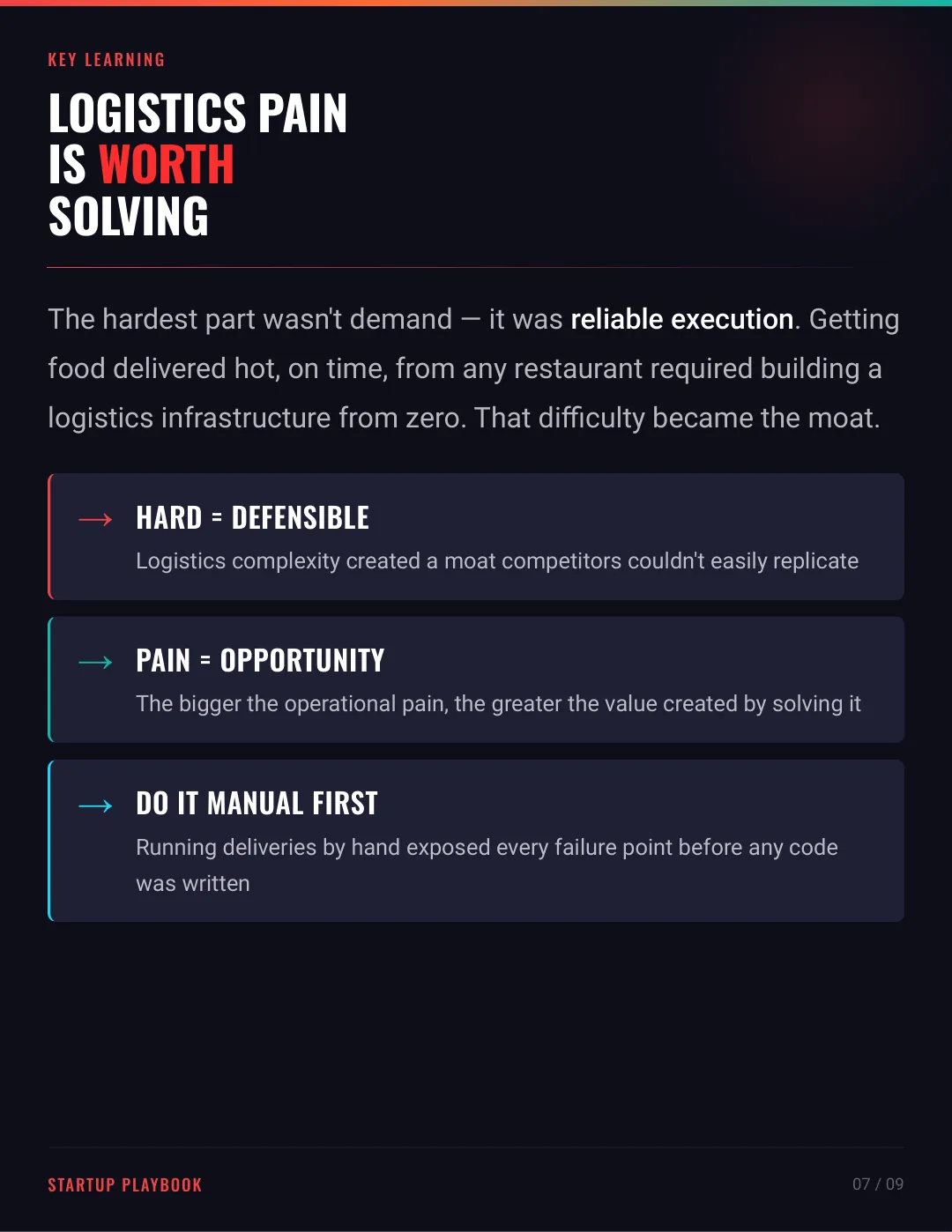
KEY LEARNING
LOGISTICS PAIN
IS WORTH
SOLVING
The hardest part wasn't demand — it was reliable execution. Getting
food delivered hot, on time, from any restaurant required building a
logistics infrastructure from zero. That difficulty became the moat.
→HARD = DEFENSIBLE
Logistics complexity created a moat competitors couldn't easily replicate
→PAIN = OPPORTUNITY
The bigger the operational pain, the greater the value created by solving it
→DO IT MANUAL FIRST
Running deliveries by hand exposed every failure point before any code
was written
STARTUP PLAYBOOK
07 / 09
Slide 8
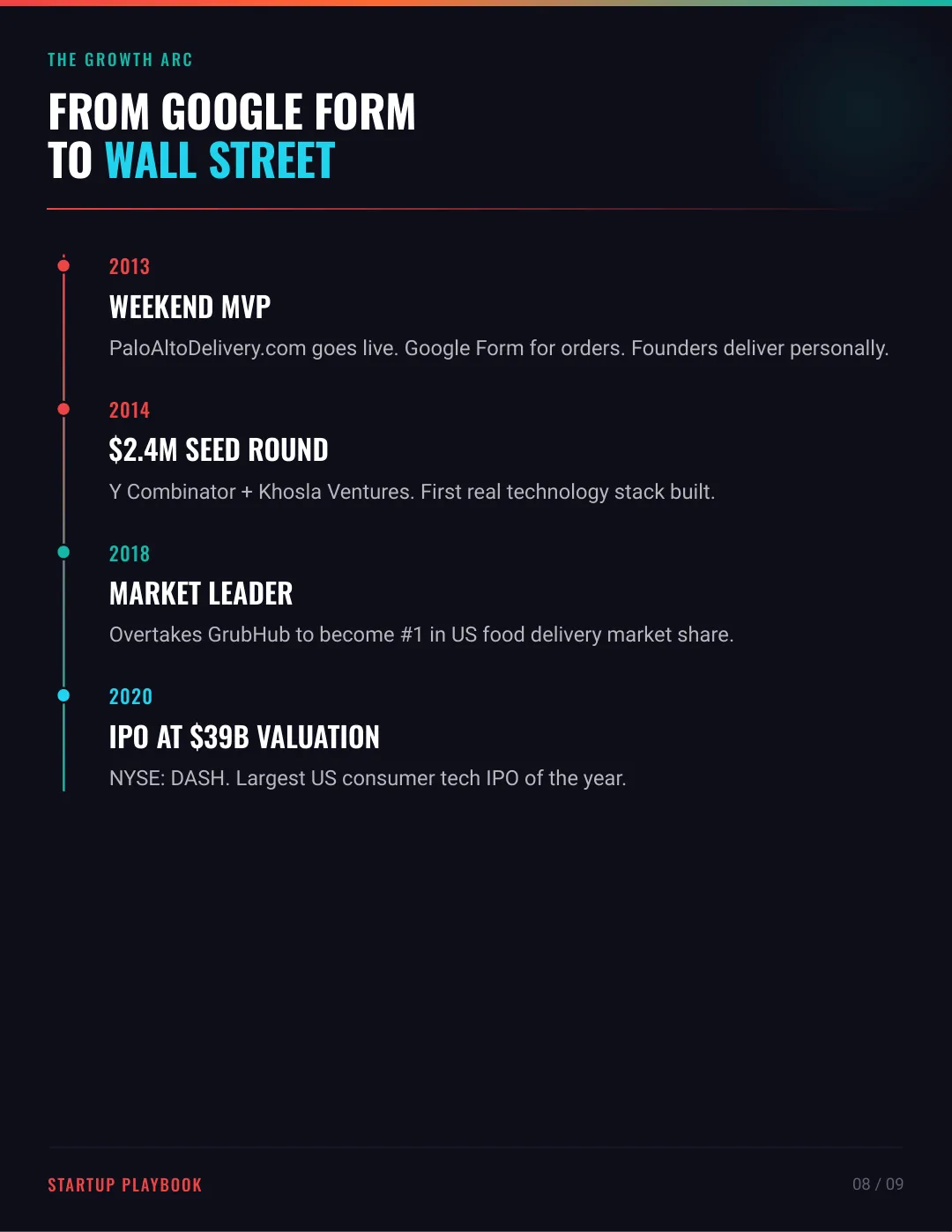
THE GROWTH ARC
FROM GOOGLE FORM
TO WALL STREET
STARTUP PLAYBOOK
2013
WEEKEND MVP
PaloAltoDelivery.com goes live. Google Form for orders. Founders deliver personally.
2014
$2.4M SEED ROUND
Y Combinator + Khosla Ventures. First real technology stack built.
2018
MARKET LEADER
Overtakes GrubHub to become #1 in US food delivery market share.
2020
IPO AT $39B VALUATION
NYSE: DASH. Largest US consumer tech IPO of the year.
08 / 09
Slide 9
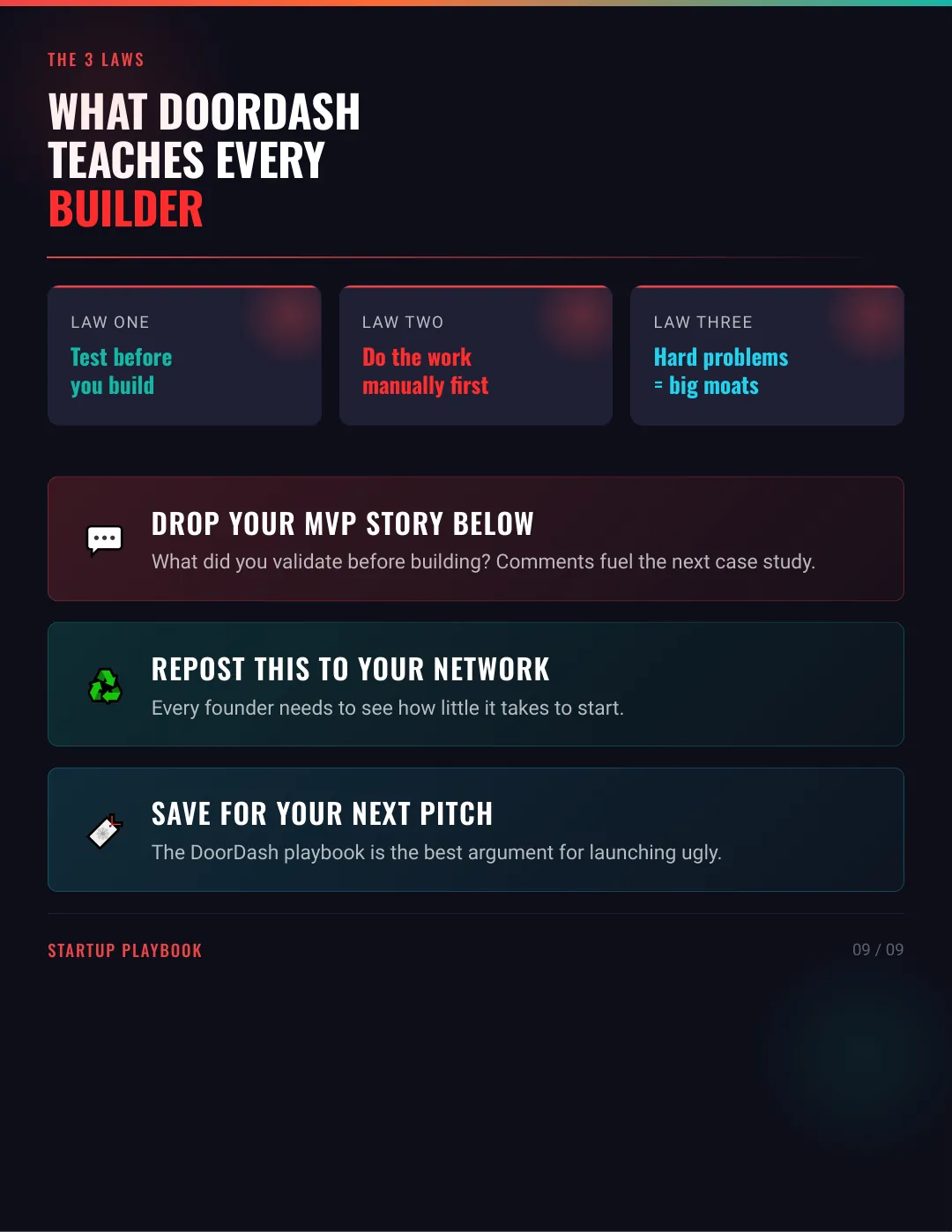
THE 3 LAWS
WHAT DOORDASH
TEACHES EVERY
BUILDER
💬
DROP YOUR MVP STORY BELOW
What did you validate before building? Comments fuel the next case study.
♻️
REPOST THIS TO YOUR NETWORK
Every founder needs to see how little it takes to start.
🔖
SAVE FOR YOUR NEXT PITCH
The DoorDash playbook is the best argument for launching ugly.
STARTUP PLAYBOOK
LAW ONE
Test before
you build
LAW TWO
Do the work
manually first
LAW THREE
Hard problems
= big moats
09 / 09