How A Messy Manual Process Taught Thumbtack What Actually Drives Marketplace Growth
Thumbtack began as four friends in a rented San Francisco house, playing matchmaker between strangers and plumbers by hand, one email at a time.
No app, no algorithm, just a founder squinting at a spreadsheet. Pros drowned in requests, most going nowhere.
Then came the twist: stop rewarding fast replies, start rewarding the right ones. Lead quality beat lead volume, and a scrappy side project turned into a billion dollar marketplace.
Read the slides as text
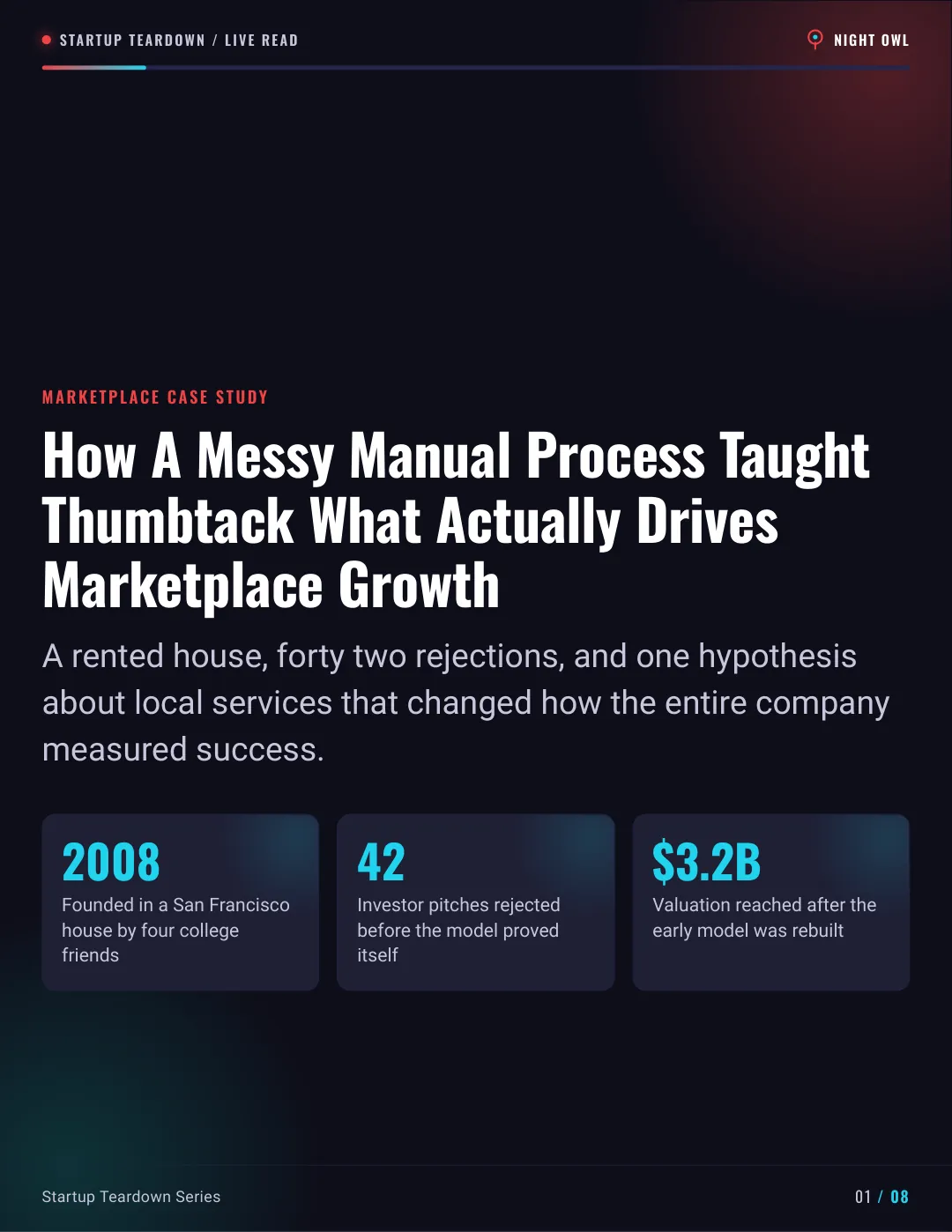
Slide 1
STARTUP TEARDOWN / LIVE READ
NIGHT OWL
MARKETPLACE CASE STUDY
How A Messy Manual Process Taught
Thumbtack What Actually Drives
Marketplace Growth
A rented house, forty two rejections, and one hypothesis
about local services that changed how the entire company
measured success.
2008
Founded in a San Francisco
house by four college
friends
42
Investor pitches rejected
before the model proved
itself
$3.2B
Valuation reached after the
early model was rebuilt
Startup Teardown Series
01 / 08
Slide 2
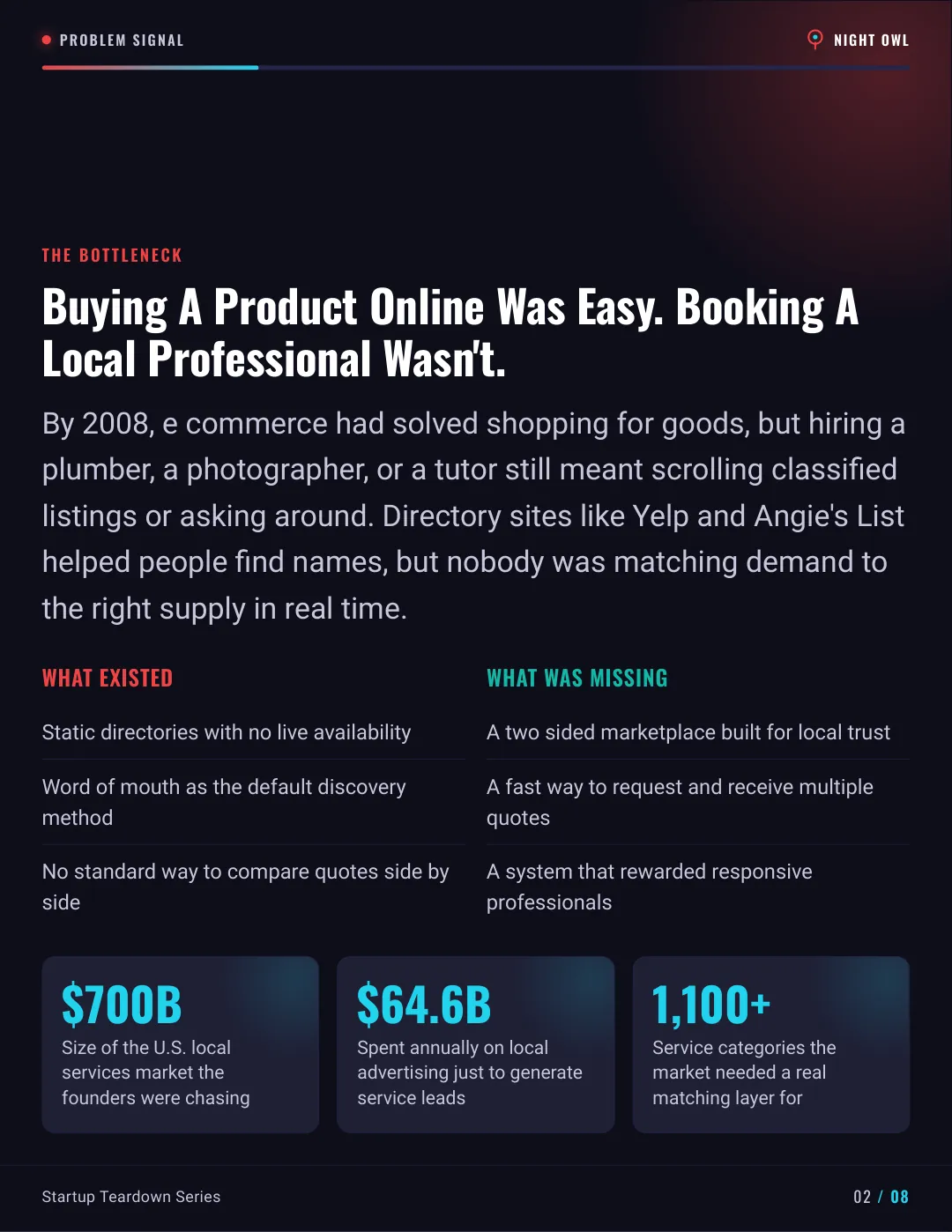
PROBLEM SIGNAL
NIGHT OWL
THE BOTTLENECK
Buying A Product Online Was Easy. Booking A
Local Professional Wasn't.
By 2008, e commerce had solved shopping for goods, but hiring a
plumber, a photographer, or a tutor still meant scrolling classified
listings or asking around. Directory sites like Yelp and Angie's List
helped people find names, but nobody was matching demand to
the right supply in real time.
WHAT EXISTED
Static directories with no live availability
Word of mouth as the default discovery
method
No standard way to compare quotes side by
side
WHAT WAS MISSING
A two sided marketplace built for local trust
A fast way to request and receive multiple
quotes
A system that rewarded responsive
professionals
$700B
Size of the U.S. local
services market the
founders were chasing
$64.6B
Spent annually on local
advertising just to generate
service leads
1,100+
Service categories the
market needed a real
matching layer for
Startup Teardown Series
02 / 08
Slide 3
MVP BUILD
NIGHT OWL
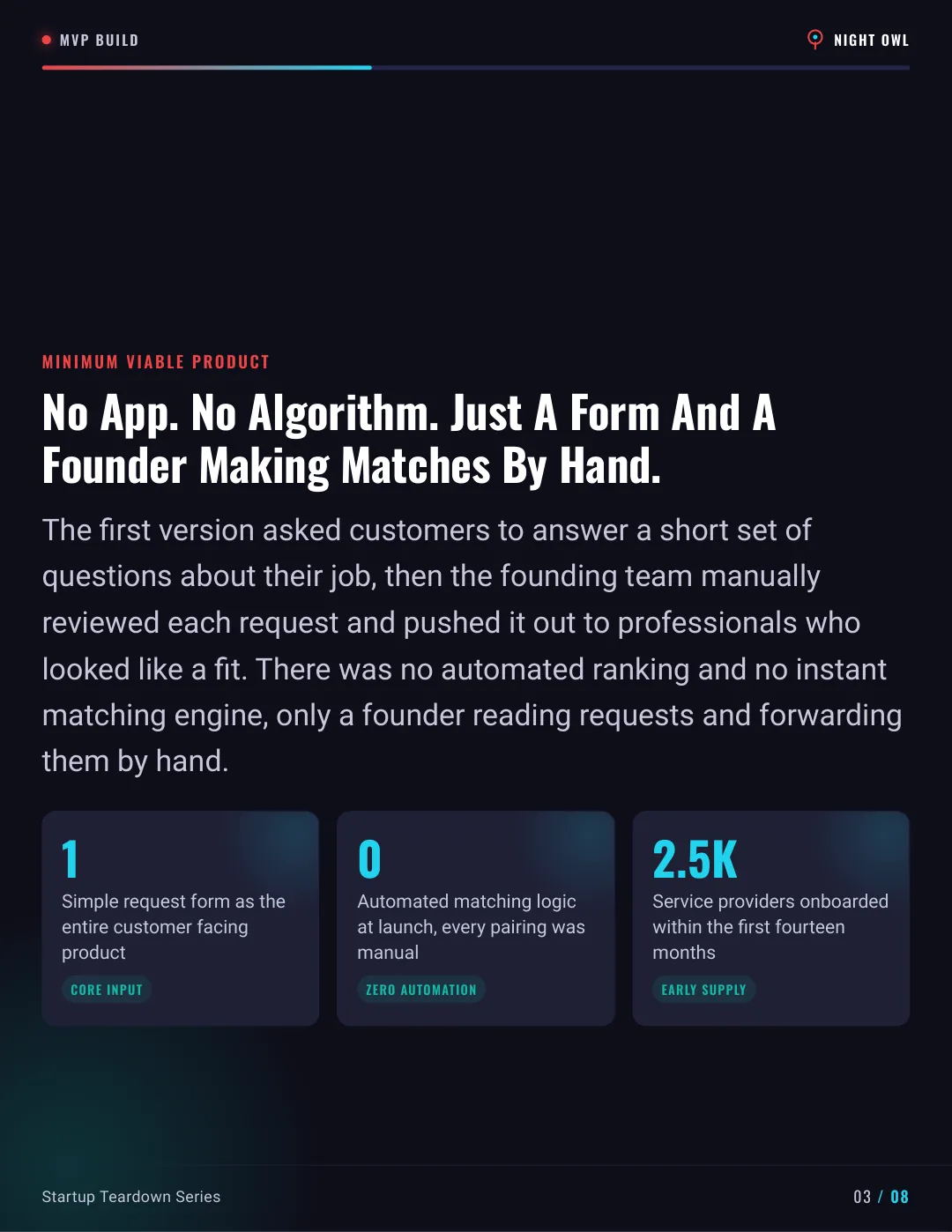
MINIMUM VIABLE PRODUCT
No App. No Algorithm. Just A Form And A
Founder Making Matches By Hand.
The first version asked customers to answer a short set of
questions about their job, then the founding team manually
reviewed each request and pushed it out to professionals who
looked like a fit. There was no automated ranking and no instant
matching engine, only a founder reading requests and forwarding
them by hand.
1
Simple request form as the
entire customer facing
product
CORE INPUT
0
Automated matching logic
at launch, every pairing was
manual
ZERO AUTOMATION
2.5K
Service providers onboarded
within the first fourteen
months
EARLY SUPPLY
Startup Teardown Series
03 / 08
Slide 4
OPERATING FLOW
NIGHT OWL
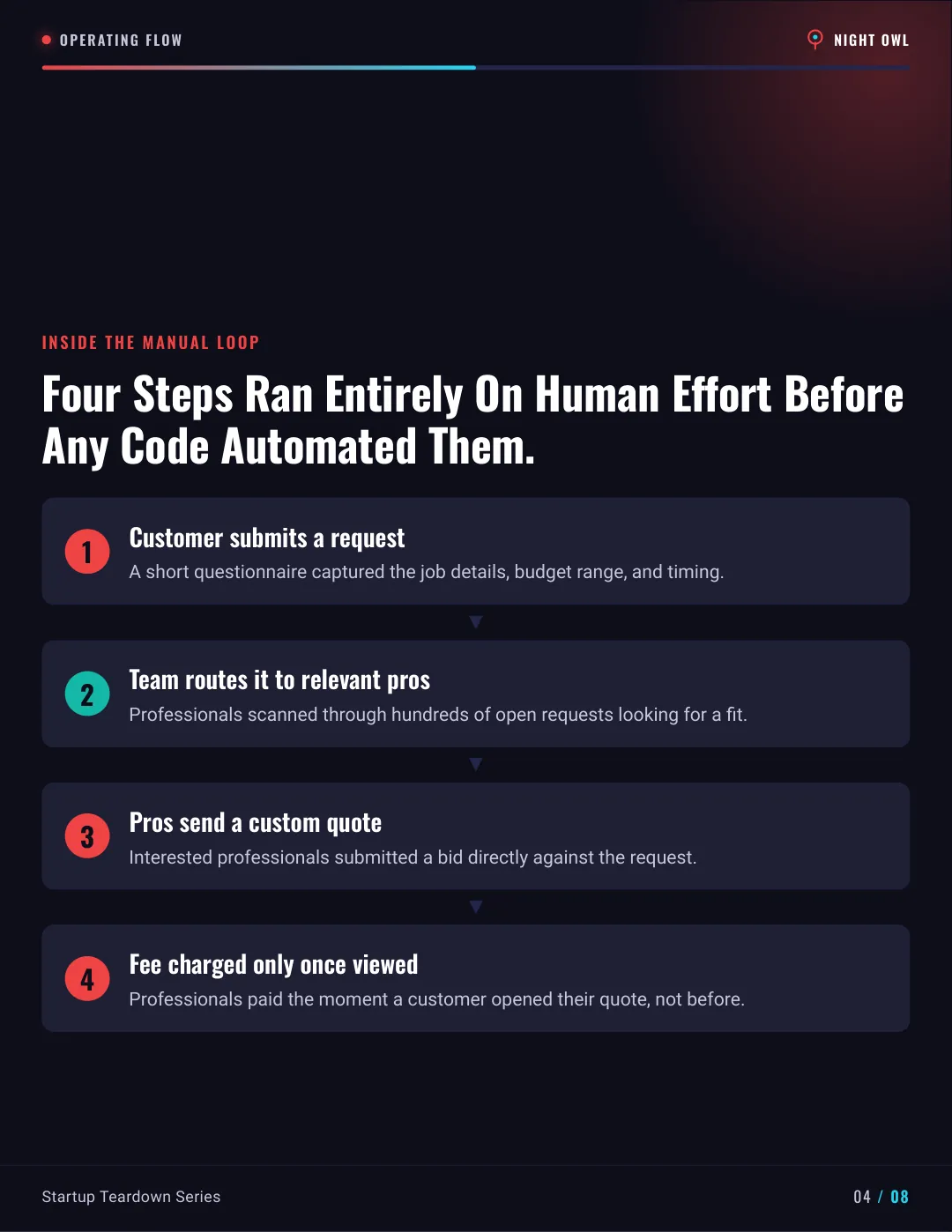
INSIDE THE MANUAL LOOP
Four Steps Ran Entirely On Human Effort Before
Any Code Automated Them.
▼
▼
▼
1
Customer submits a request
A short questionnaire captured the job details, budget range, and timing.
2
Team routes it to relevant pros
Professionals scanned through hundreds of open requests looking for a fit.
3
Pros send a custom quote
Interested professionals submitted a bid directly against the request.
4
Fee charged only once viewed
Professionals paid the moment a customer opened their quote, not before.
Startup Teardown Series
04 / 08
Slide 5
HYPOTHESIS TEST
NIGHT OWL
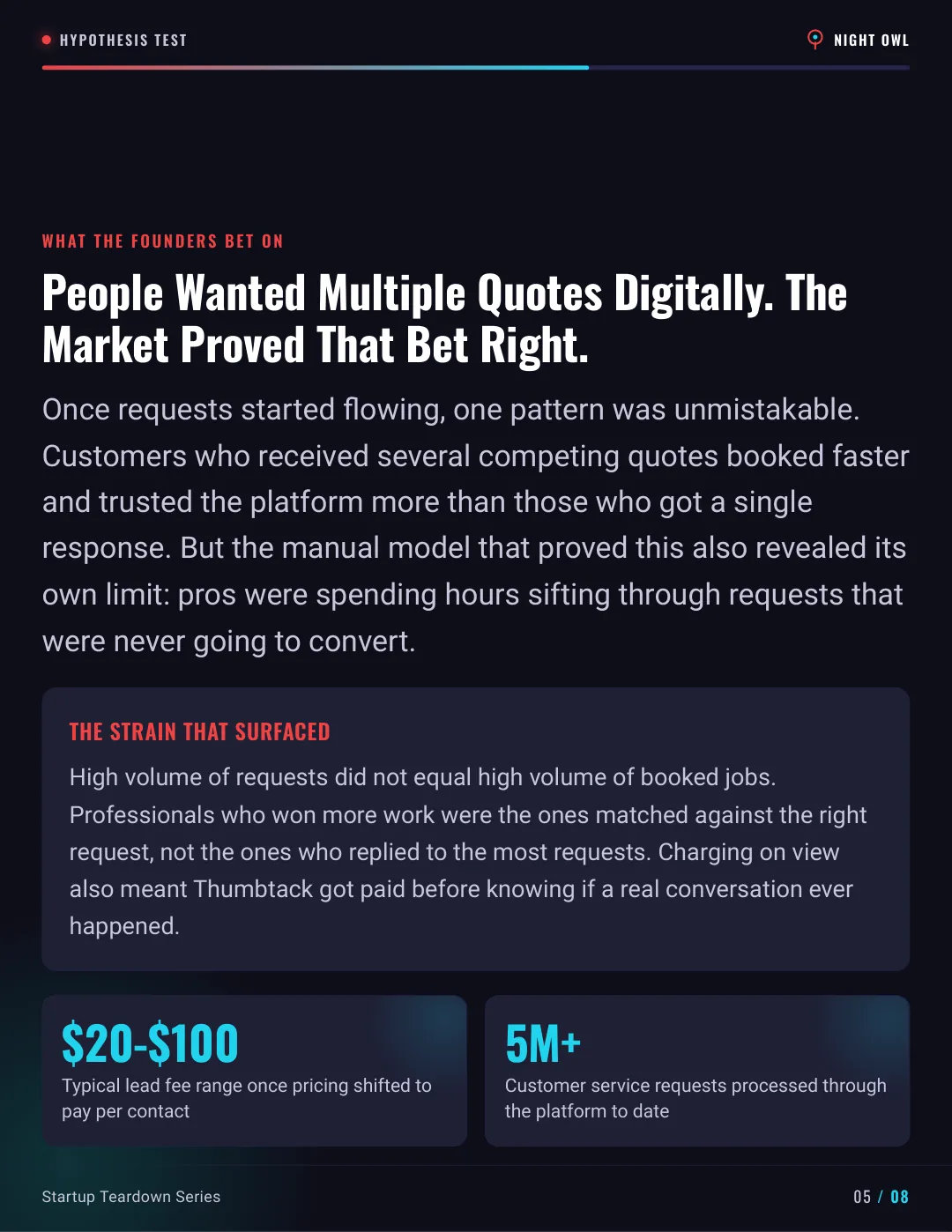
WHAT THE FOUNDERS BET ON
People Wanted Multiple Quotes Digitally. The
Market Proved That Bet Right.
Once requests started flowing, one pattern was unmistakable.
Customers who received several competing quotes booked faster
and trusted the platform more than those who got a single
response. But the manual model that proved this also revealed its
own limit: pros were spending hours sifting through requests that
were never going to convert.
THE STRAIN THAT SURFACED
High volume of requests did not equal high volume of booked jobs.
Professionals who won more work were the ones matched against the right
request, not the ones who replied to the most requests. Charging on view
also meant Thumbtack got paid before knowing if a real conversation ever
happened.
$20-$100
Typical lead fee range once pricing shifted to
pay per contact
5M+
Customer service requests processed through
the platform to date
Startup Teardown Series
05 / 08
Slide 6
GROWTH TRAJECTORY
NIGHT OWL
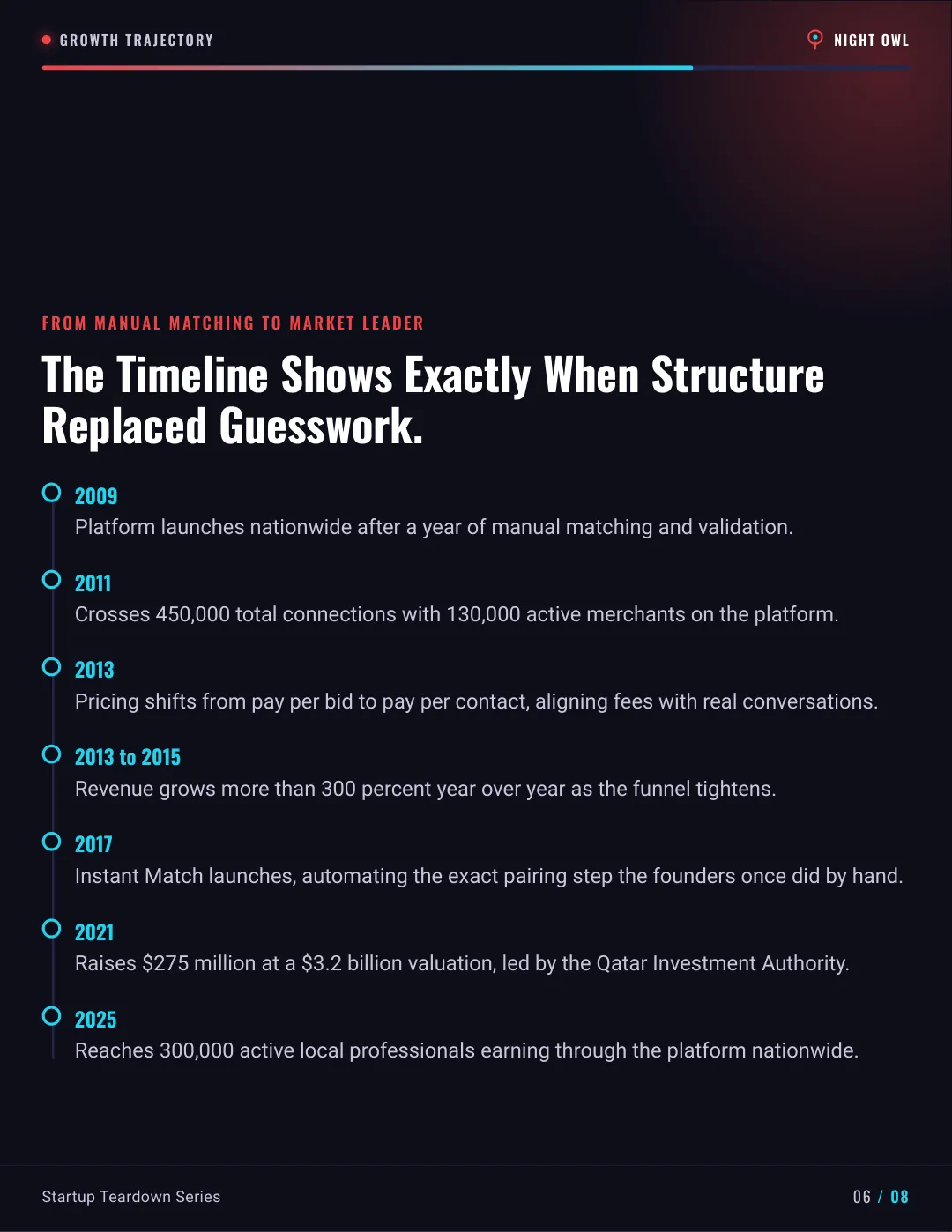
FROM MANUAL MATCHING TO MARKET LEADER
The Timeline Shows Exactly When Structure
Replaced Guesswork.
2009
Platform launches nationwide after a year of manual matching and validation.
2011
Crosses 450,000 total connections with 130,000 active merchants on the platform.
2013
Pricing shifts from pay per bid to pay per contact, aligning fees with real conversations.
2013 to 2015
Revenue grows more than 300 percent year over year as the funnel tightens.
2017
Instant Match launches, automating the exact pairing step the founders once did by hand.
2021
Raises $275 million at a $3.2 billion valuation, led by the Qatar Investment Authority.
2025
Reaches 300,000 active local professionals earning through the platform nationwide.
Startup Teardown Series
06 / 08
Slide 7
CORE INSIGHT
NIGHT OWL
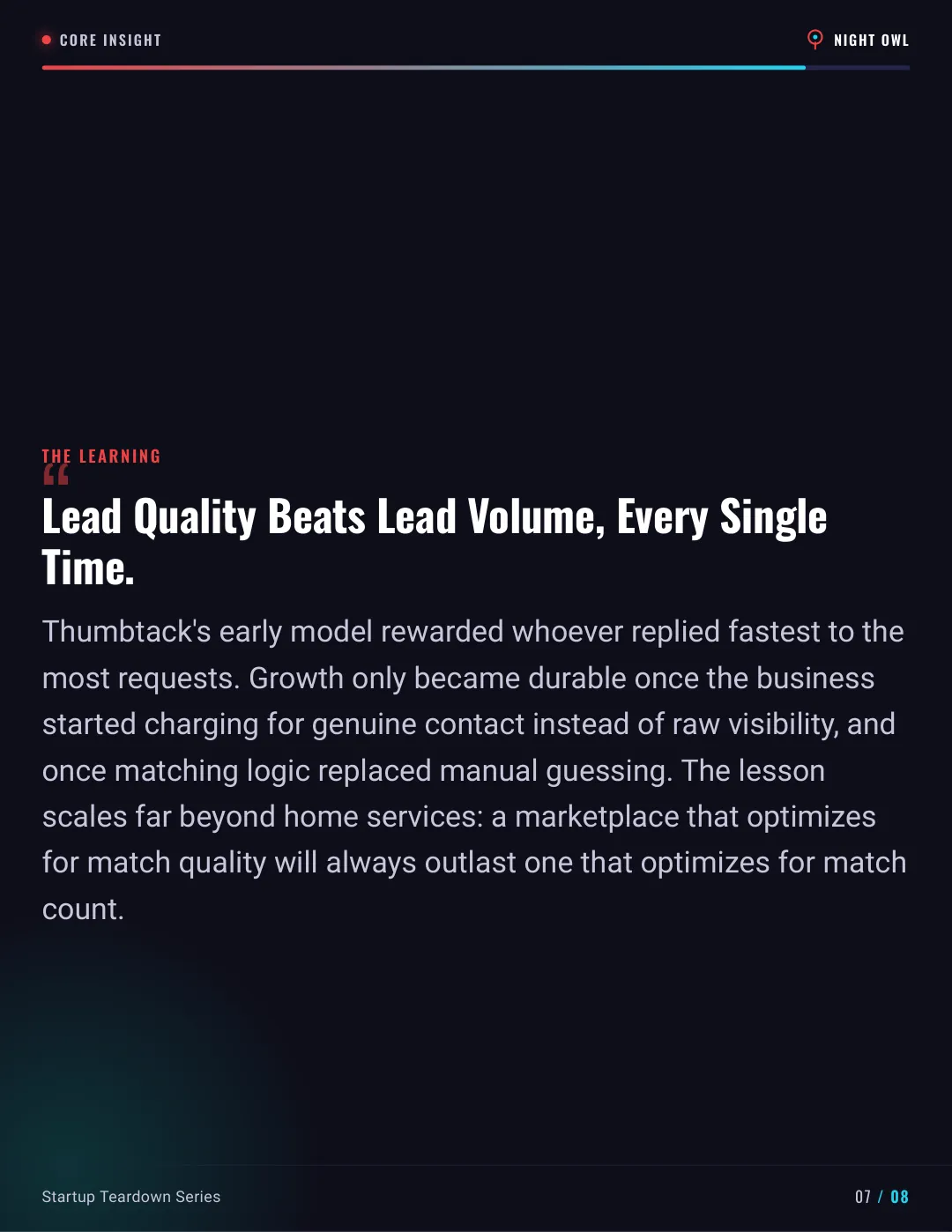
THE LEARNING
Lead Quality Beats Lead Volume, Every Single
Time.
Thumbtack's early model rewarded whoever replied fastest to the
most requests. Growth only became durable once the business
started charging for genuine contact instead of raw visibility, and
once matching logic replaced manual guessing. The lesson
scales far beyond home services: a marketplace that optimizes
for match quality will always outlast one that optimizes for match
count.
“
Startup Teardown Series
07 / 08
Slide 8
FOUNDER TAKEAWAY
NIGHT OWL
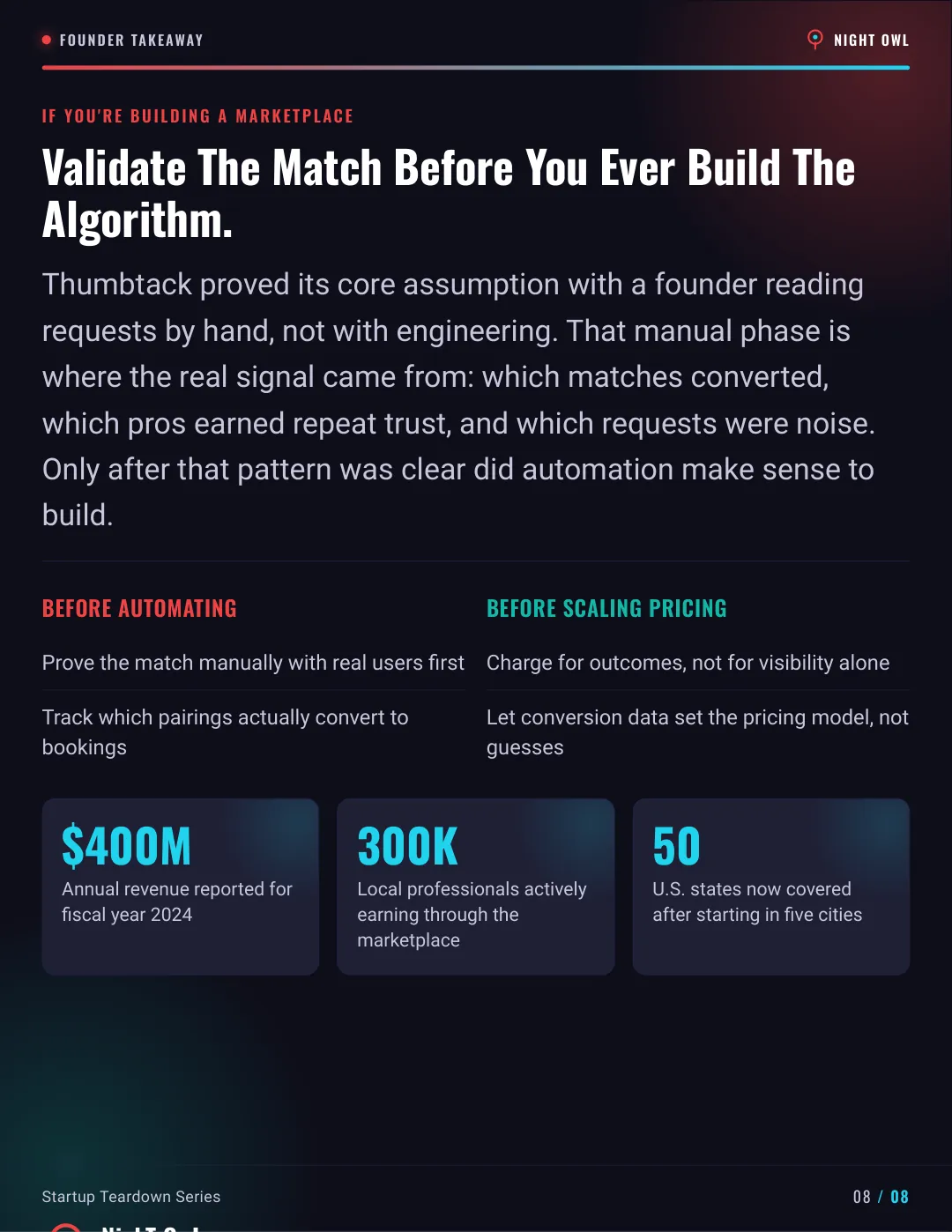
IF YOU'RE BUILDING A MARKETPLACE
Validate The Match Before You Ever Build The
Algorithm.
Thumbtack proved its core assumption with a founder reading
requests by hand, not with engineering. That manual phase is
where the real signal came from: which matches converted,
which pros earned repeat trust, and which requests were noise.
Only after that pattern was clear did automation make sense to
build.
BEFORE AUTOMATING
Prove the match manually with real users first
Track which pairings actually convert to
bookings
BEFORE SCALING PRICING
Charge for outcomes, not for visibility alone
Let conversion data set the pricing model, not
guesses
Ni hT O L
$400M
Annual revenue reported for
fiscal year 2024
300K
Local professionals actively
earning through the
marketplace
50
U.S. states now covered
after starting in five cities
Startup Teardown Series
08 / 08