How Your Stock Order Executes in Milliseconds

You clicked "Buy" on a stock. In 400 microseconds, your order traveled across the country, got sorted by an algorithm, and landed in a matching engine running on bare metal hardware with no operating system.
You blinked. It was already done.
Most people think the stock market is just numbers changing on a screen. It's actually one of the most insane distributed systems ever built — part physics experiment, part speed race, part live auction happening millions of times per second.
I broke down the whole thing across 9 slides. Market orders, limit orders, HFT firms spending $300M on microwave towers, and why price moves the second you trade.
Drop a comment if something surprised you.
Read the slides as text
Slide 1
🚀 F I N A N C E × T E C H N O L O G Y
Your "Buy" Click
Just Traveled
Around the World
in 400µs.
Most people know stocks go up and down. Very few know
the insane engineering that makes it happen in under a
millisecond. Let's fix that.
M A R K E T O R D E R S
M ATC H I N G E N G I N E S
H I G H - F R E Q U E N C Y T R A D I N G
P R I C E D I S C OV E RY
M A R K E T S E X P L A I N E D
0 1 / 0 9
1ms
Slide 2
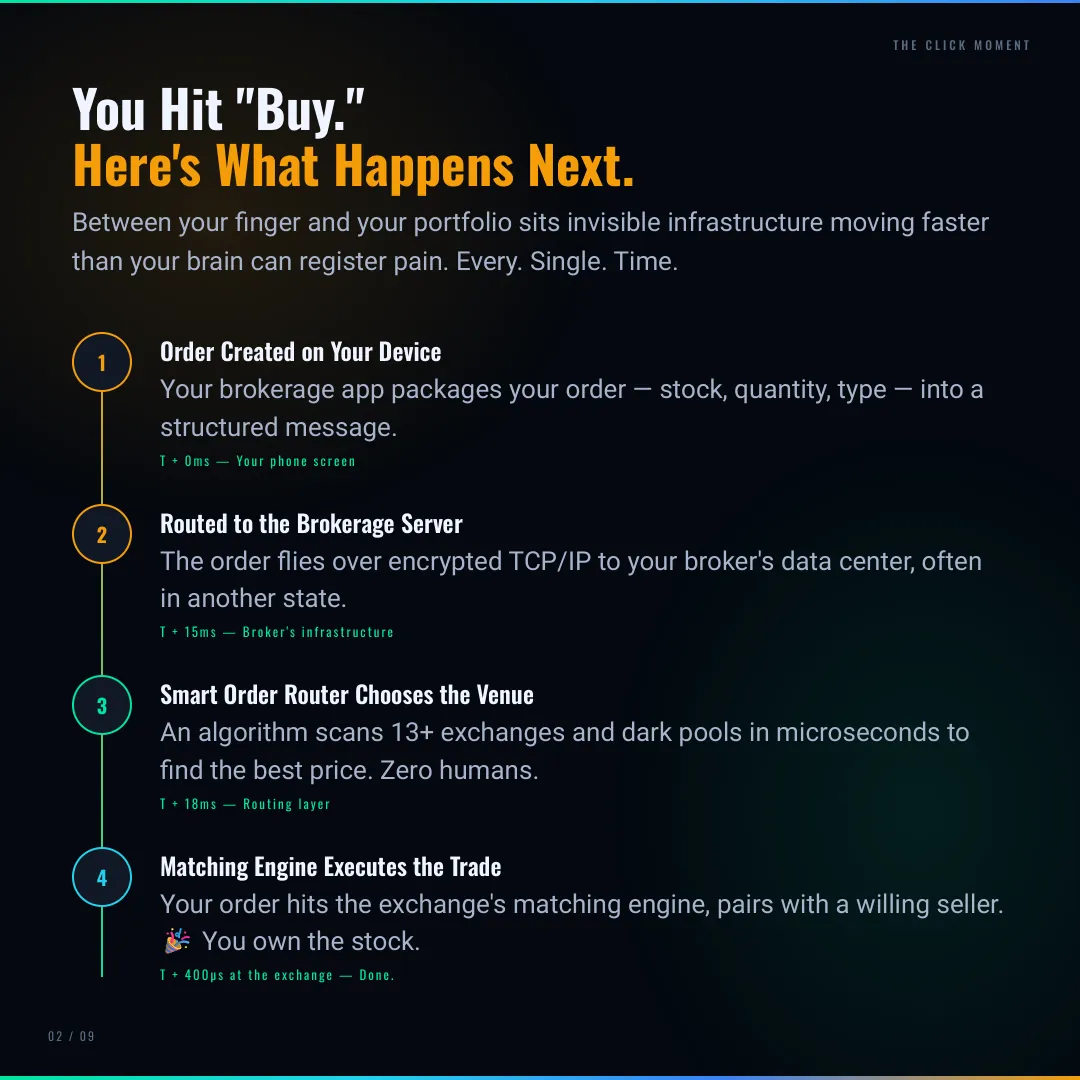
You Hit "Buy."
Here's What Happens Next.
Between your finger and your portfolio sits invisible infrastructure moving faster
than your brain can register pain. Every. Single. Time.
T H E C L I C K M O M E N T
0 2 / 0 9
Order Created on Your Device
Your brokerage app packages your order — stock, quantity, type — into a
structured message.
T + 0 m s — Yo u r p h o n e s c r e e n
Routed to the Brokerage Server
The order flies over encrypted TCP/IP to your broker's data center, often
in another state.
T + 1 5 m s — B r o ke r 's i n f ra s t r u c t u r e
Smart Order Router Chooses the Venue
An algorithm scans 13+ exchanges and dark pools in microseconds to
find the best price. Zero humans.
T + 1 8 m s — Ro u t i n g l a y e r
Matching Engine Executes the Trade
Your order hits the exchange's matching engine, pairs with a willing seller.
🎉 You own the stock.
T + 4 0 0 µ s a t t h e exc h a n ge — D o n e .
1
2
3
4
Slide 3
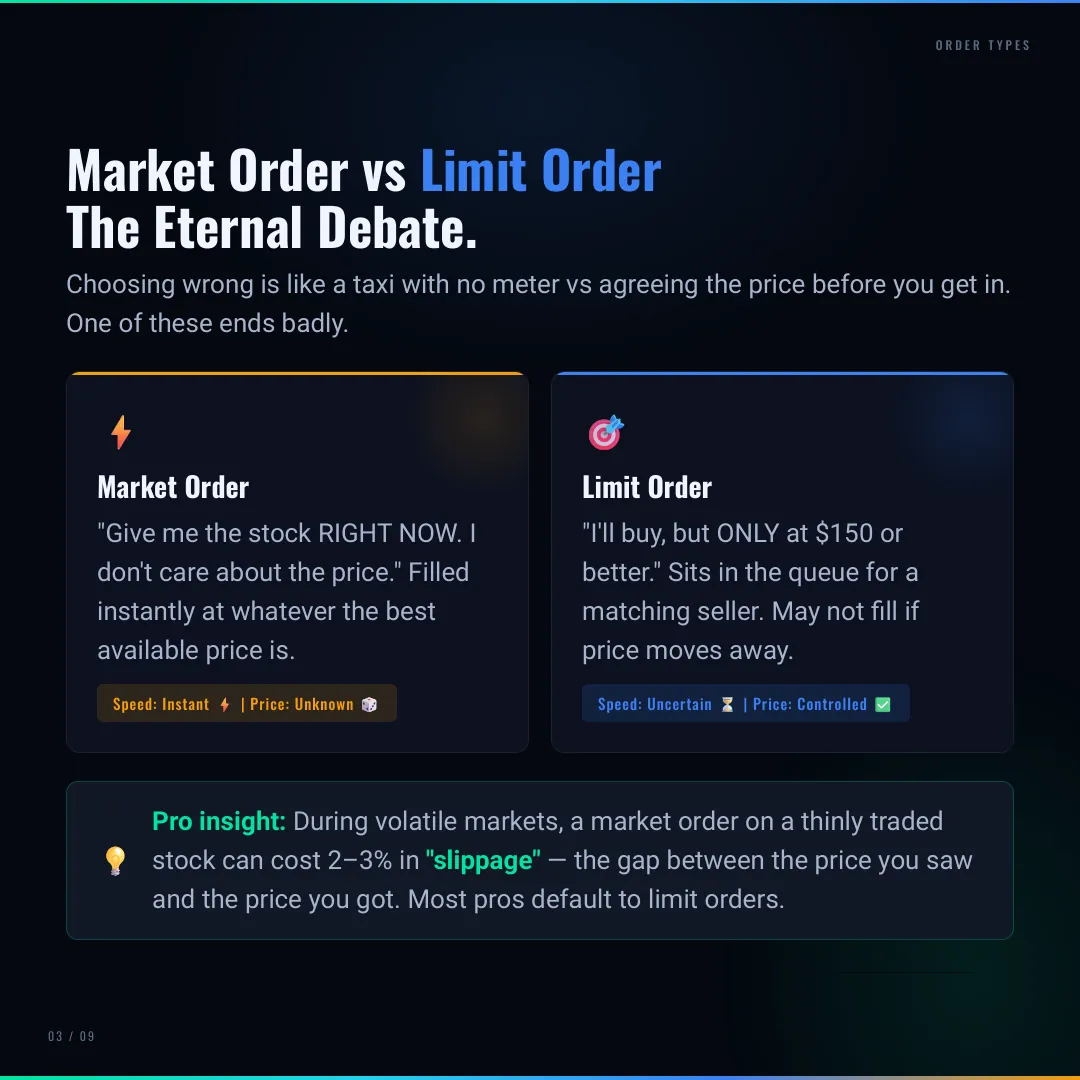
Market Order vs Limit Order
The Eternal Debate.
Choosing wrong is like a taxi with no meter vs agreeing the price before you get in.
One of these ends badly.
💡
Pro insight: During volatile markets, a market order on a thinly traded
stock can cost 2–3% in "slippage" — the gap between the price you saw
and the price you got. Most pros default to limit orders.
O R D E R T Y P E S
0 3 / 0 9
⚡
Market Order
"Give me the stock RIGHT NOW. I
don't care about the price." Filled
instantly at whatever the best
available price is.
Speed: Instant ⚡ | Price: Unknown 🎲
🎯
Limit Order
"I'll buy, but ONLY at $150 or
better." Sits in the queue for a
matching seller. May not fill if
price moves away.
Speed: Uncertain ⏳ | Price: Controlled ✅
Slide 4
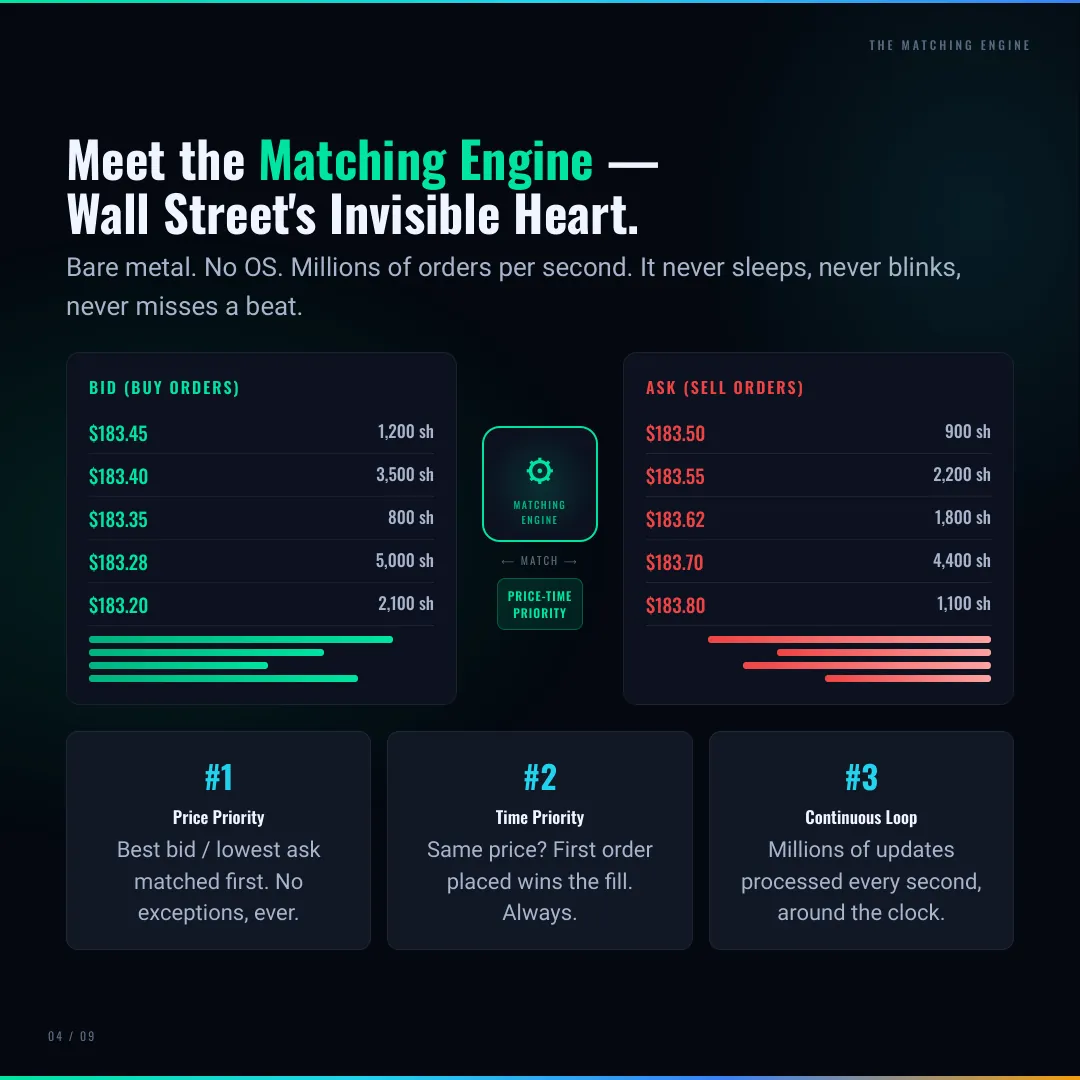
Meet the Matching Engine —
Wall Street's Invisible Heart.
Bare metal. No OS. Millions of orders per second. It never sleeps, never blinks,
never misses a beat.
BID (BUY ORDERS)
$183.45
1,200 sh
$183.40
3,500 sh
$183.35
800 sh
$183.28
5,000 sh
$183.20
2,100 sh
⟵ M AT C H ⟶
PRICE-TIME
PRIORITY
ASK (SELL ORDERS)
$183.50
900 sh
$183.55
2,200 sh
$183.62
1,800 sh
$183.70
4,400 sh
$183.80
1,100 sh
#1
Price Priority
Best bid / lowest ask
matched first. No
exceptions, ever.
#2
Time Priority
Same price? First order
placed wins the fill.
Always.
#3
Continuous Loop
Millions of updates
processed every second,
around the clock.
T H E M A T C H I N G E N G I N E
0 4 / 0 9
⚙
MATC H I N G
E N G I N E
Slide 5
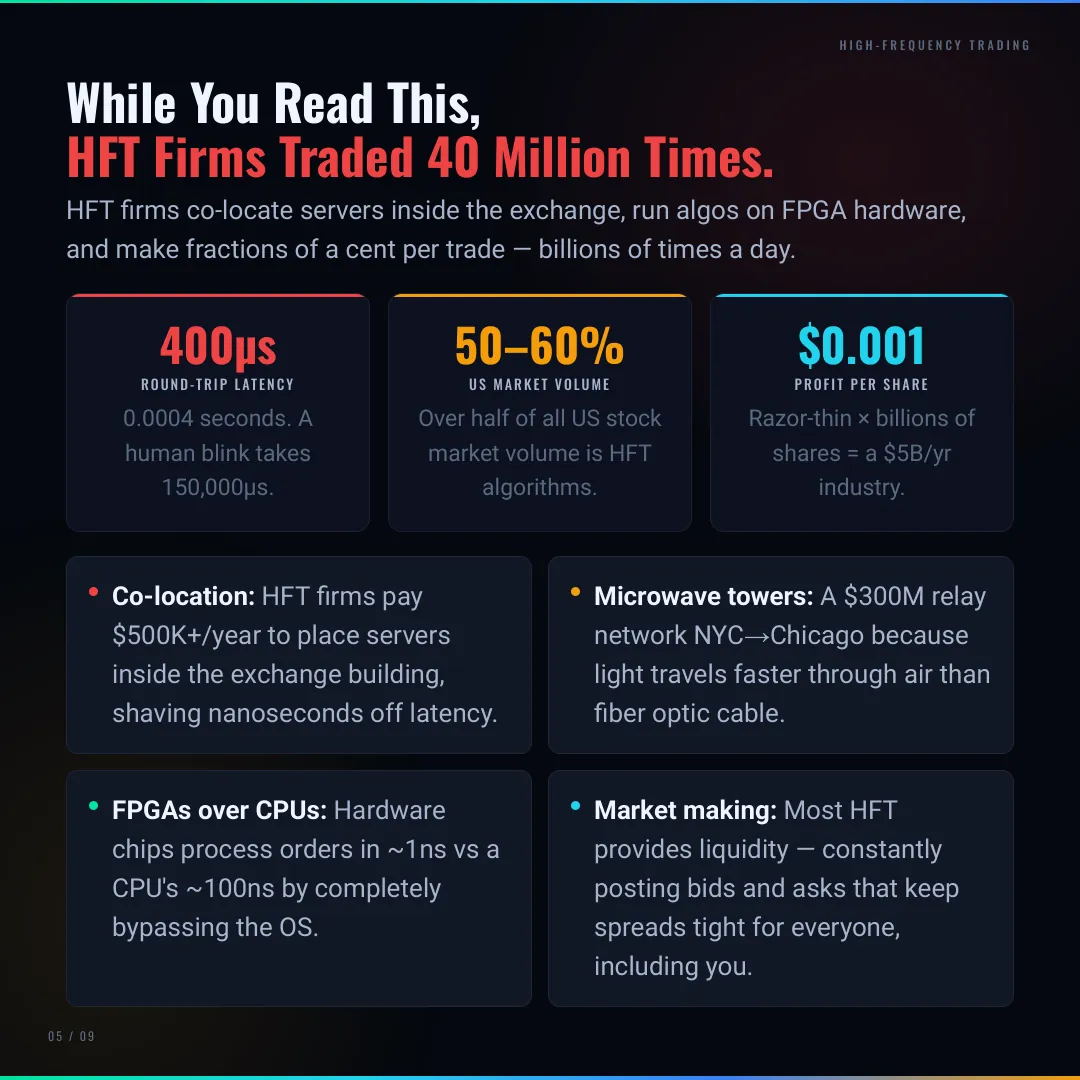
While You Read This,
HFT Firms Traded 40 Million Times.
HFT firms co-locate servers inside the exchange, run algos on FPGA hardware,
and make fractions of a cent per trade — billions of times a day.
Co-location: HFT firms pay
$500K+/year to place servers
inside the exchange building,
shaving nanoseconds off latency.
Microwave towers: A $300M relay
network NYC→Chicago because
light travels faster through air than
fiber optic cable.
FPGAs over CPUs: Hardware
chips process orders in ~1ns vs a
CPU's ~100ns by completely
bypassing the OS.
Market making: Most HFT
provides liquidity — constantly
posting bids and asks that keep
spreads tight for everyone,
including you.
H I G H - F R E Q U E N C Y T R A D I N G
0 5 / 0 9
400µs
ROUND-TRIP LATENCY
0.0004 seconds. A
human blink takes
150,000µs.
50–60%
US MARKET VOLUME
Over half of all US stock
market volume is HFT
algorithms.
$0.001
PROFIT PER SHARE
Razor-thin × billions of
shares = a $5B/yr
industry.
Slide 6
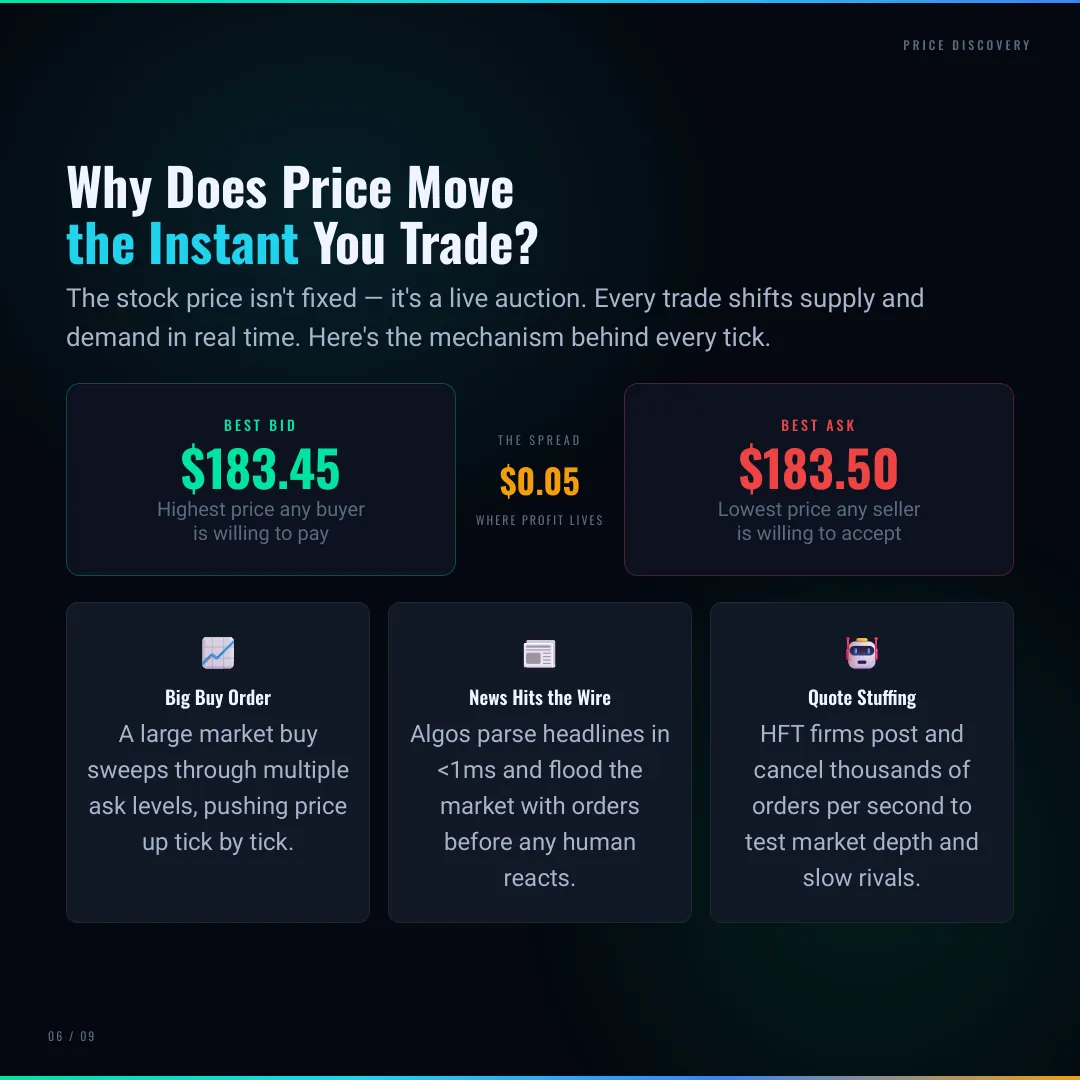
Why Does Price Move
the Instant You Trade?
The stock price isn't fixed — it's a live auction. Every trade shifts supply and
demand in real time. Here's the mechanism behind every tick.
B E S T B I D
$183.45
Highest price any buyer
is willing to pay
T H E S P R E A D
$0.05
W H E R E P R O F I T L I V E S
B E S T A S K
$183.50
Lowest price any seller
is willing to accept
📈
Big Buy Order
A large market buy
sweeps through multiple
ask levels, pushing price
up tick by tick.
📰
News Hits the Wire
Algos parse headlines in
<1ms and flood the
market with orders
before any human
reacts.
🤖
Quote Stuffing
HFT firms post and
cancel thousands of
orders per second to
test market depth and
slow rivals.
P R I C E D I S C O V E R Y
0 6 / 0 9
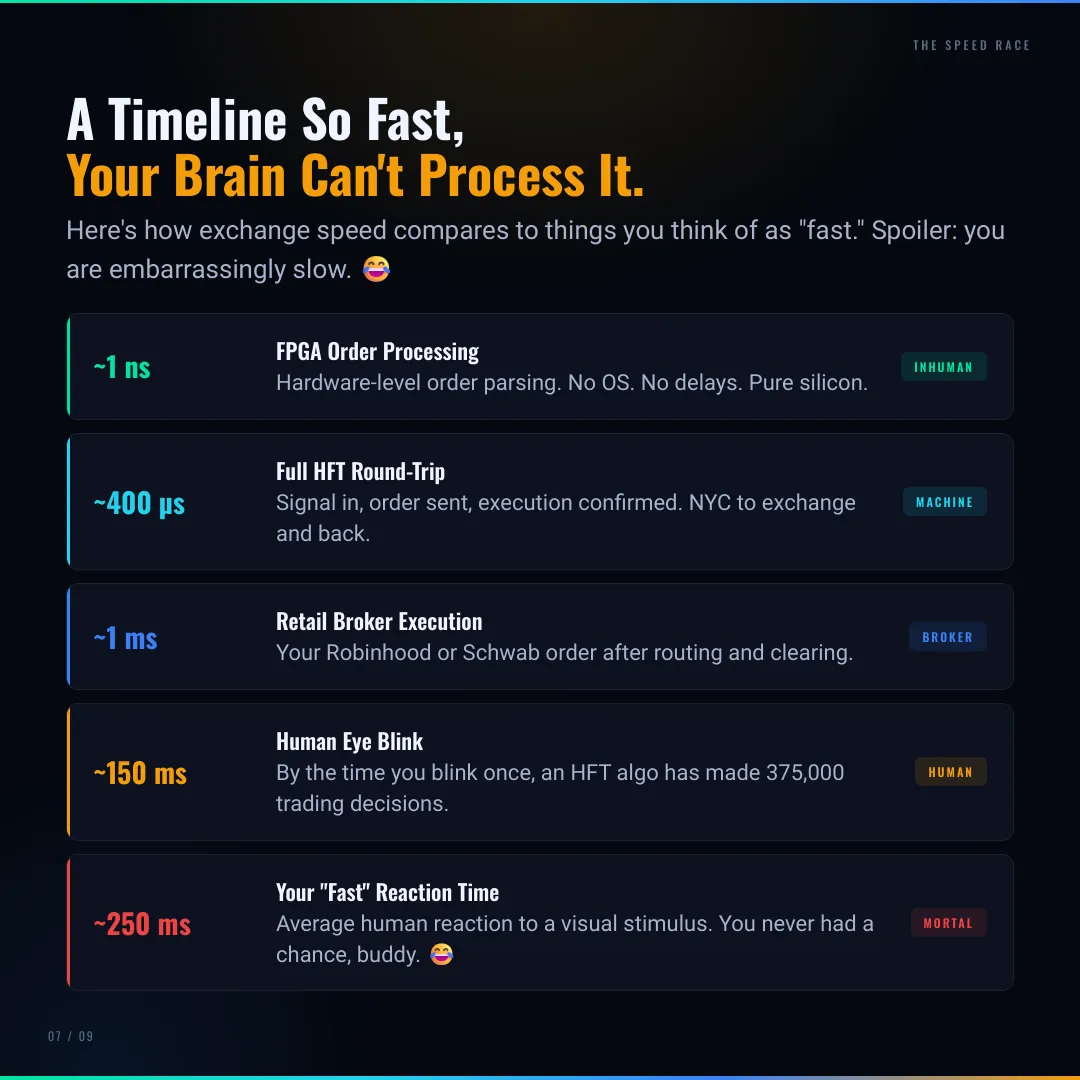
Slide 7
A Timeline So Fast,
Your Brain Can't Process It.
Here's how exchange speed compares to things you think of as "fast." Spoiler: you
are embarrassingly slow. 😂
T H E S P E E D R A C E
0 7 / 0 9
~1 ns
FPGA Order Processing
Hardware-level order parsing. No OS. No delays. Pure silicon.
I N H U M A N
~400 µs
Full HFT Round-Trip
Signal in, order sent, execution confirmed. NYC to exchange
and back.
M A C H I N E
~1 ms
Retail Broker Execution
Your Robinhood or Schwab order after routing and clearing.
B R O K E R
~150 ms
Human Eye Blink
By the time you blink once, an HFT algo has made 375,000
trading decisions.
H U M A N
~250 ms
Your "Fast" Reaction Time
Average human reaction to a visual stimulus. You never had a
chance, buddy. 😂
M O R TA L
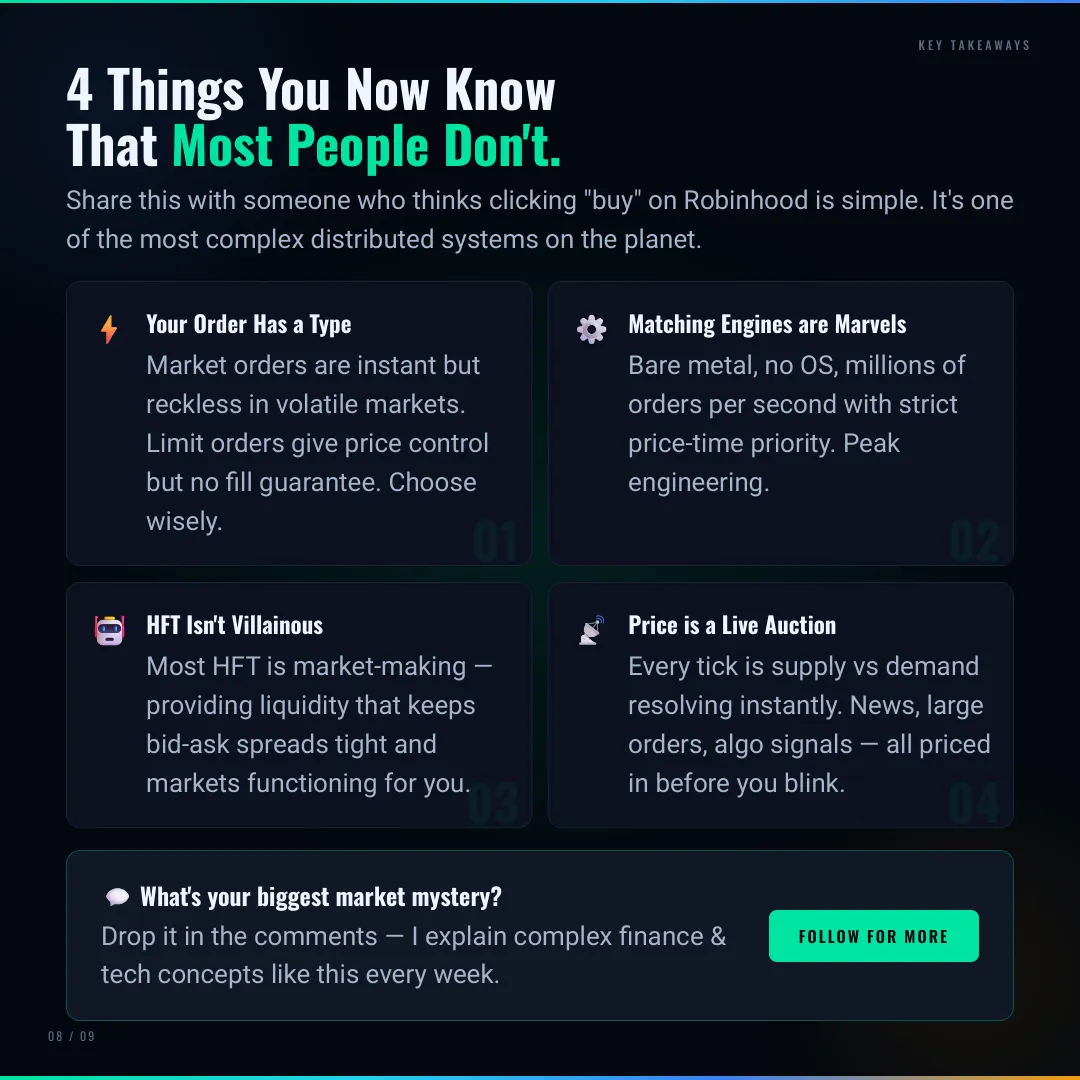
Slide 8
4 Things You Now Know
That Most People Don't.
Share this with someone who thinks clicking "buy" on Robinhood is simple. It's one
of the most complex distributed systems on the planet.
💬 What's your biggest market mystery?
Drop it in the comments — I explain complex finance &
tech concepts like this every week.
FOLLOW FOR MORE
K E Y T A K E A W A Y S
0 8 / 0 9
⚡Your Order Has a Type
Market orders are instant but
reckless in volatile markets.
Limit orders give price control
but no fill guarantee. Choose
wisely.
01
⚙️Matching Engines are Marvels
Bare metal, no OS, millions of
orders per second with strict
price-time priority. Peak
engineering.
02
🤖HFT Isn't Villainous
Most HFT is market-making —
providing liquidity that keeps
bid-ask spreads tight and
markets functioning for you.03
📡Price is a Live Auction
Every tick is supply vs demand
resolving instantly. News, large
orders, algo signals — all priced
in before you blink.
04
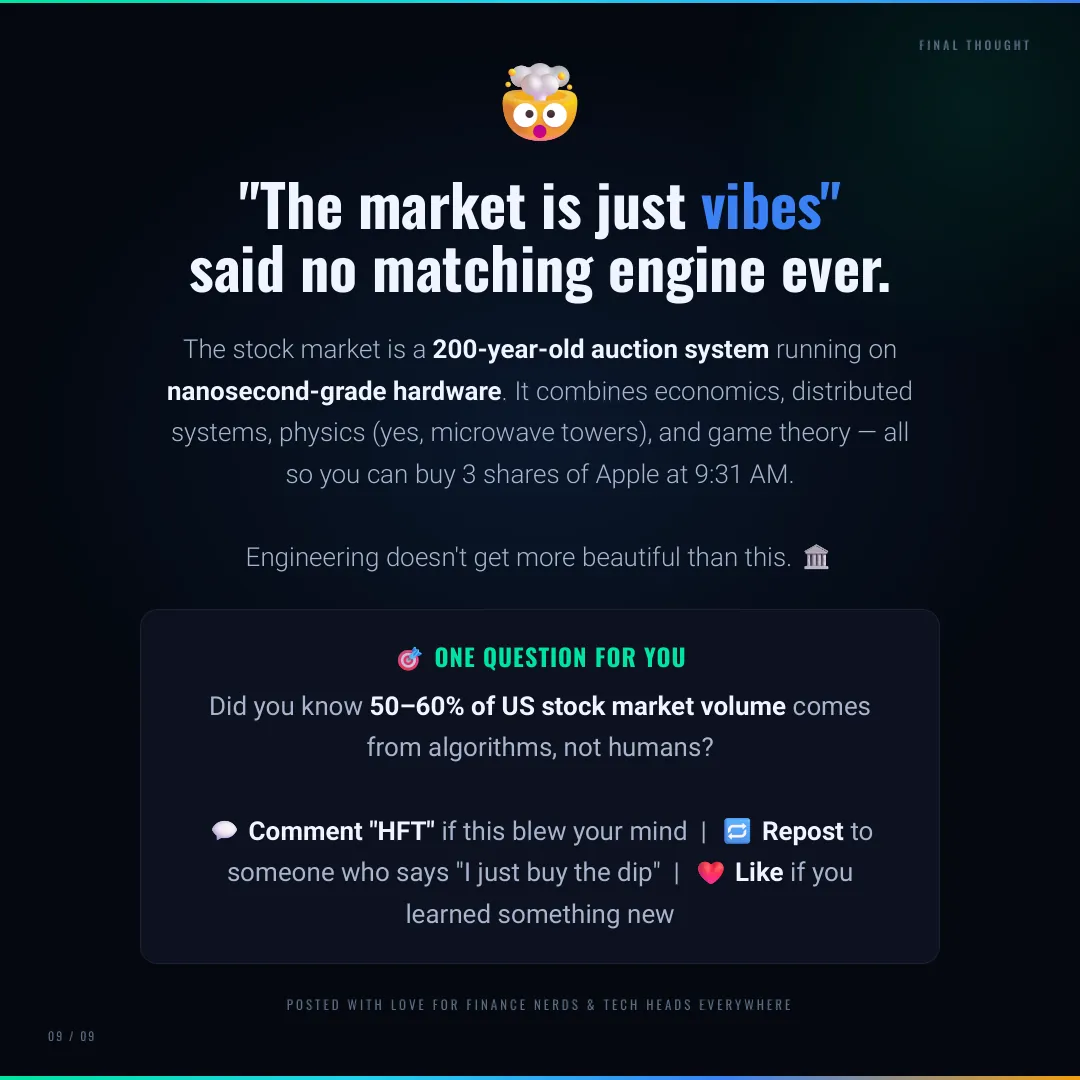
Slide 9
🤯
"The market is just vibes"
said no matching engine ever.
The stock market is a 200-year-old auction system running on
nanosecond-grade hardware. It combines economics, distributed
systems, physics (yes, microwave towers), and game theory — all
so you can buy 3 shares of Apple at 9:31 AM.
Engineering doesn't get more beautiful than this. 🏛️
🎯 ONE QUESTION FOR YOU
Did you know 50–60% of US stock market volume comes
from algorithms, not humans?
💬 Comment "HFT" if this blew your mind | 🔁 Repost to
someone who says "I just buy the dip" | ❤️ Like if you
learned something new
P O S T E D W I T H L O V E F O R F I N A N C E N E R D S & T E C H H E A D S E V E R Y W H E R E
F I N A L T H O U G H T
0 9 / 0 9