Minimum Viable Product (MVP)
MVP isn’t “half a product.” It’s the smart first move.
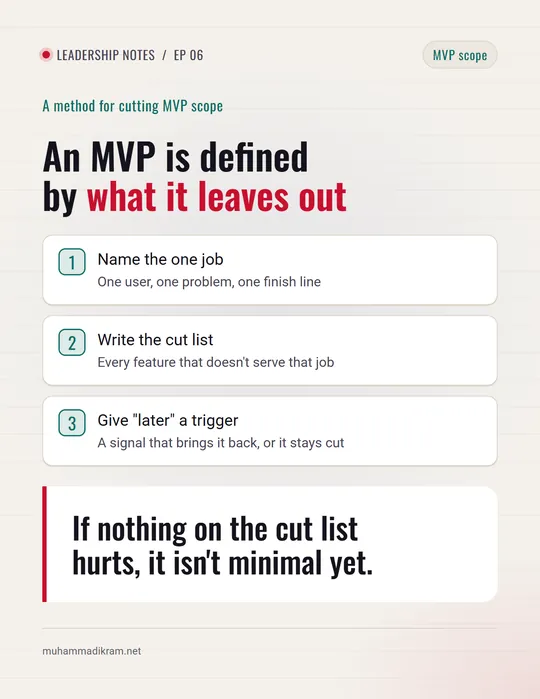
A Minimum Viable Product focuses on one real problem, solves it well, and gets into users’ hands fast.
In Agile & Scrum, MVPs cut risk, speed up time-to-market, and replace assumptions with real feedback.
Build less. Learn more. Iterate smarter. That’s how products actually win.
Read the slides as text
Slide 1
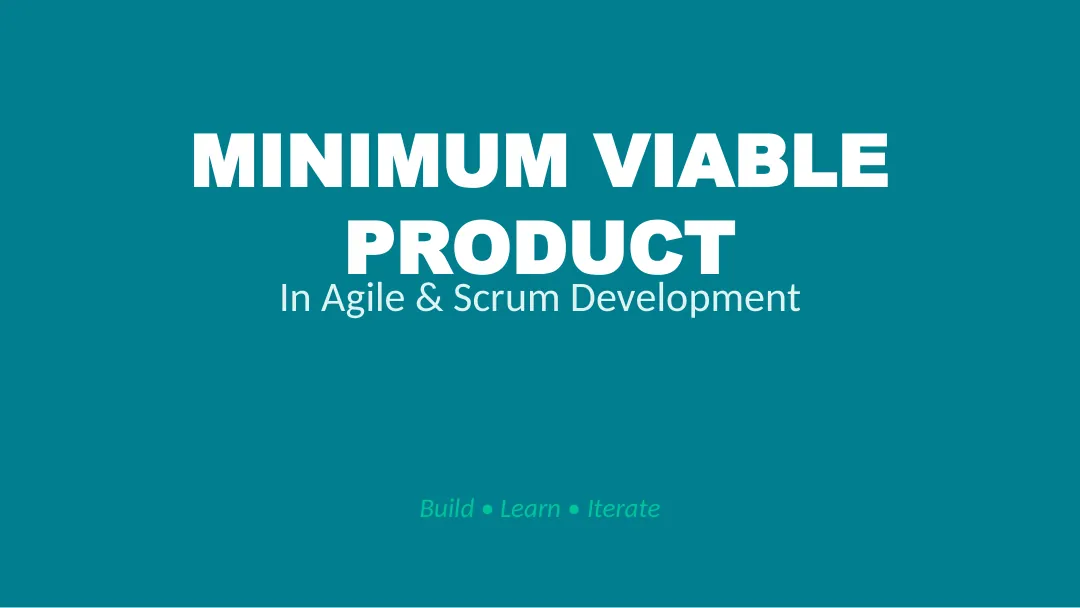
MINIMUM VIABLE
PRODUCT
In Agile & Scrum Development
Build • Learn • Iterate
Slide 2
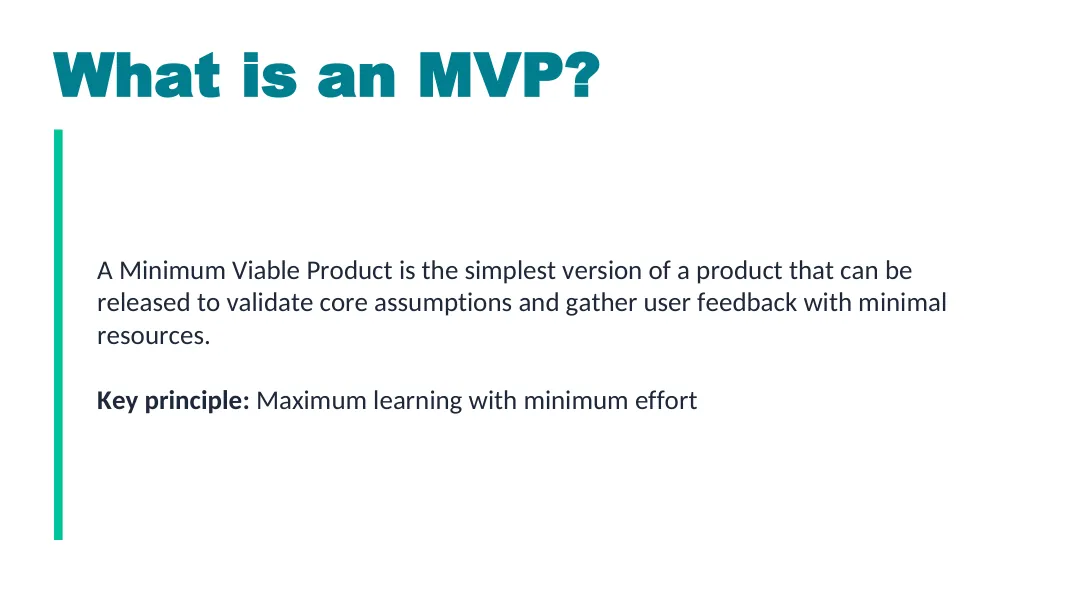
What is an MVP?
A Minimum Viable Product is the simplest version of a product that can be
released to validate core assumptions and gather user feedback with minimal
resources.
Key principle: Maximum learning with minimum effort
Slide 3
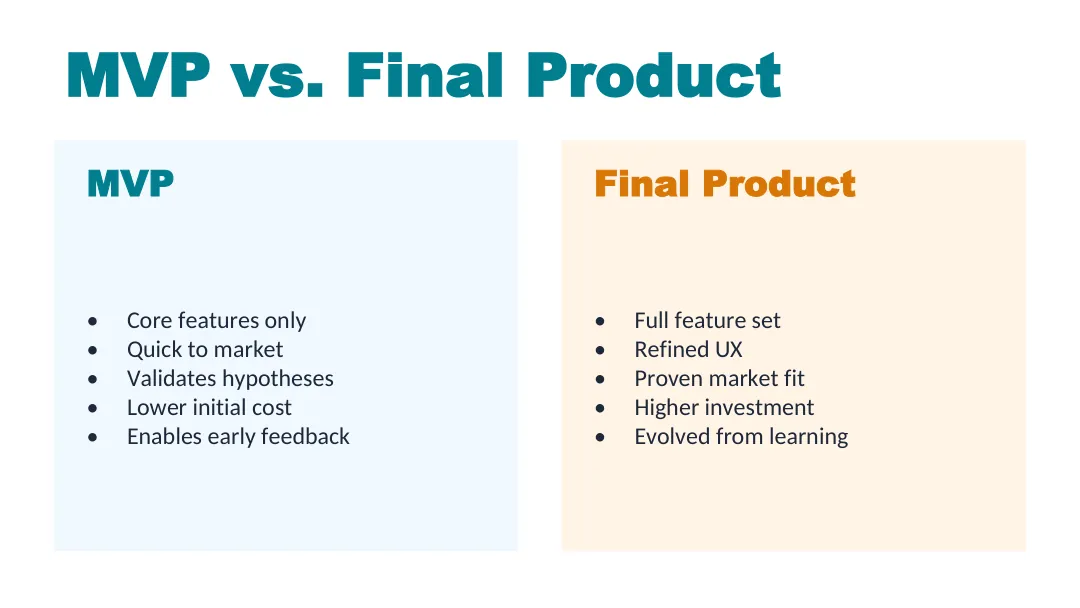
MVP vs. Final Product
MVP
•
Core features only
•
Quick to market
•
Validates hypotheses
•
Lower initial cost
•
Enables early feedback
Final Product
•
Full feature set
•
Refined UX
•
Proven market fit
•
Higher investment
•
Evolved from learning
Slide 4
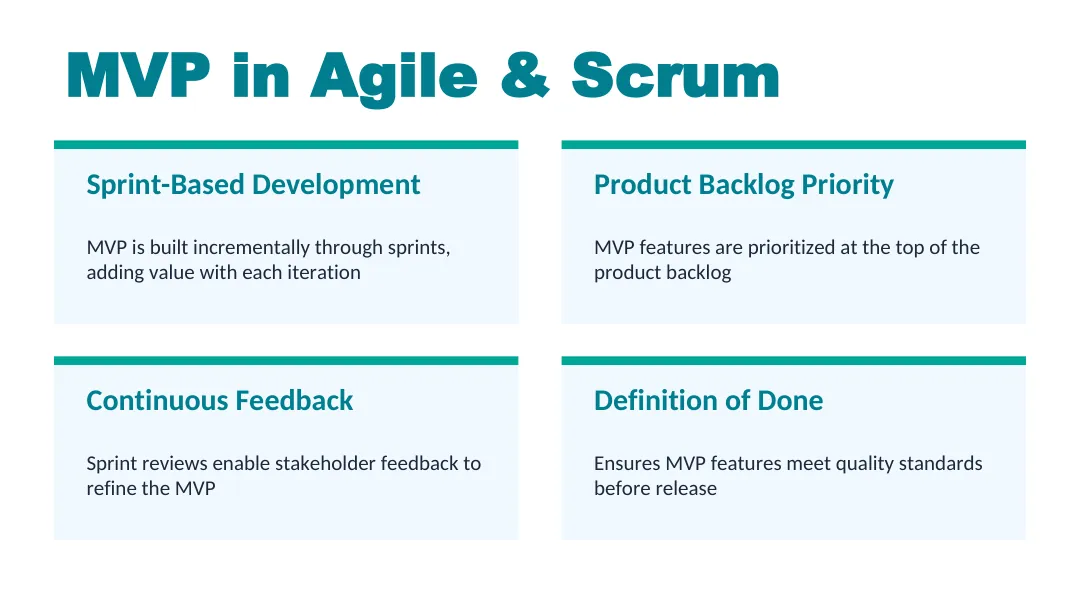
MVP in Agile & Scrum
Sprint-Based Development
MVP is built incrementally through sprints,
adding value with each iteration
Product Backlog Priority
MVP features are prioritized at the top of the
product backlog
Continuous Feedback
Sprint reviews enable stakeholder feedback to
refine the MVP
Definition of Done
Ensures MVP features meet quality standards
before release
Slide 5
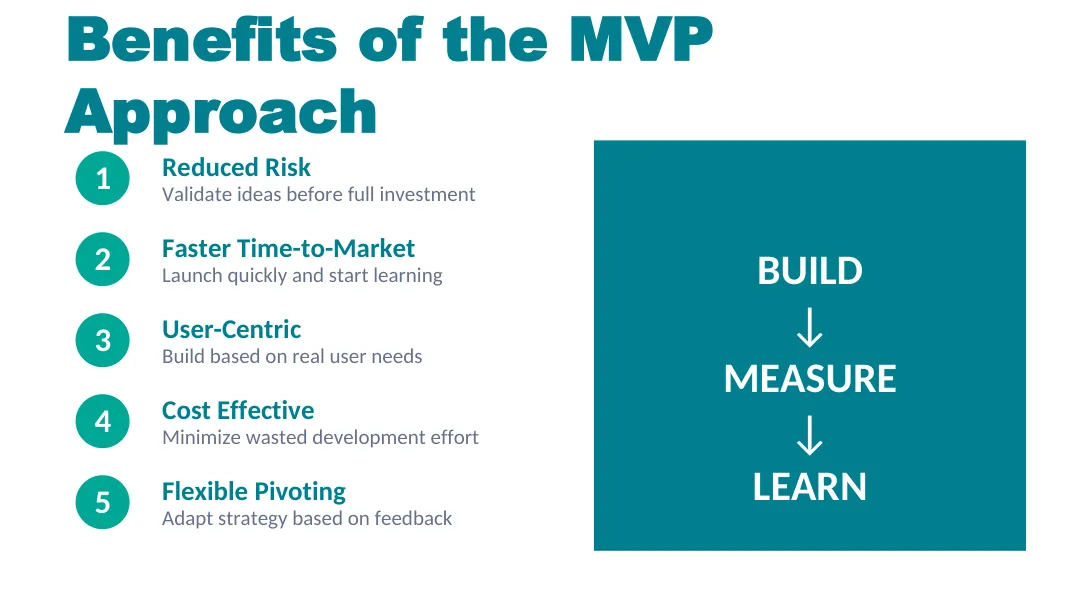
Benefits of the MVP
Approach
1
Reduced Risk
Validate ideas before full investment
2
Faster Time-to-Market
Launch quickly and start learning
3
User-Centric
Build based on real user needs
4
Cost Effective
Minimize wasted development effort
5
Flexible Pivoting
Adapt strategy based on feedback
BUILD
↓
MEASURE
↓
LEARN
Slide 6
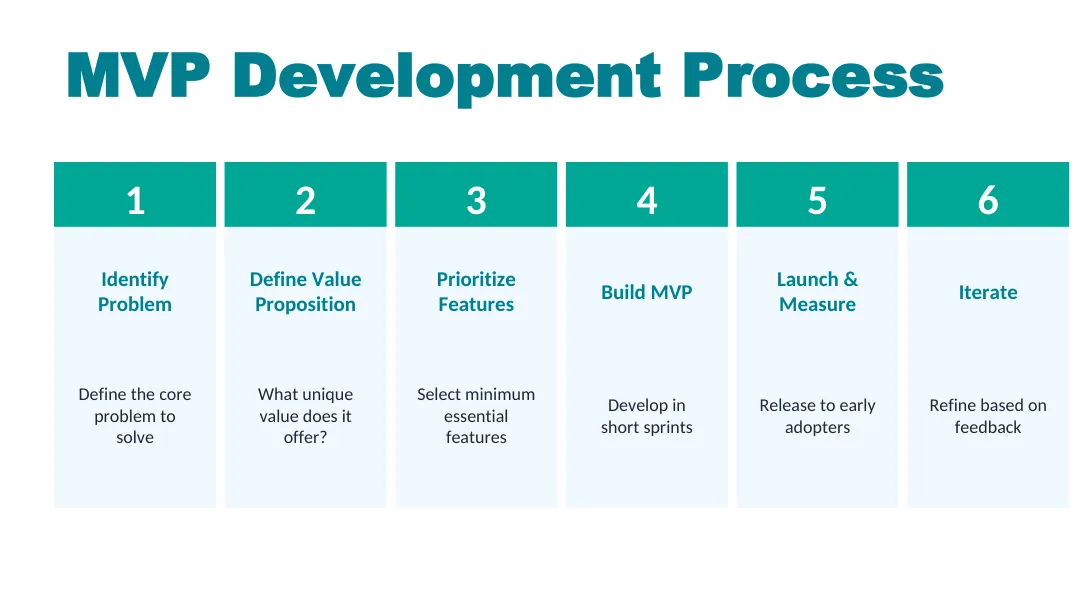
MVP Development Process
1
Identify
Problem
Define the core
problem to
solve
2
Define Value
Proposition
What unique
value does it
offer?
3
Prioritize
Features
Select minimum
essential
features
4
Build MVP
Develop in
short sprints
5
Launch &
Measure
Release to early
adopters
6
Iterate
Refine based on
feedback
Slide 7
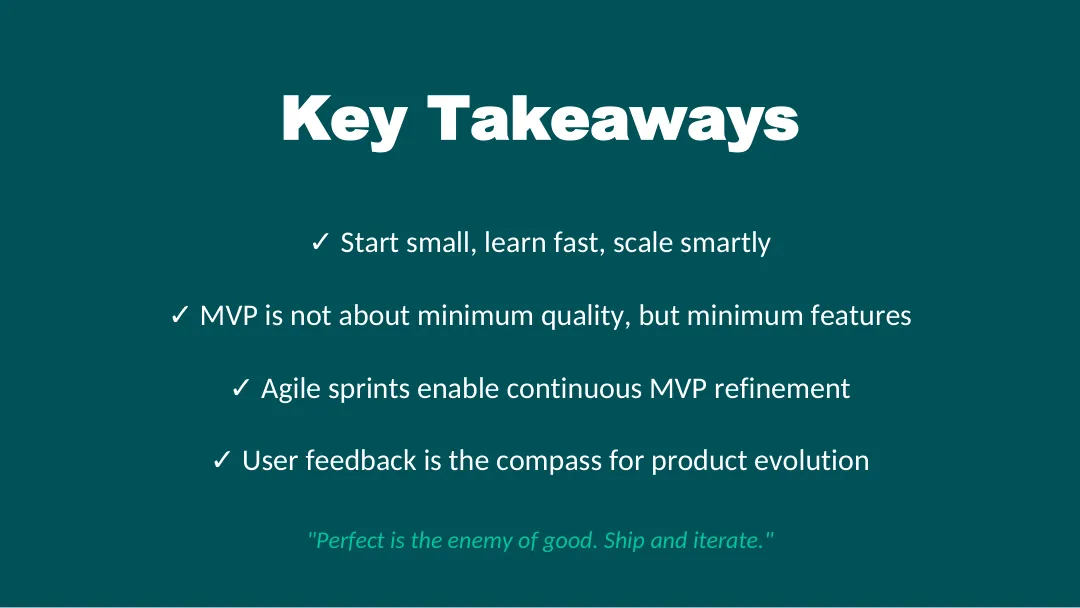
Key Takeaways
✓Start small, learn fast, scale smartly
✓MVP is not about minimum quality, but minimum features
✓Agile sprints enable continuous MVP refinement
✓User feedback is the compass for product evolution
"Perfect is the enemy of good. Ship and iterate."