Most founders build for months, then discover nobody wants it
Buffer did the opposite.
A two-page site with fake pricing plans. No product behind it. Users who clicked a plan hit a "coming soon" wall and left their email. Joel wrote back to each one personally.
120 signups. Paying intent confirmed. Product development started with confidence.
The fastest way to validate is to sell before building.
Read the slides as text
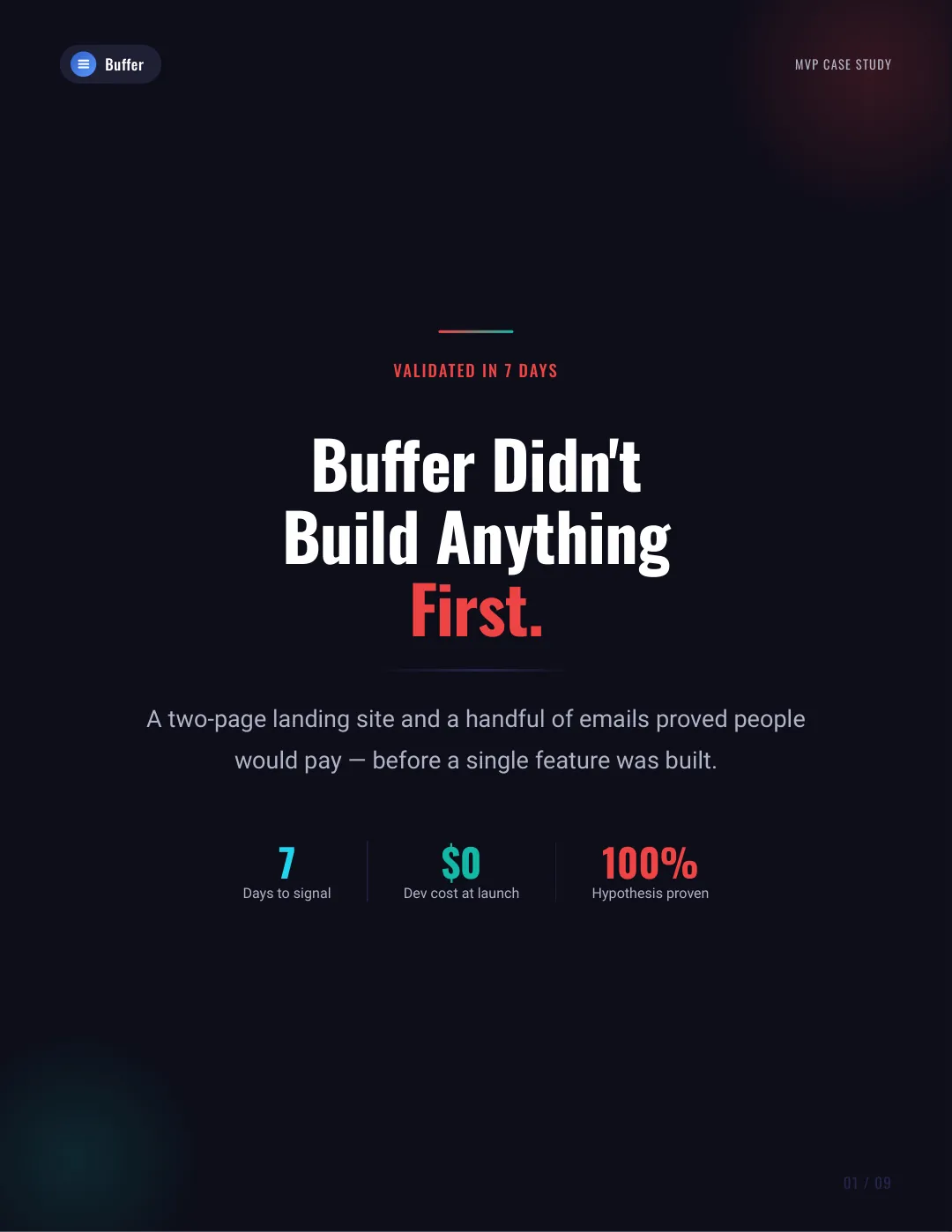
Slide 1
Buffer
MVP CASE STUDY
01 / 09
VALIDATED IN 7 DAYS
Buffer Didn't
Build Anything
First.
A two-page landing site and a handful of emails proved people
would pay — before a single feature was built.
7
Days to signal
$0
Dev cost at launch
100%
Hypothesis proven
Slide 2
Buffer
THE PROBLEM
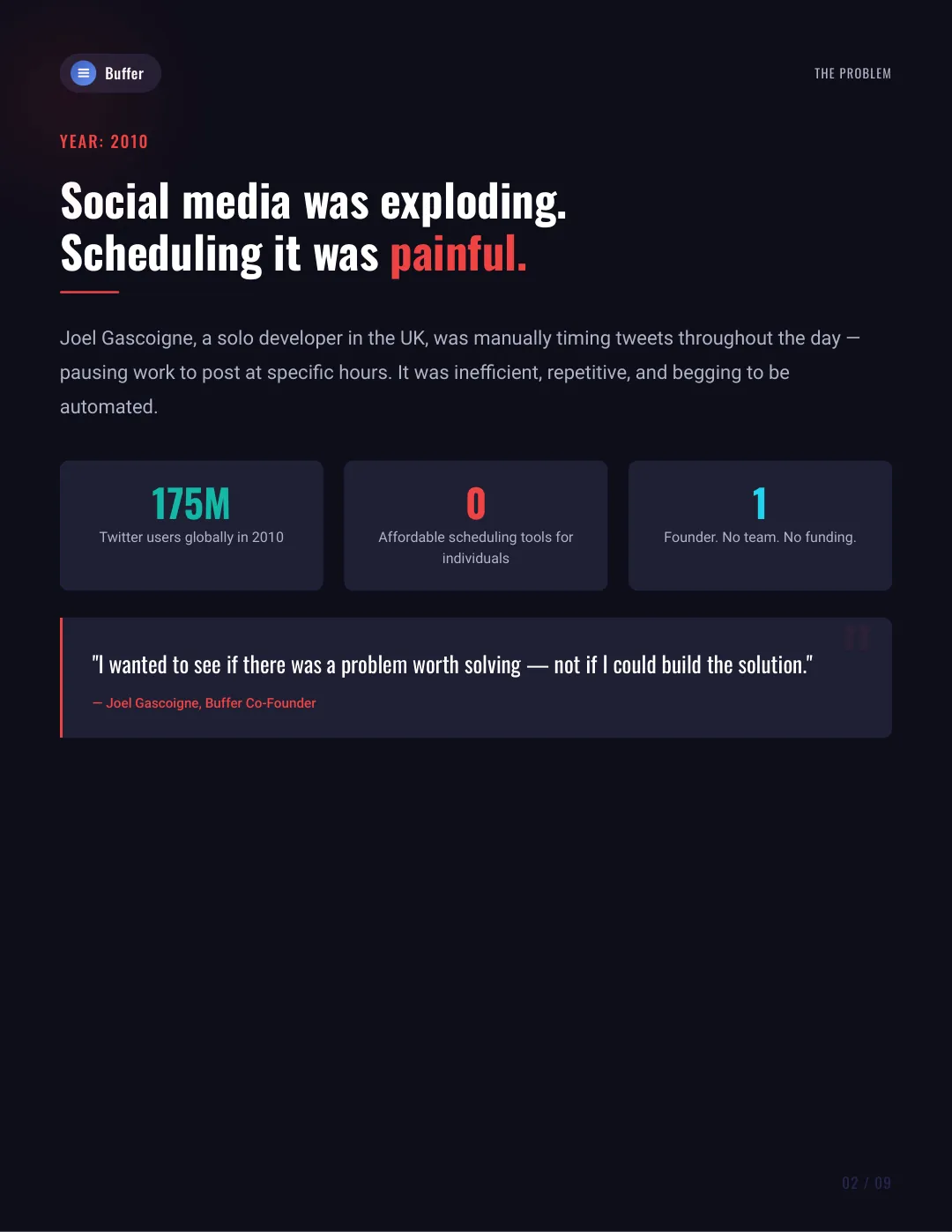
YEAR: 2010
Social media was exploding.
Scheduling it was painful.
Joel Gascoigne, a solo developer in the UK, was manually timing tweets throughout the day —
pausing work to post at specific hours. It was inefficient, repetitive, and begging to be
automated.
175M
Twitter users globally in 2010
0
Affordable scheduling tools for
individuals
1
Founder. No team. No funding.
"I wanted to see if there was a problem worth solving — not if I could build the solution."
— Joel Gascoigne, Buffer Co-Founder
"
02 / 09
Slide 3
Buffer
THE MVP
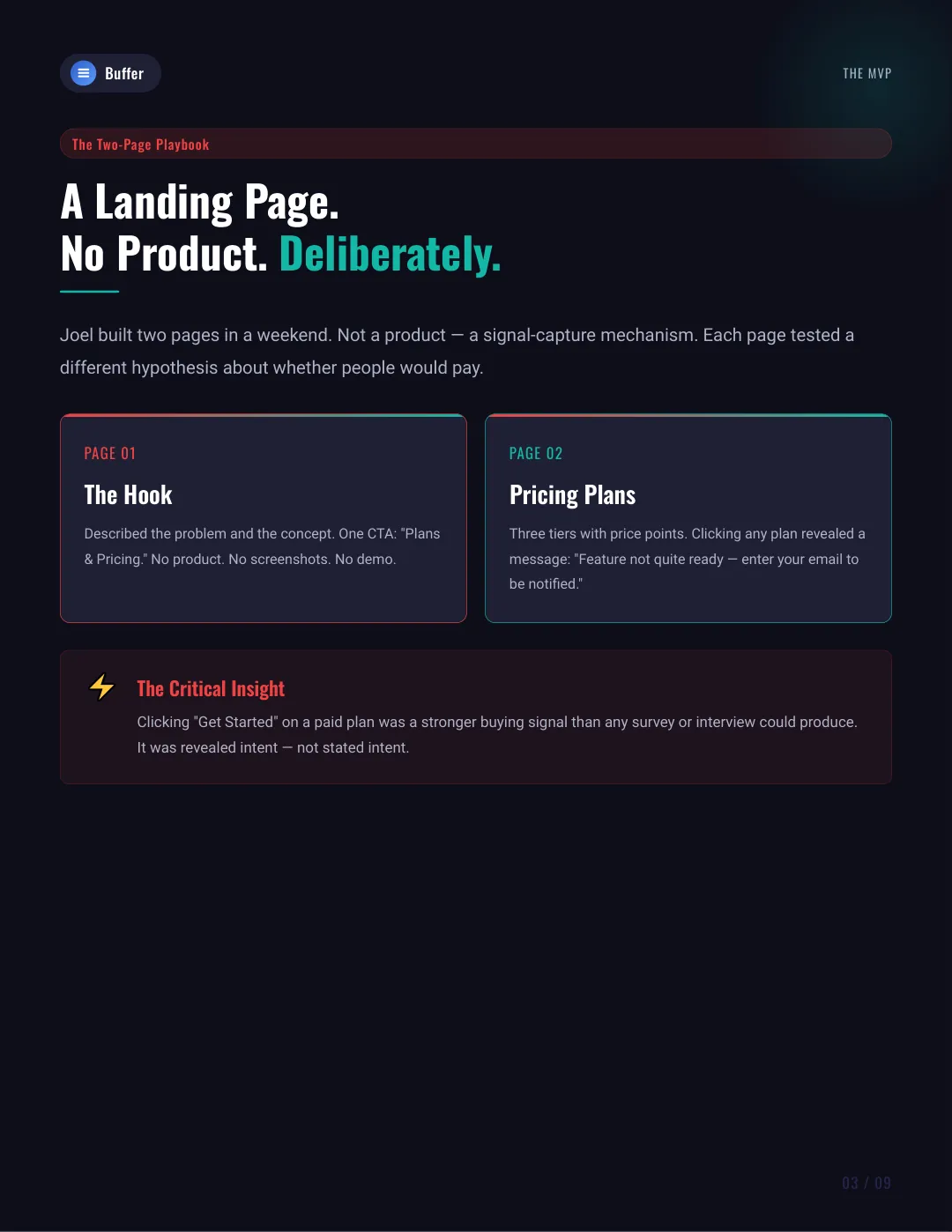
The Two-Page Playbook
A Landing Page.
No Product. Deliberately.
Joel built two pages in a weekend. Not a product — a signal-capture mechanism. Each page tested a
different hypothesis about whether people would pay.
⚡
The Critical Insight
Clicking "Get Started" on a paid plan was a stronger buying signal than any survey or interview could produce.
It was revealed intent — not stated intent.
PAGE 01
The Hook
Described the problem and the concept. One CTA: "Plans
& Pricing." No product. No screenshots. No demo.
PAGE 02
Pricing Plans
Three tiers with price points. Clicking any plan revealed a
message: "Feature not quite ready — enter your email to
be notified."
03 / 09
Slide 4
Buffer
MANUAL WORK
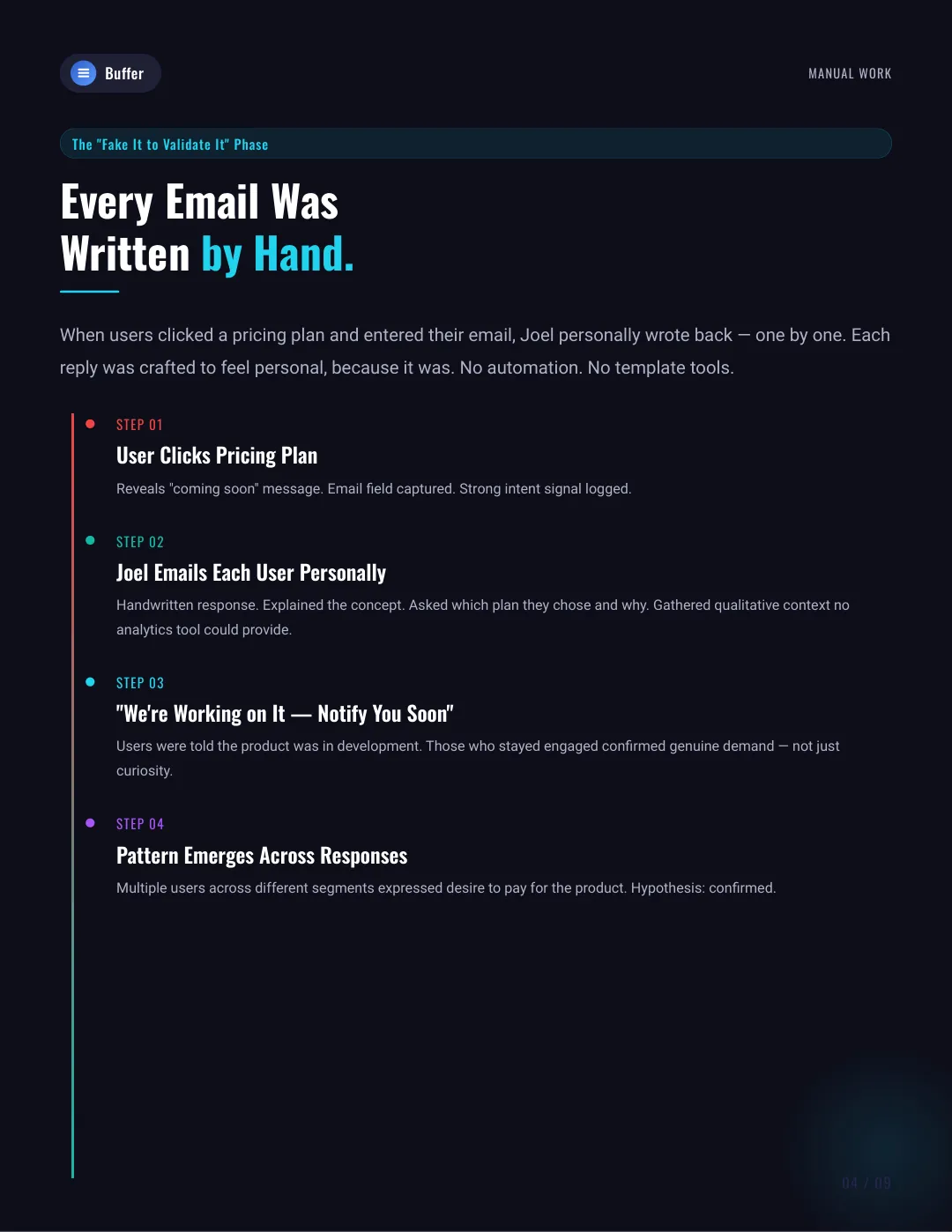
The "Fake It to Validate It" Phase
Every Email Was
Written by Hand.
When users clicked a pricing plan and entered their email, Joel personally wrote back — one by one. Each
reply was crafted to feel personal, because it was. No automation. No template tools.
STEP 01
User Clicks Pricing Plan
Reveals "coming soon" message. Email field captured. Strong intent signal logged.
STEP 02
Joel Emails Each User Personally
Handwritten response. Explained the concept. Asked which plan they chose and why. Gathered qualitative context no
analytics tool could provide.
STEP 03
"We're Working on It — Notify You Soon"
Users were told the product was in development. Those who stayed engaged confirmed genuine demand — not just
curiosity.
STEP 04
Pattern Emerges Across Responses
Multiple users across different segments expressed desire to pay for the product. Hypothesis: confirmed.
04 / 09
Slide 5
Buffer
WHAT HAPPENED
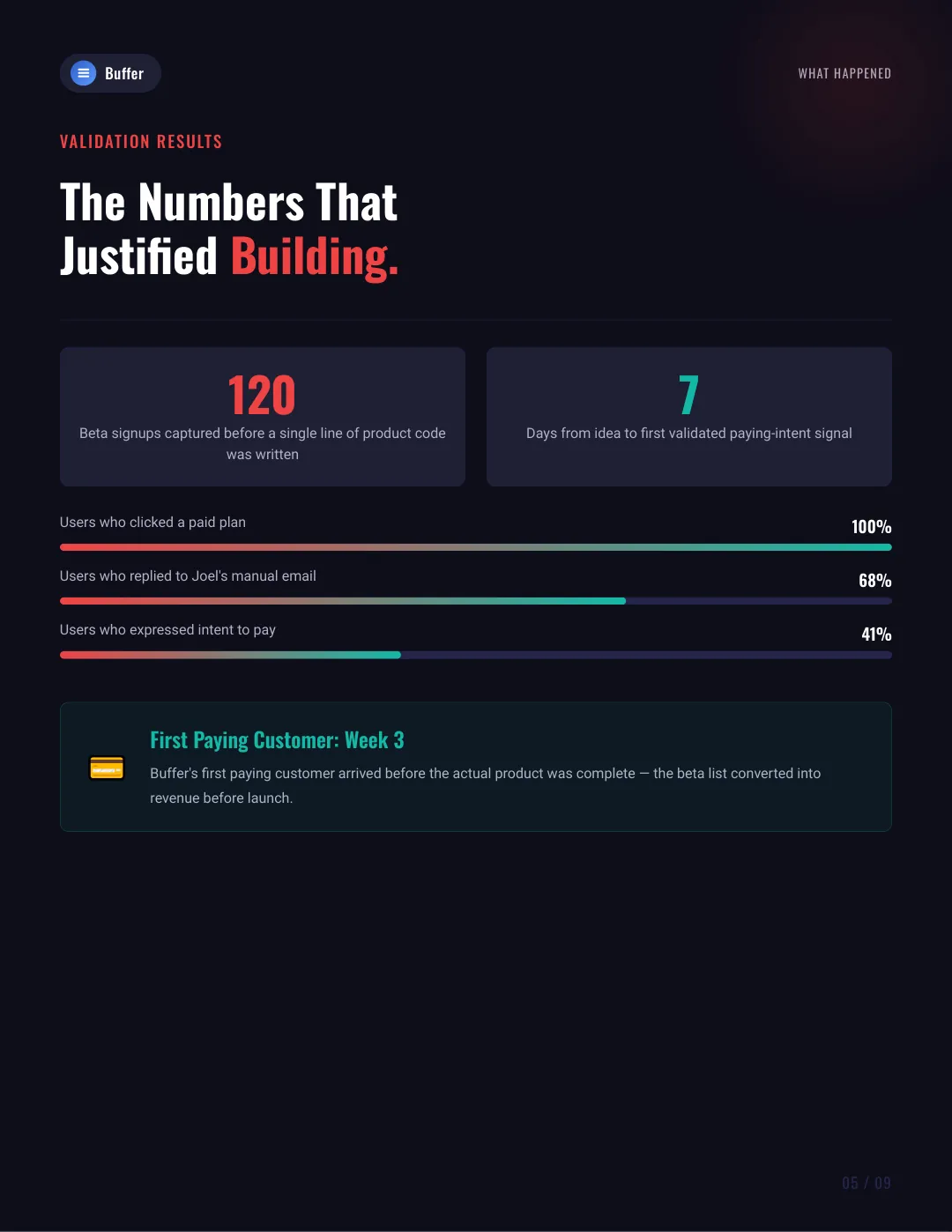
VALIDATION RESULTS
The Numbers That
Justified Building.
120
Beta signups captured before a single line of product code
was written
7
Days from idea to first validated paying-intent signal
Users who clicked a paid plan
100%
Users who replied to Joel's manual email
68%
Users who expressed intent to pay
41%
💳
First Paying Customer: Week 3
Buffer's first paying customer arrived before the actual product was complete — the beta list converted into
revenue before launch.
05 / 09
Slide 6
Buffer
HYPOTHESIS TESTING
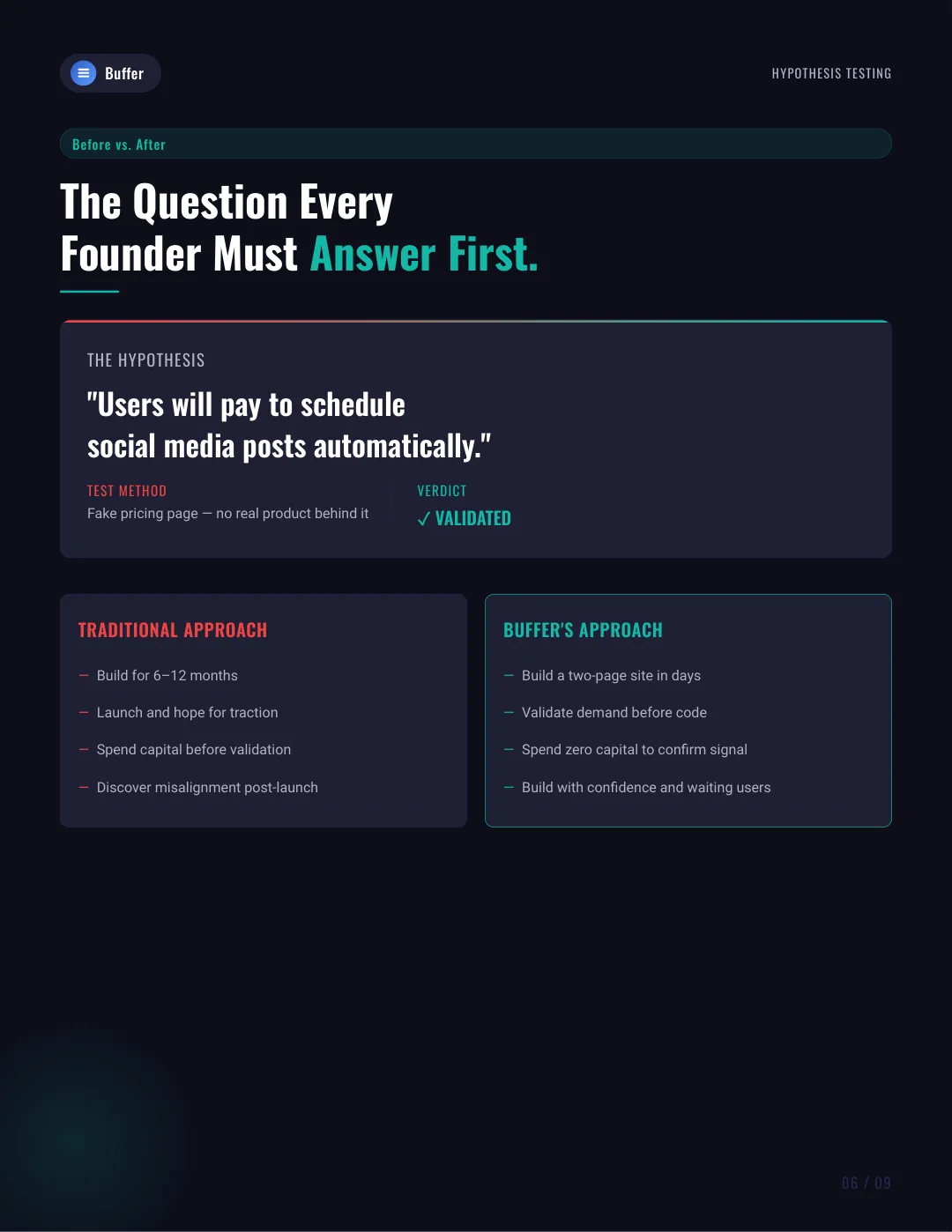
Before vs. After
The Question Every
Founder Must Answer First.
TRADITIONAL APPROACH
— Build for 6–12 months
— Launch and hope for traction
— Spend capital before validation
— Discover misalignment post-launch
BUFFER'S APPROACH
— Build a two-page site in days
— Validate demand before code
— Spend zero capital to confirm signal
— Build with confidence and waiting users
THE HYPOTHESIS
"Users will pay to schedule
social media posts automatically."
TEST METHOD
Fake pricing page — no real product behind it
VERDICT
✓ VALIDATED
06 / 09
Slide 7
Buffer
CORE LEARNING
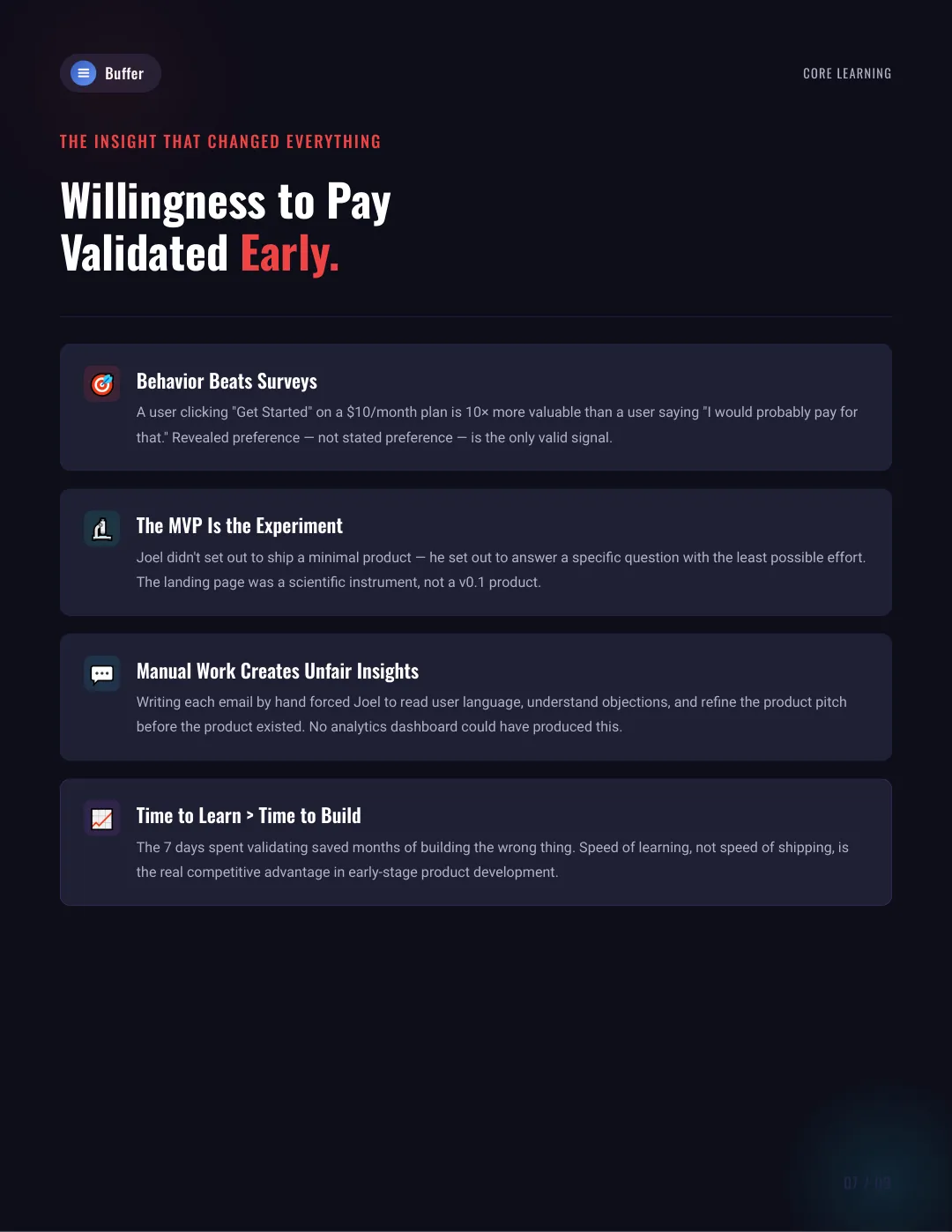
THE INSIGHT THAT CHANGED EVERYTHING
Willingness to Pay
Validated Early.
🎯
Behavior Beats Surveys
A user clicking "Get Started" on a $10/month plan is 10× more valuable than a user saying "I would probably pay for
that." Revealed preference — not stated preference — is the only valid signal.
🔬
The MVP Is the Experiment
Joel didn't set out to ship a minimal product — he set out to answer a specific question with the least possible effort.
The landing page was a scientific instrument, not a v0.1 product.
💬
Manual Work Creates Unfair Insights
Writing each email by hand forced Joel to read user language, understand objections, and refine the product pitch
before the product existed. No analytics dashboard could have produced this.
📈
Time to Learn > Time to Build
The 7 days spent validating saved months of building the wrong thing. Speed of learning, not speed of shipping, is
the real competitive advantage in early-stage product development.
07 / 09
Slide 8
Buffer
THE OUTCOME
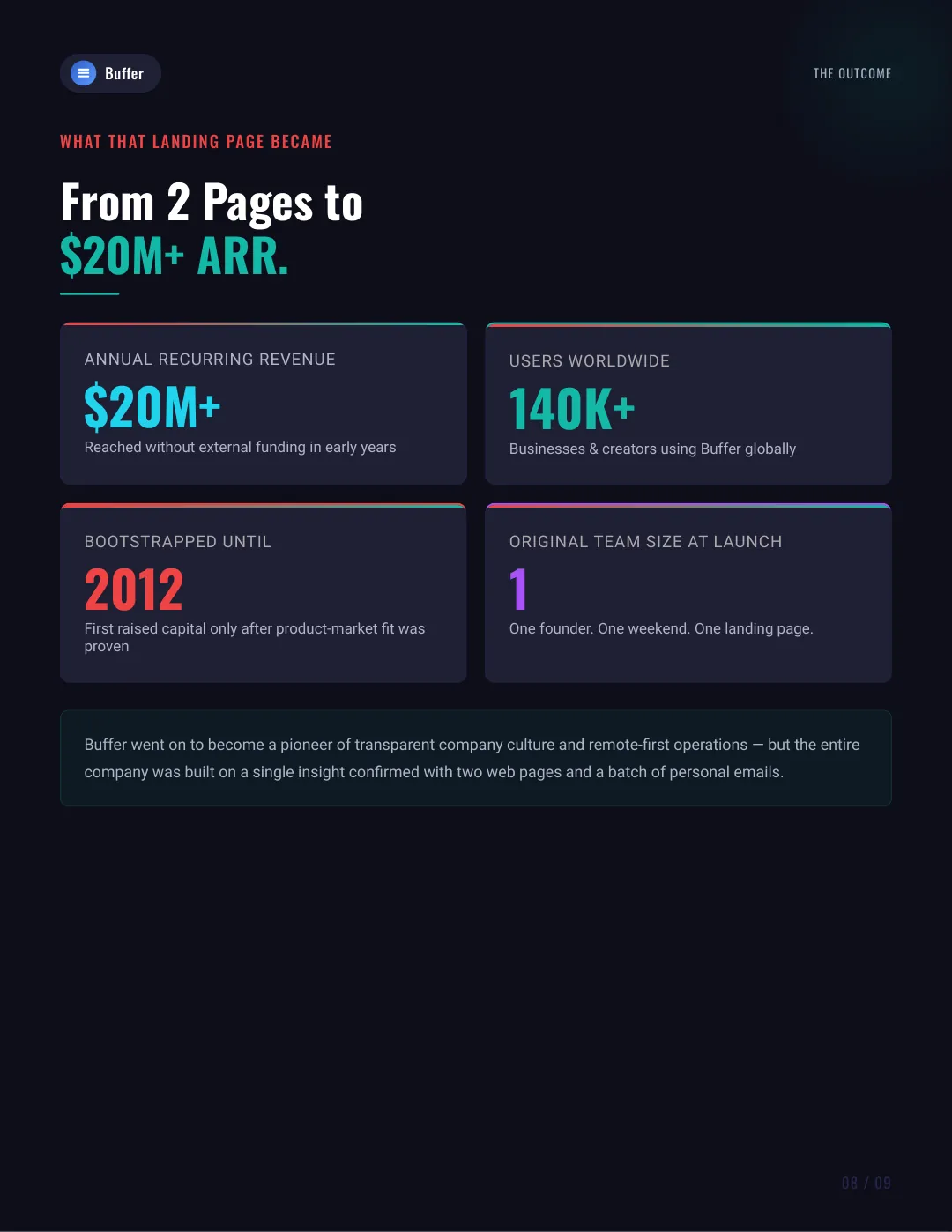
WHAT THAT LANDING PAGE BECAME
From 2 Pages to
$20M+ ARR.
Buffer went on to become a pioneer of transparent company culture and remote-first operations — but the entire
company was built on a single insight confirmed with two web pages and a batch of personal emails.
ANNUAL RECURRING REVENUE
$20M+
Reached without external funding in early years
USERS WORLDWIDE
140K+
Businesses & creators using Buffer globally
BOOTSTRAPPED UNTIL
2012
First raised capital only after product-market fit was
proven
ORIGINAL TEAM SIZE AT LAUNCH
1
One founder. One weekend. One landing page.
08 / 09
Slide 9
09 / 09
Stop Building.
Start Validating.
Buffer's $20M+ business started with two web pages, zero product, and one
founder willing to test before building.
💬
Drop your biggest MVP lesson
What's the smallest test that gave you the clearest signal? Share it in the comments.
🔁
Repost to your network
Every founder building before validating needs to see this story. Pass it on.
🔖
Save for your next build
Come back to this before you write your next line of product code.
CASE STUDY SERIES