Muhammad Ikram Let's talk

Run Post-Mortems on Failed Campaigns, Not on People

Google's SRE book sets one rule for post-mortems: find the contributing causes "without indicting any individual or team."

That rule changes what people tell you. When a review hunts for a culprit, the next mistake gets hidden instead of reported.

A blameless review needs four things:
1. A timeline of what happened.
2. Contributing factors, not culprits.
3. Action items, each with an owner and a date.
4. A write-up shared beyond the team.

Does your team share its post-mortems, or file them away?

First comment (optional): Google SRE book, Postmortem Culture: https://sre.google/sre-book/postmortem-culture/
01 / 01Incidents

After an outage, fix the system, not the person

Google's SRE book: find the contributing causes "without indicting any individual or team."

1

Write the timeline first

What happened, and when, before why
2

Contributing factors, not culprits

Ask what made the mistake easy to make
3

Every action item has an owner

A name and a date, or it will not happen

Then share it. A lesson kept in one team repeats.

More insights

Keep reading

All posts
Carousel

Startups & Product 1 min read

The Fastest Growth Test Is the Feature You Cut

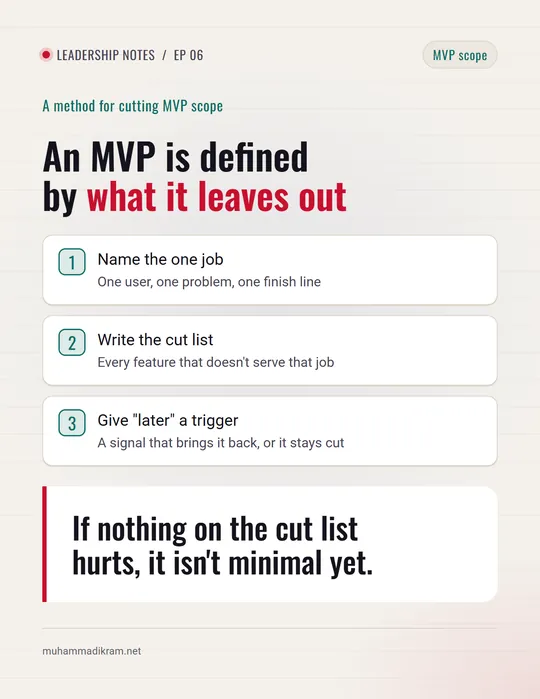
A common trap: the MVP ships with ten features, conversion moves, and nobody can say which one did it. Name the one job, write the cut list, give every "later" a trigger. A smaller launch gives a cleaner signal and a faster next test.

Carousel

Startups & Product 1 min read

Vague Requests Cost More Than Slow Launches

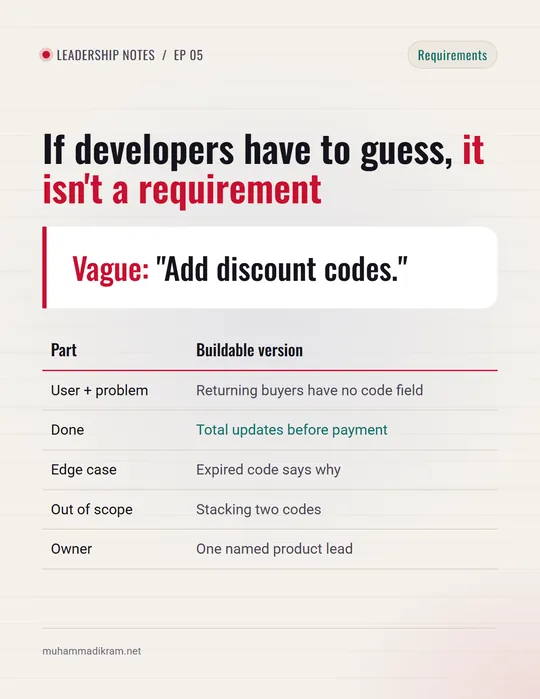
A common trap: a growth idea lands in the backlog as "add discount codes". No user, no definition of done, no edge cases, no owner. The team guesses, ships late, reworks. A spec with those five parts is the cheapest conversion tactic.