Test Demand Before You Build: MVP Lessons From Zappos, DoorDash, Booking.com and Thumbtack
Some of the biggest companies on the internet started with something you could build in an afternoon: a web page, a form, a phone number and founders willing to do the work by hand.
I have written short posts on several of these stories. This article puts them together, pulls out the pattern they share, and shows how to use it before you spend money on a new store, app or system.
1. Zappos: sell it before you stock it
Before Zappos had a warehouse, founder Nick Swinmurn wanted to know one thing: would people buy shoes online without trying them on? He photographed shoes in local stores and put them on a simple website. When an order came in, he bought the pair at full price and shipped it himself.
He lost money on those early orders, but he learned the answer cheaply. Amazon bought Zappos in 2009 for around $1.2 billion.
More in How a Fake Door Built a Billion-Dollar Brand.
2. DoorDash: the founders were the delivery drivers
DoorDash began in 2013 as Palo Alto Delivery, a basic website with restaurant menus as PDFs and a phone number, put together by Stanford students. There was no dispatch system and no algorithm. The founders took the orders and drove the food across town themselves.
Orders came in quickly, which answered the only question that mattered at that stage: do people want this? Every delivery was also a research session on what customers and restaurants actually needed.
More in DoorDash Didn't Start With an App.
3. Booking.com: one problem, solved simply
In 1996 Booking.com was Bookings.nl, a simple Dutch website listing a small number of hotels with photos, contact details and a way to request a reservation. No app, no loyalty programme, no clever pricing.
It grew by making one thing easy: finding and booking a hotel. The features came later, once demand was proven.
More in Booking.com Didn't Start as a Travel Giant.
4. Thumbtack: manual work showed what mattered
Thumbtack started by matching customers with local service professionals largely by hand. Doing it manually exposed the real problem: pros were flooded with requests that went nowhere. The lesson was that the quality of each lead mattered more than the number of leads.
That insight came from doing the work, not from a dashboard. It would have been easy to miss if the first version had been fully automated.
More in How a Messy Manual Process Taught Thumbtack What Drives Growth.
5. Housejoy: proof of demand is not proof of operations
Housejoy, a home services startup in India, tested its idea with a web form and just two services. Demand was real and it expanded to many cities quickly, then had to scale back when operations could not keep up.
The test proved people wanted the service. It did not prove the company could deliver it everywhere at once. Those are two different experiments.
More in Housejoy Validated a Market With a Web Form.
The pattern
- Test the riskiest question first. Usually that is "will anyone pay for this?", not "can we build it?".
- Do things by hand at the start. Manual work is slow, but it shows you what customers actually need before you automate the wrong thing.
- Keep the first version small on purpose. Every extra feature delays feedback and makes it harder to tell what worked.
- Treat growth as a separate test. Demand in one place does not mean you can serve ten places.
How to cut scope in practice
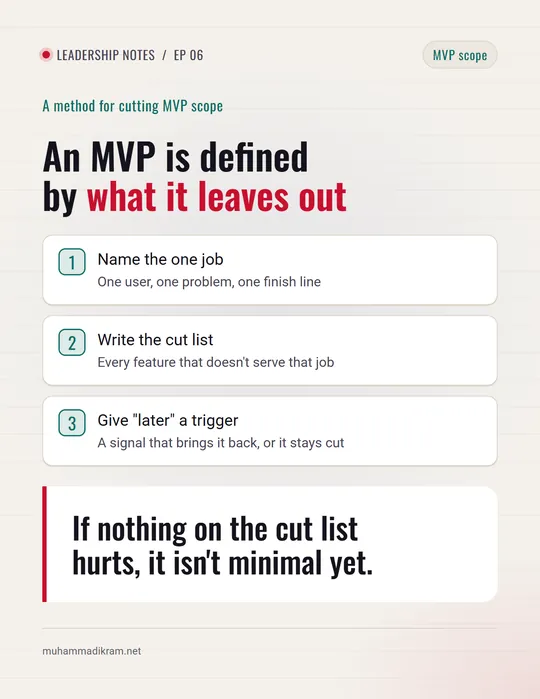
The hardest part of a minimum viable product is the "minimum". A simple method that works in scope meetings:
- Name the one job. One user, one problem, one finish line.
- Write the cut list. Every feature that job does not need goes on it, in writing.
- Give "later" a trigger. For example, "when 50 users ask" or "when we sign a second market". With no trigger, it stays cut.
More in The Fastest Growth Test Is the Feature You Cut.
What this means for your next project
Most of my clients do not need a billion-dollar idea tested. They need to know whether a new product line will sell, whether customers will use a booking feature, or whether a sales team will adopt a CRM. The same rule applies: launch the smallest version that answers the question, learn from real use, then build more.
A Shopify store with a few products, or a CRM with only the core modules, can often go live in weeks instead of months. If you want to test an idea that way, see my development services or tell me what you want to test.