Every operating system war looked like a fight for raw power
It rarely was.
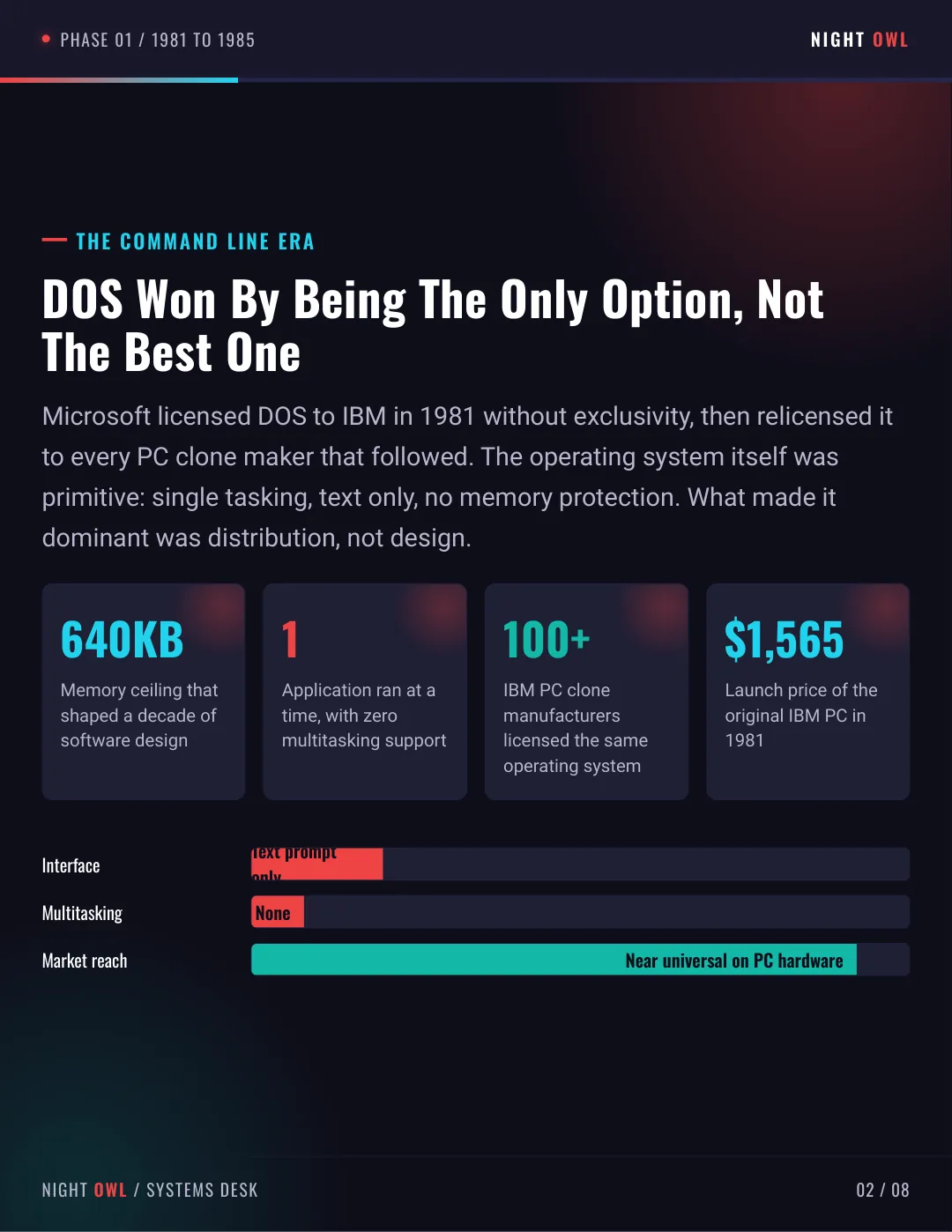
DOS won through distribution, not design.
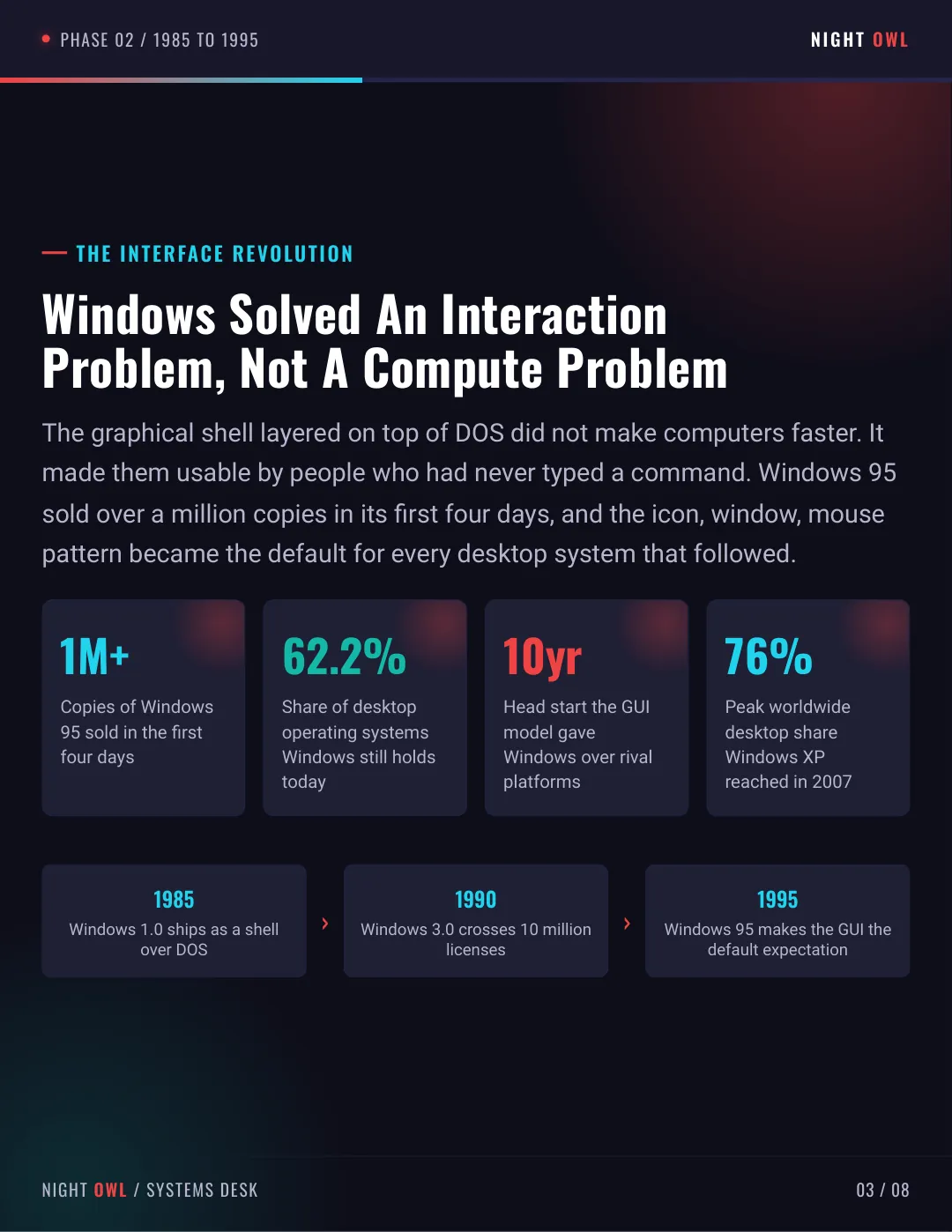
Windows overtook it by fixing the interface, not the hardware.
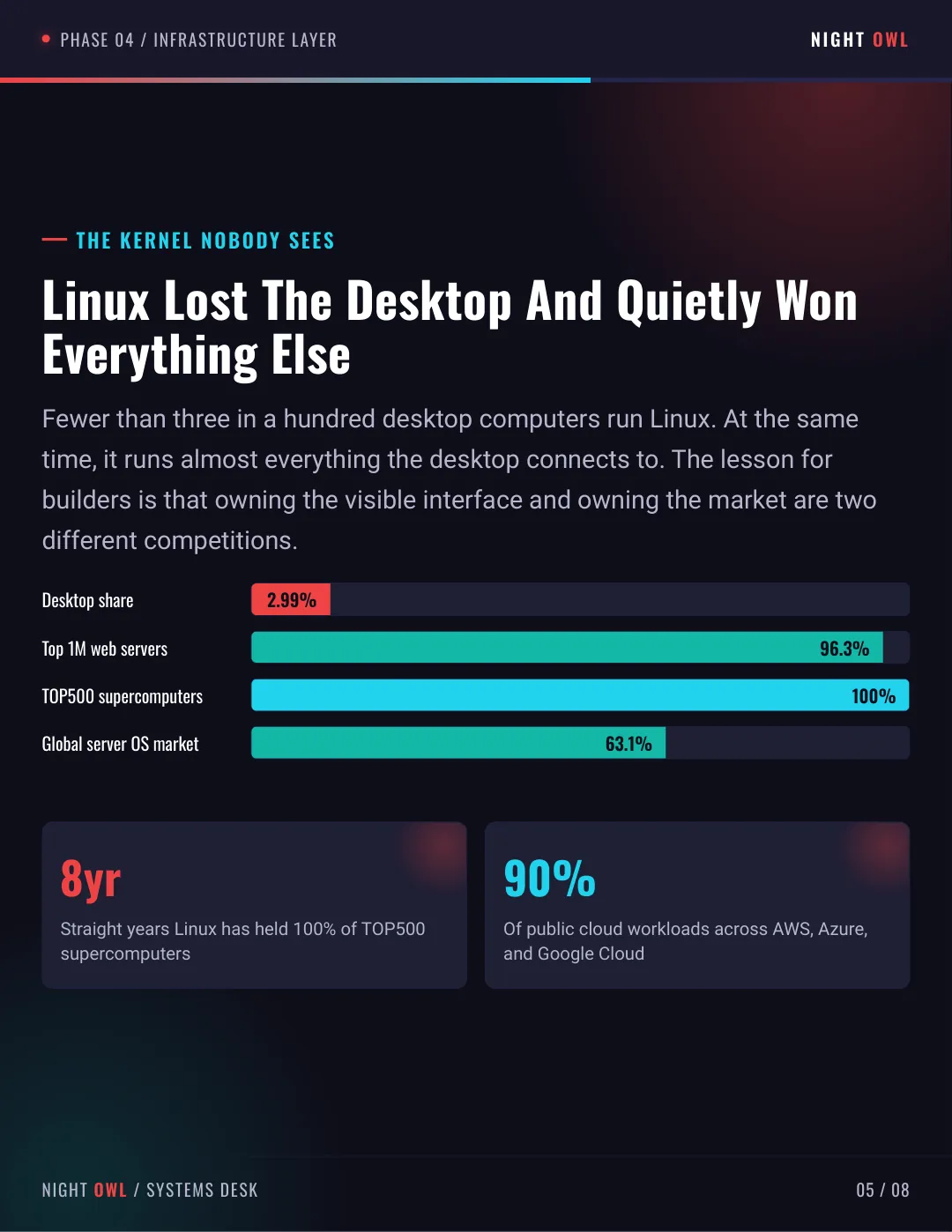
Linux lost the desktop entirely, yet now runs 96 percent of the world's top web servers and every supercomputer on the TOP500 list.
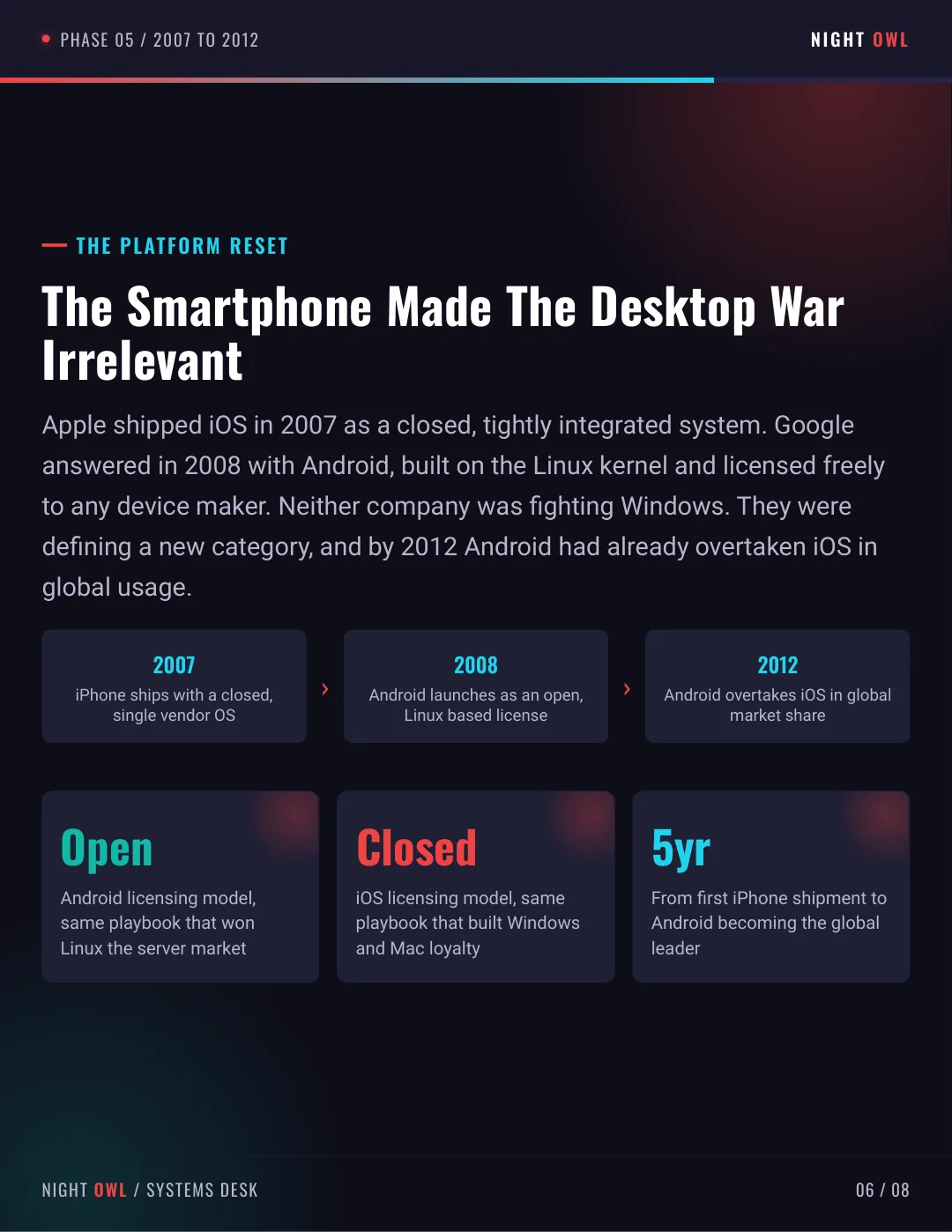
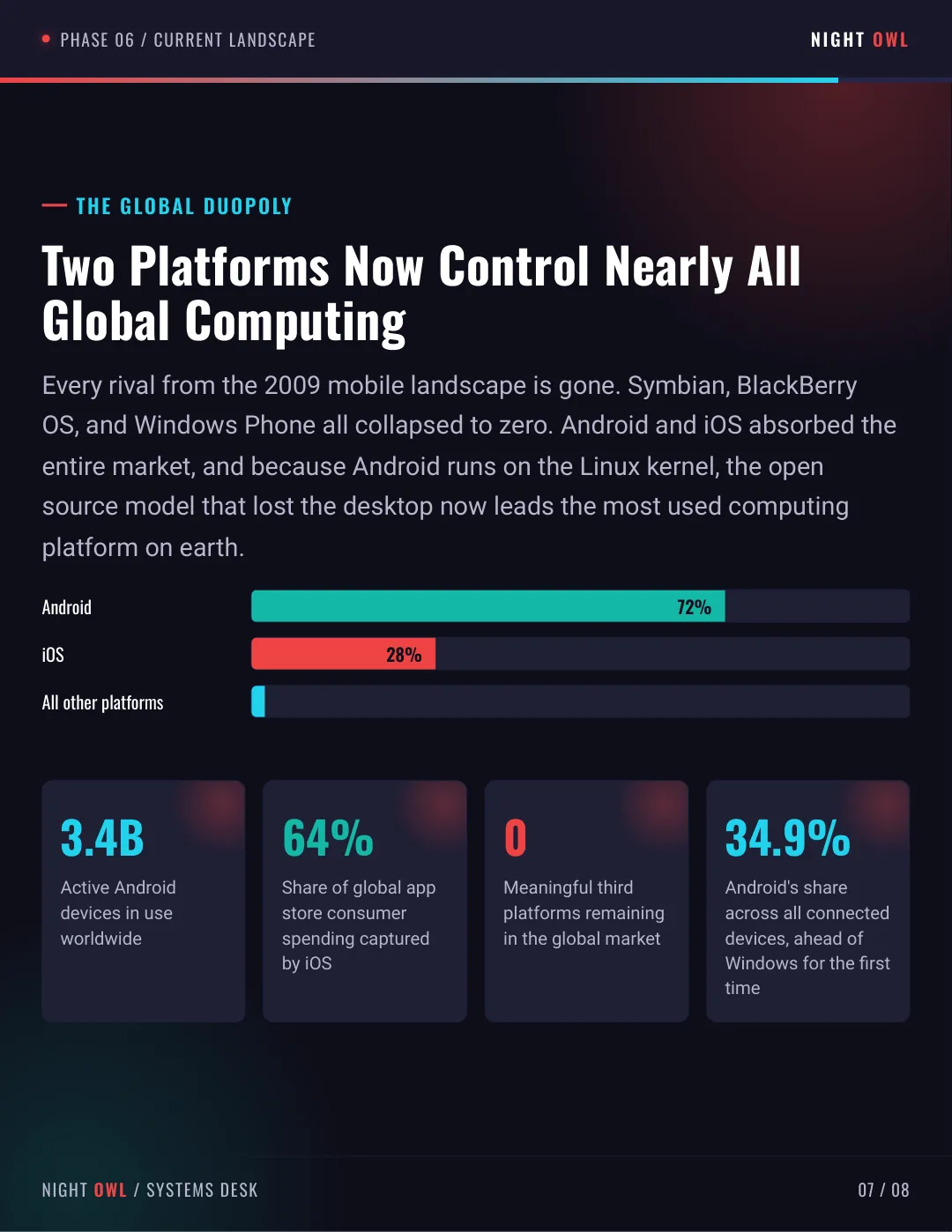
Android carried that same open model into mobile and now covers 70 percent of global devices.
Across four decades, the platform that removes friction wins, even when it is not the most advanced system in the room.
Read the slides as text
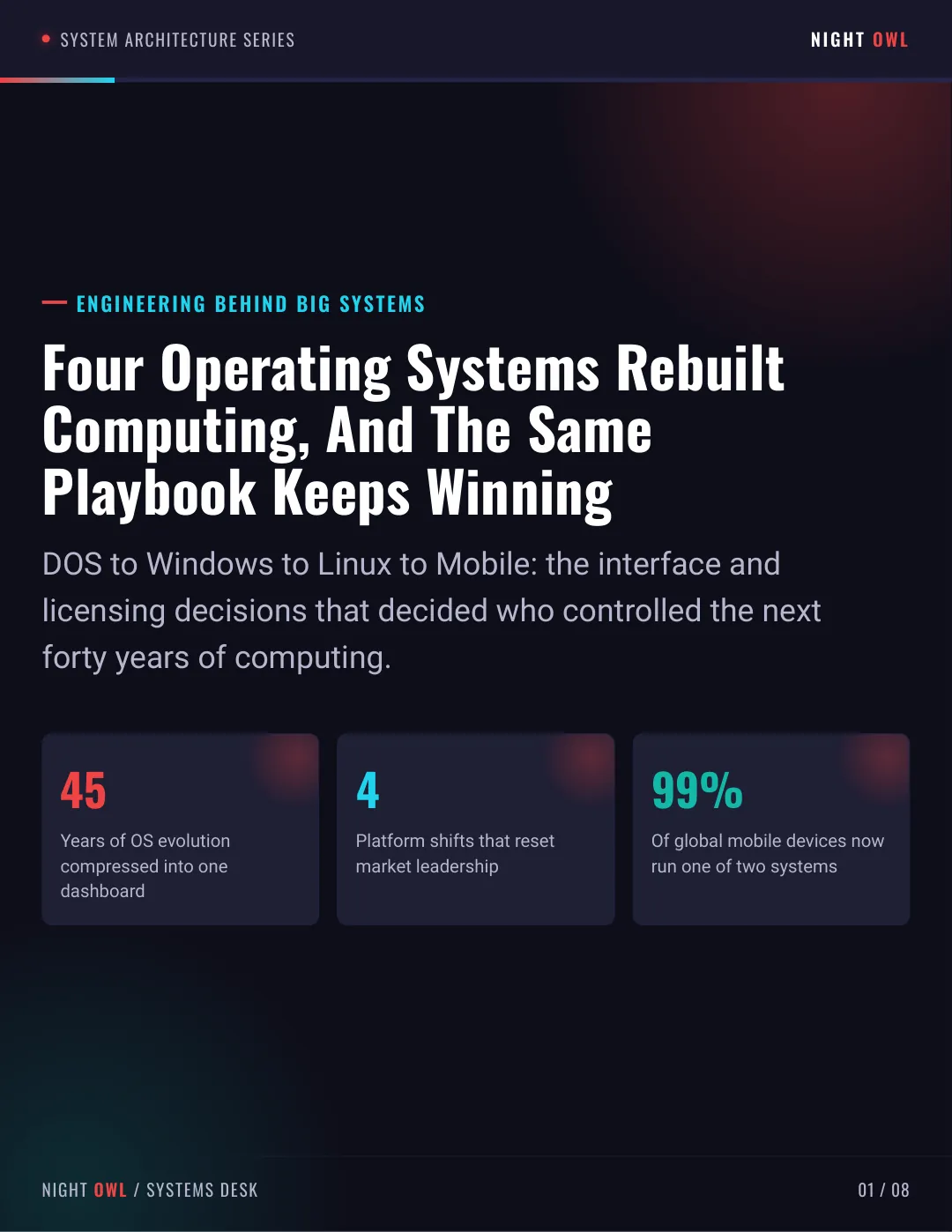
Slide 1
SYSTEM ARCHITECTURE SERIES
NIGHT OWL
ENGINEERING BEHIND BIG SYSTEMS
Four Operating Systems Rebuilt
Computing, And The Same
Playbook Keeps Winning
DOS to Windows to Linux to Mobile: the interface and
licensing decisions that decided who controlled the next
forty years of computing.
45
Years of OS evolution
compressed into one
dashboard
4
Platform shifts that reset
market leadership
99%
Of global mobile devices now
run one of two systems
NIGHT OWL / SYSTEMS DESK
01 / 08
Slide 2
PHASE 01 / 1981 TO 1985
NIGHT OWL
THE COMMAND LINE ERA
DOS Won By Being The Only Option, Not
The Best One
Microsoft licensed DOS to IBM in 1981 without exclusivity, then relicensed it
to every PC clone maker that followed. The operating system itself was
primitive: single tasking, text only, no memory protection. What made it
dominant was distribution, not design.
Interface
Multitasking
Market reach
Text prompt
only
None
Near universal on PC hardware
640KB
Memory ceiling that
shaped a decade of
software design
1
Application ran at a
time, with zero
multitasking support
100+
IBM PC clone
manufacturers
licensed the same
operating system
$1,565
Launch price of the
original IBM PC in
1981
NIGHT OWL / SYSTEMS DESK
02 / 08
Slide 3
PHASE 02 / 1985 TO 1995
NIGHT OWL
THE INTERFACE REVOLUTION
Windows Solved An Interaction
Problem, Not A Compute Problem
The graphical shell layered on top of DOS did not make computers faster. It
made them usable by people who had never typed a command. Windows 95
sold over a million copies in its first four days, and the icon, window, mouse
pattern became the default for every desktop system that followed.
›
›
1985
Windows 1.0 ships as a shell
over DOS
1990
Windows 3.0 crosses 10 million
licenses
1995
Windows 95 makes the GUI the
default expectation
1M+
Copies of Windows
95 sold in the first
four days
62.2%
Share of desktop
operating systems
Windows still holds
today
10yr
Head start the GUI
model gave
Windows over rival
platforms
76%
Peak worldwide
desktop share
Windows XP
reached in 2007
NIGHT OWL / SYSTEMS DESK
03 / 08
Slide 4
PHASE 03 / 1991
NIGHT OWL
THE OPEN SOURCE FORK
A 21 Year Old Student Split The Industry
With A Licensing Model
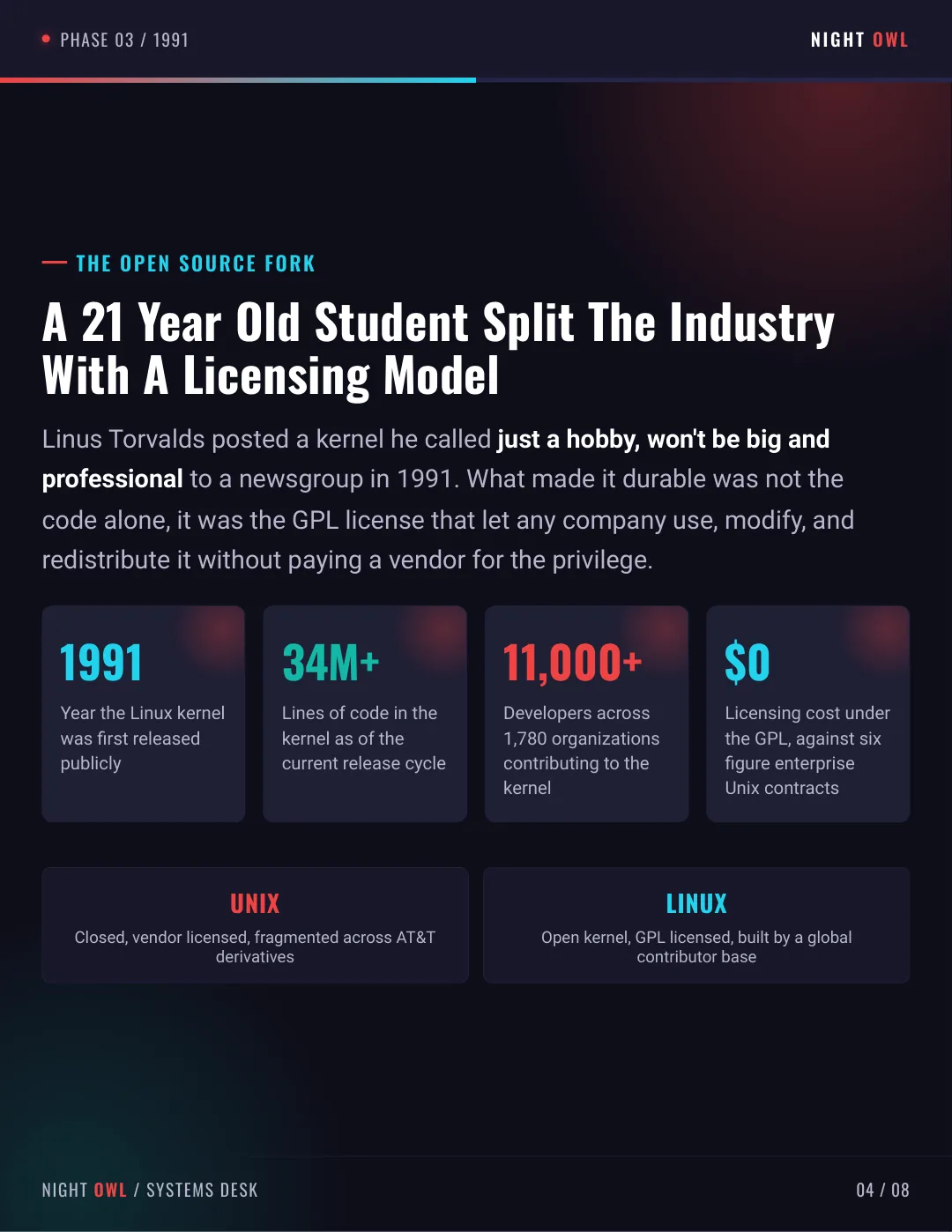
Linus Torvalds posted a kernel he called just a hobby, won't be big and
professional to a newsgroup in 1991. What made it durable was not the
code alone, it was the GPL license that let any company use, modify, and
redistribute it without paying a vendor for the privilege.
UNIX
Closed, vendor licensed, fragmented across AT&T
derivatives
LINUX
Open kernel, GPL licensed, built by a global
contributor base
1991
Year the Linux kernel
was first released
publicly
34M+
Lines of code in the
kernel as of the
current release cycle
11,000+
Developers across
1,780 organizations
contributing to the
kernel
$0
Licensing cost under
the GPL, against six
figure enterprise
Unix contracts
NIGHT OWL / SYSTEMS DESK
04 / 08
Slide 5
PHASE 04 / INFRASTRUCTURE LAYER
NIGHT OWL
THE KERNEL NOBODY SEES
Linux Lost The Desktop And Quietly Won
Everything Else
Fewer than three in a hundred desktop computers run Linux. At the same
time, it runs almost everything the desktop connects to. The lesson for
builders is that owning the visible interface and owning the market are two
different competitions.
Desktop share
Top 1M web servers
TOP500 supercomputers
Global server OS market
2.99%
96.3%
100%
63.1%
8yr
Straight years Linux has held 100% of TOP500
supercomputers
90%
Of public cloud workloads across AWS, Azure,
and Google Cloud
NIGHT OWL / SYSTEMS DESK
05 / 08
Slide 6
PHASE 05 / 2007 TO 2012
NIGHT OWL
THE PLATFORM RESET
The Smartphone Made The Desktop War
Irrelevant
Apple shipped iOS in 2007 as a closed, tightly integrated system. Google
answered in 2008 with Android, built on the Linux kernel and licensed freely
to any device maker. Neither company was fighting Windows. They were
defining a new category, and by 2012 Android had already overtaken iOS in
global usage.
›
›
2007
iPhone ships with a closed,
single vendor OS
2008
Android launches as an open,
Linux based license
2012
Android overtakes iOS in global
market share
Open
Android licensing model,
same playbook that won
Linux the server market
Closed
iOS licensing model, same
playbook that built Windows
and Mac loyalty
5yr
From first iPhone shipment to
Android becoming the global
leader
NIGHT OWL / SYSTEMS DESK
06 / 08
Slide 7
PHASE 06 / CURRENT LANDSCAPE
NIGHT OWL
THE GLOBAL DUOPOLY
Two Platforms Now Control Nearly All
Global Computing
Every rival from the 2009 mobile landscape is gone. Symbian, BlackBerry
OS, and Windows Phone all collapsed to zero. Android and iOS absorbed the
entire market, and because Android runs on the Linux kernel, the open
source model that lost the desktop now leads the most used computing
platform on earth.
Android
iOS
All other platforms
72%
28%
3.4B
Active Android
devices in use
worldwide
64%
Share of global app
store consumer
spending captured
by iOS
0
Meaningful third
platforms remaining
in the global market
34.9%
Android's share
across all connected
devices, ahead of
Windows for the first
time
NIGHT OWL / SYSTEMS DESK
07 / 08
Slide 8
THE PATTERN
NIGHT OWL
WHAT REPEATS ACROSS EVERY CYCLE
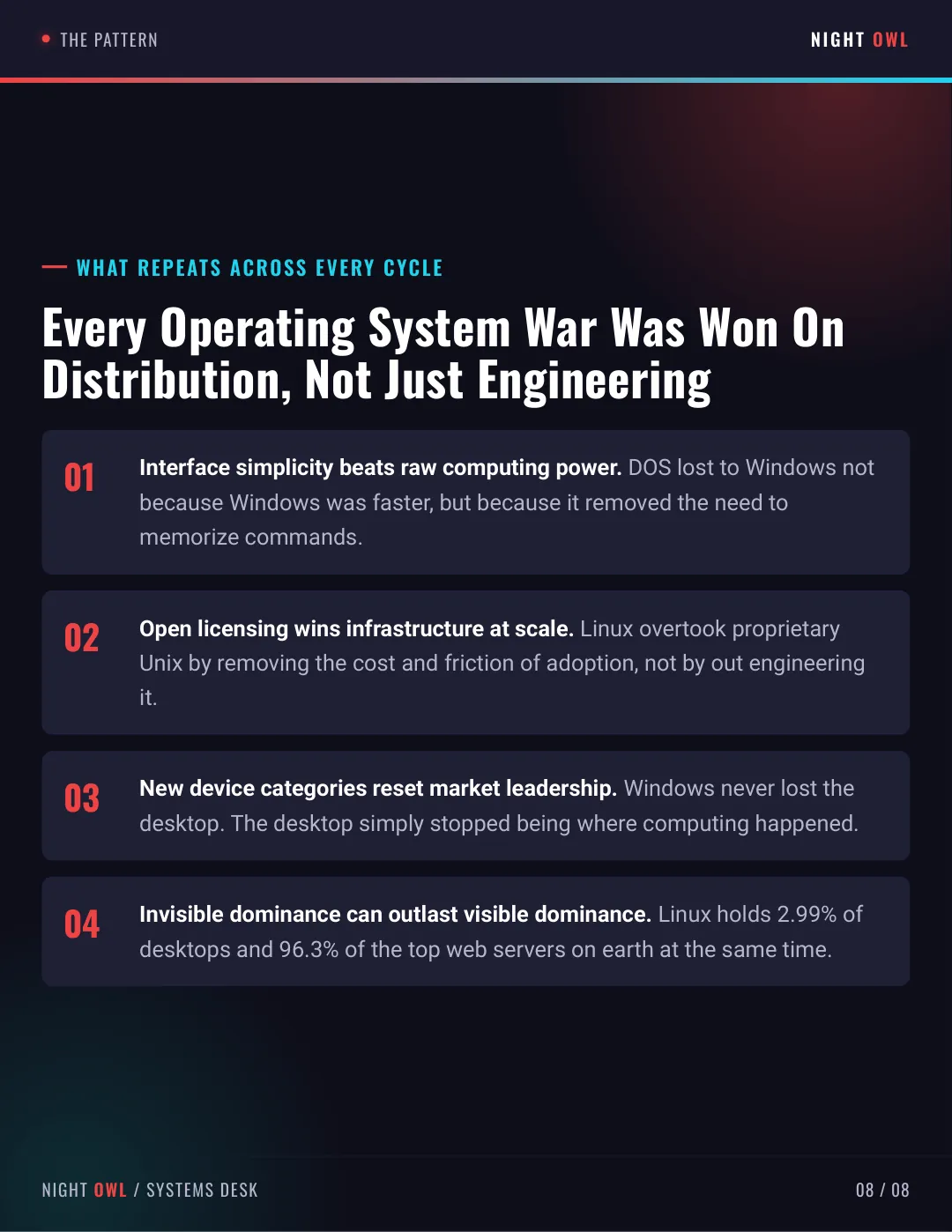
Every Operating System War Was Won On
Distribution, Not Just Engineering
01
Interface simplicity beats raw computing power. DOS lost to Windows not
because Windows was faster, but because it removed the need to
memorize commands.
02
Open licensing wins infrastructure at scale. Linux overtook proprietary
Unix by removing the cost and friction of adoption, not by out engineering
it.
03
New device categories reset market leadership. Windows never lost the
desktop. The desktop simply stopped being where computing happened.
04
Invisible dominance can outlast visible dominance. Linux holds 2.99% of
desktops and 96.3% of the top web servers on earth at the same time.
NIGHT OWL / SYSTEMS DESK
08 / 08