From 80KB Floppy Disks To 215 Petabytes Per Gram Of DNA
Storage has been rebuilt six times in fifty five years, and each rebuild solved one bottleneck instead of adding space. Floppy disks solved portability. Hard drives solved scale. Optical discs made storage mainstream. Flash removed moving parts. Cloud turned storage into an on demand utility. Now DNA storage research targets density itself, packing 215 petabytes into a single gram. Growth came from removing a limitation, not from scaling the same design.
Read the slides as text
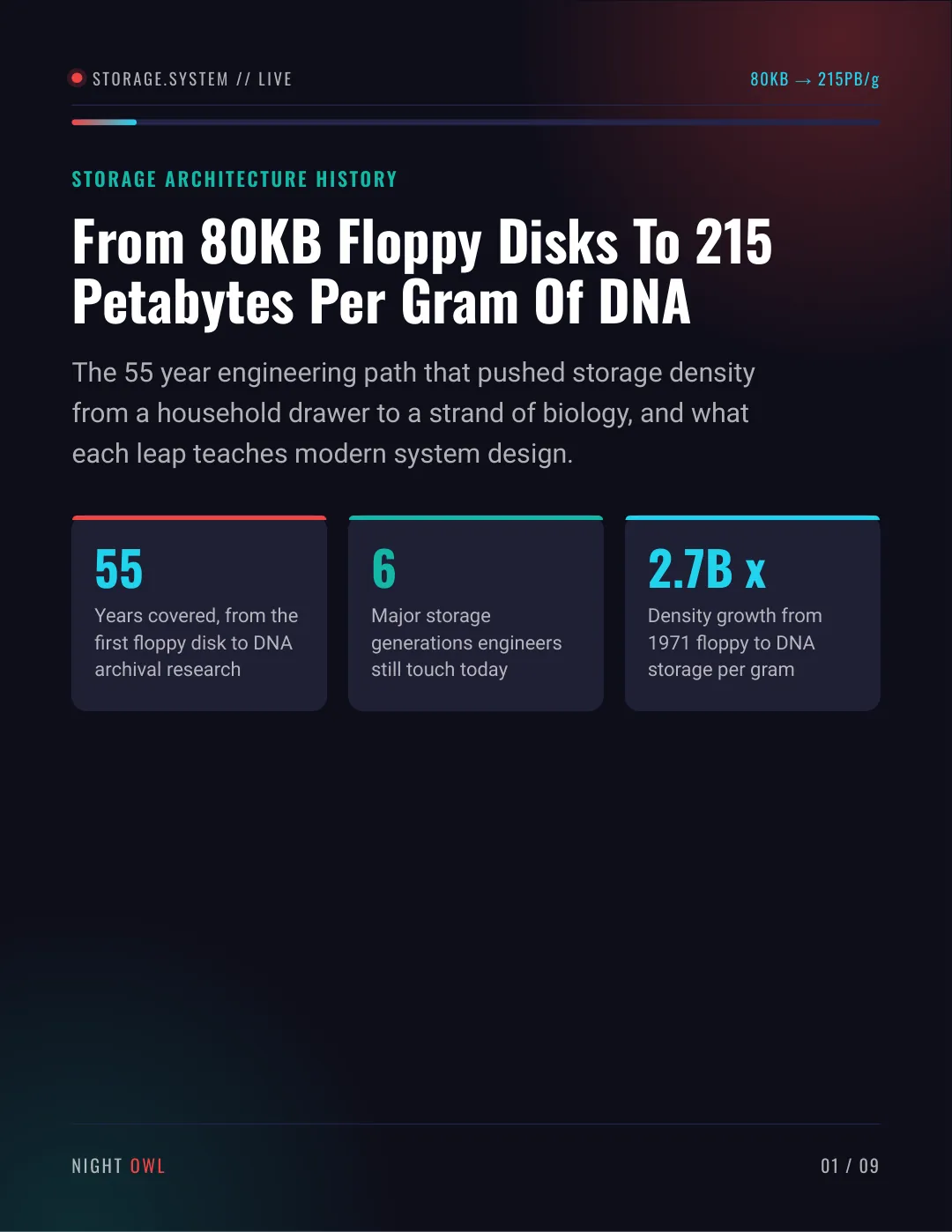
Slide 1
STORAGE.SYSTEM // LIVE
80KB → 215PB/g
STORAGE ARCHITECTURE HISTORY
From 80KB Floppy Disks To 215
Petabytes Per Gram Of DNA
The 55 year engineering path that pushed storage density
from a household drawer to a strand of biology, and what
each leap teaches modern system design.
55
Years covered, from the
first floppy disk to DNA
archival research
6
Major storage
generations engineers
still touch today
2.7B x
Density growth from
1971 floppy to DNA
storage per gram
NIGHT OWL
01 / 09
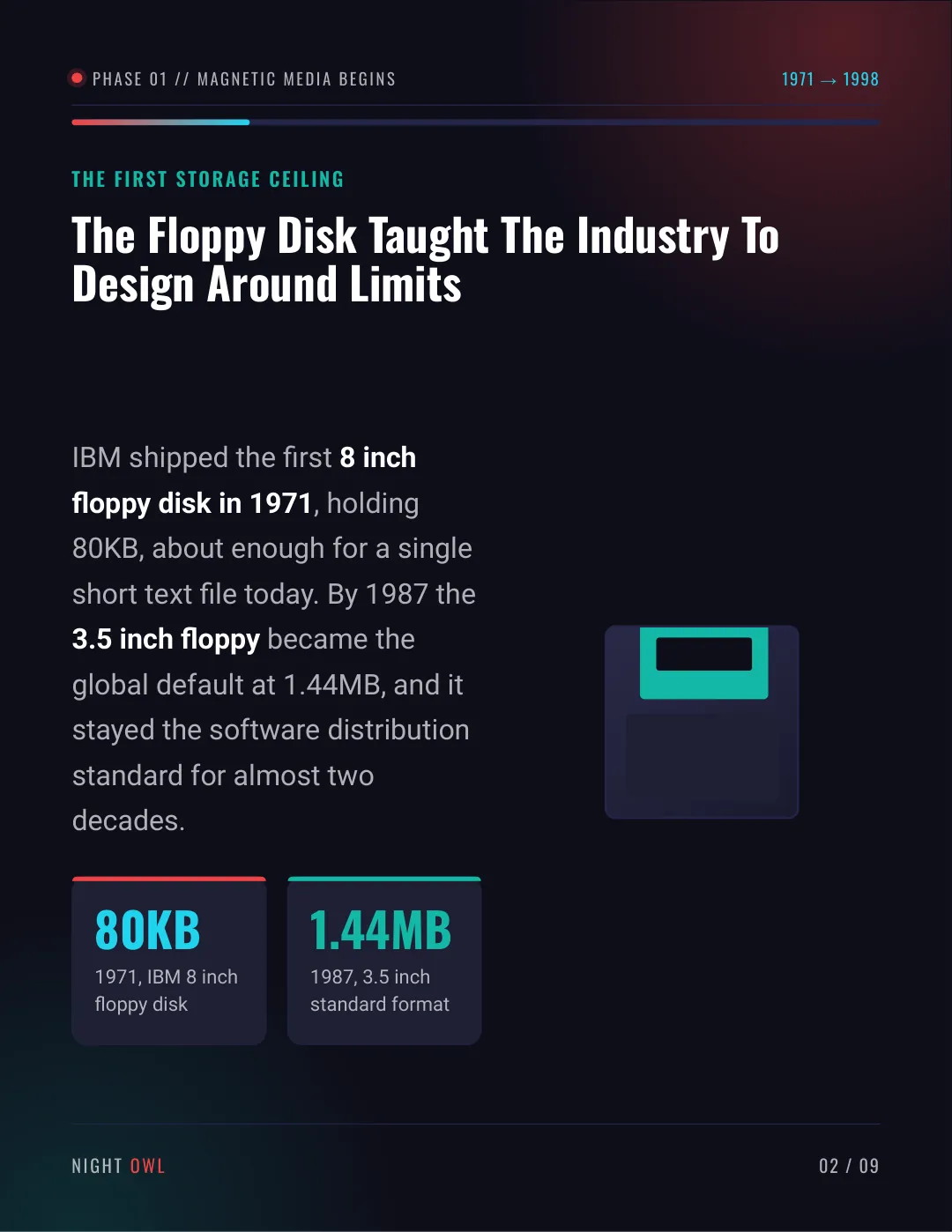
Slide 2
PHASE 01 // MAGNETIC MEDIA BEGINS
1971 → 1998
THE FIRST STORAGE CEILING
The Floppy Disk Taught The Industry To
Design Around Limits
IBM shipped the first 8 inch
floppy disk in 1971, holding
80KB, about enough for a single
short text file today. By 1987 the
3.5 inch floppy became the
global default at 1.44MB, and it
stayed the software distribution
standard for almost two
decades.
80KB
1971, IBM 8 inch
floppy disk
1.44MB
1987, 3.5 inch
standard format
NIGHT OWL
02 / 09
Slide 3
PHASE 02 // SPINNING PLATTERS SCALE UP
1956 → 2026
STORAGE BECOMES INFRASTRUCTURE
Hard Drives Turned A Lab Prototype Into
Data Center Backbone
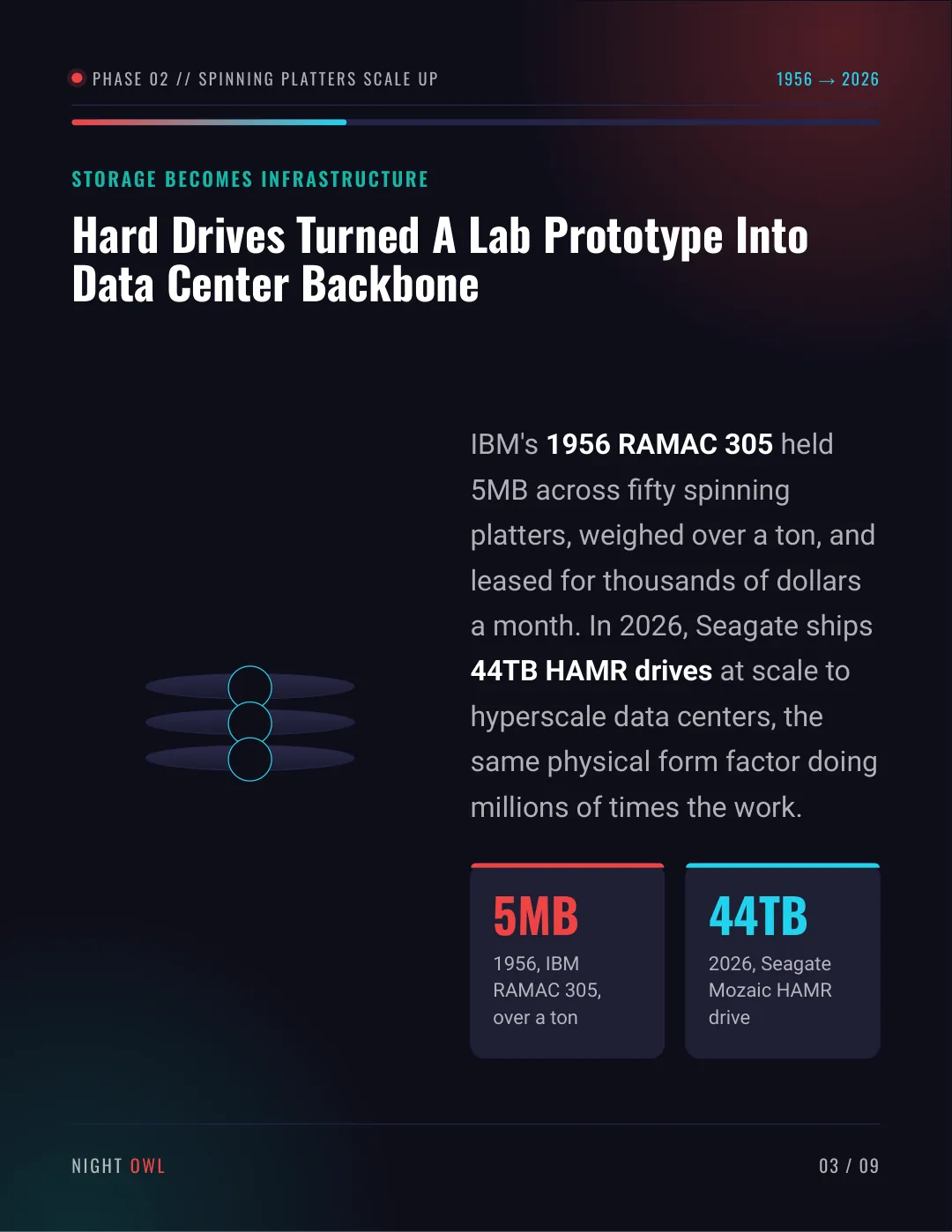
IBM's 1956 RAMAC 305 held
5MB across fifty spinning
platters, weighed over a ton, and
leased for thousands of dollars
a month. In 2026, Seagate ships
44TB HAMR drives at scale to
hyperscale data centers, the
same physical form factor doing
millions of times the work.
5MB
1956, IBM
RAMAC 305,
over a ton
44TB
2026, Seagate
Mozaic HAMR
drive
NIGHT OWL
03 / 09
Slide 4
PHASE 03 // LIGHT REPLACES MAGNETISM
1982 → 2006
OPTICAL STORAGE ERA
CDs And DVDs Made Storage A Consumer
Product
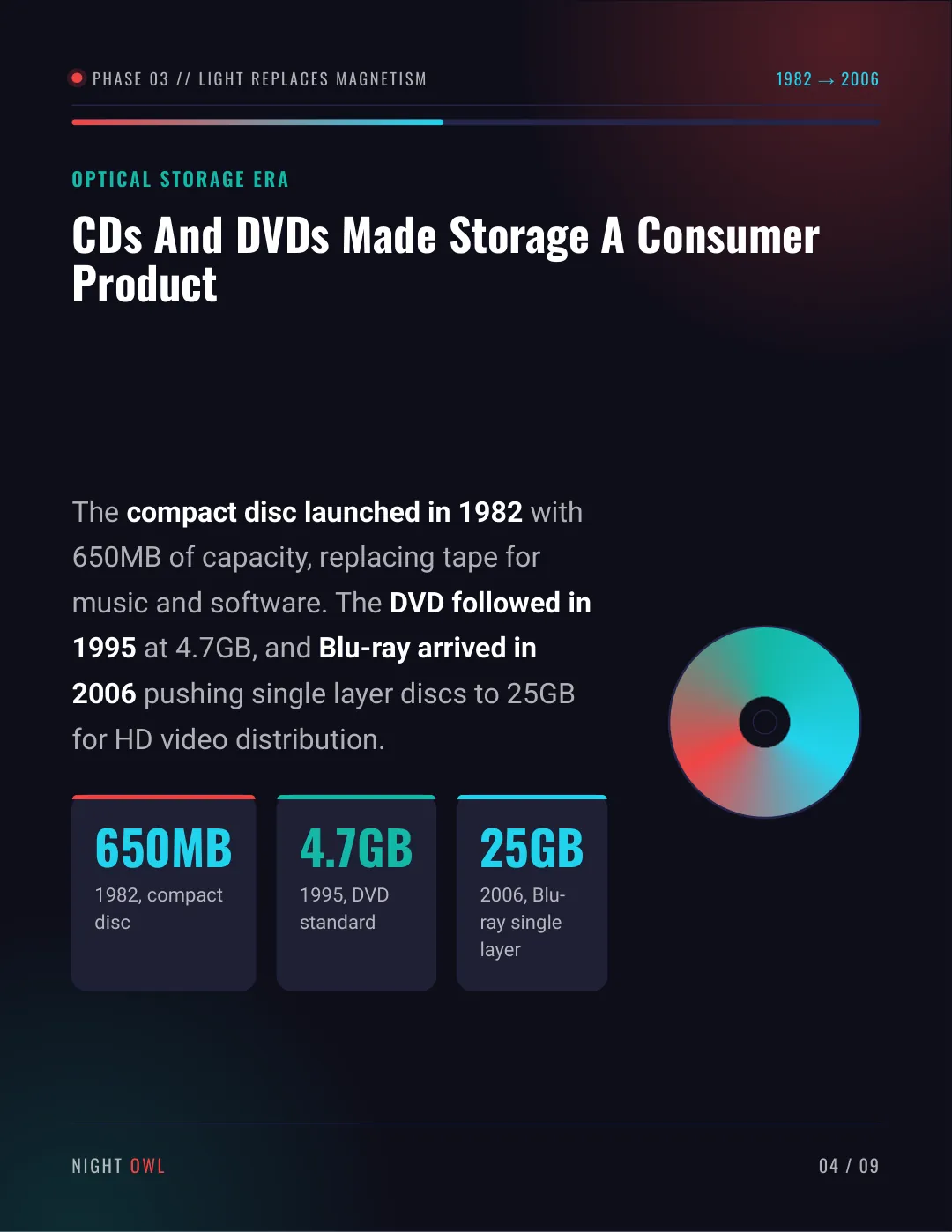
The compact disc launched in 1982 with
650MB of capacity, replacing tape for
music and software. The DVD followed in
1995 at 4.7GB, and Blu-ray arrived in
2006 pushing single layer discs to 25GB
for HD video distribution.
650MB
1982, compact
disc
4.7GB
1995, DVD
standard
25GB
2006, Blu-
ray single
layer
NIGHT OWL
04 / 09
Slide 5
PHASE 04 // SOLID STATE TAKES OVER
1991 → 2026
NO MOVING PARTS, NO LIMITS
Flash Memory Removed The Mechanical
Bottleneck Entirely
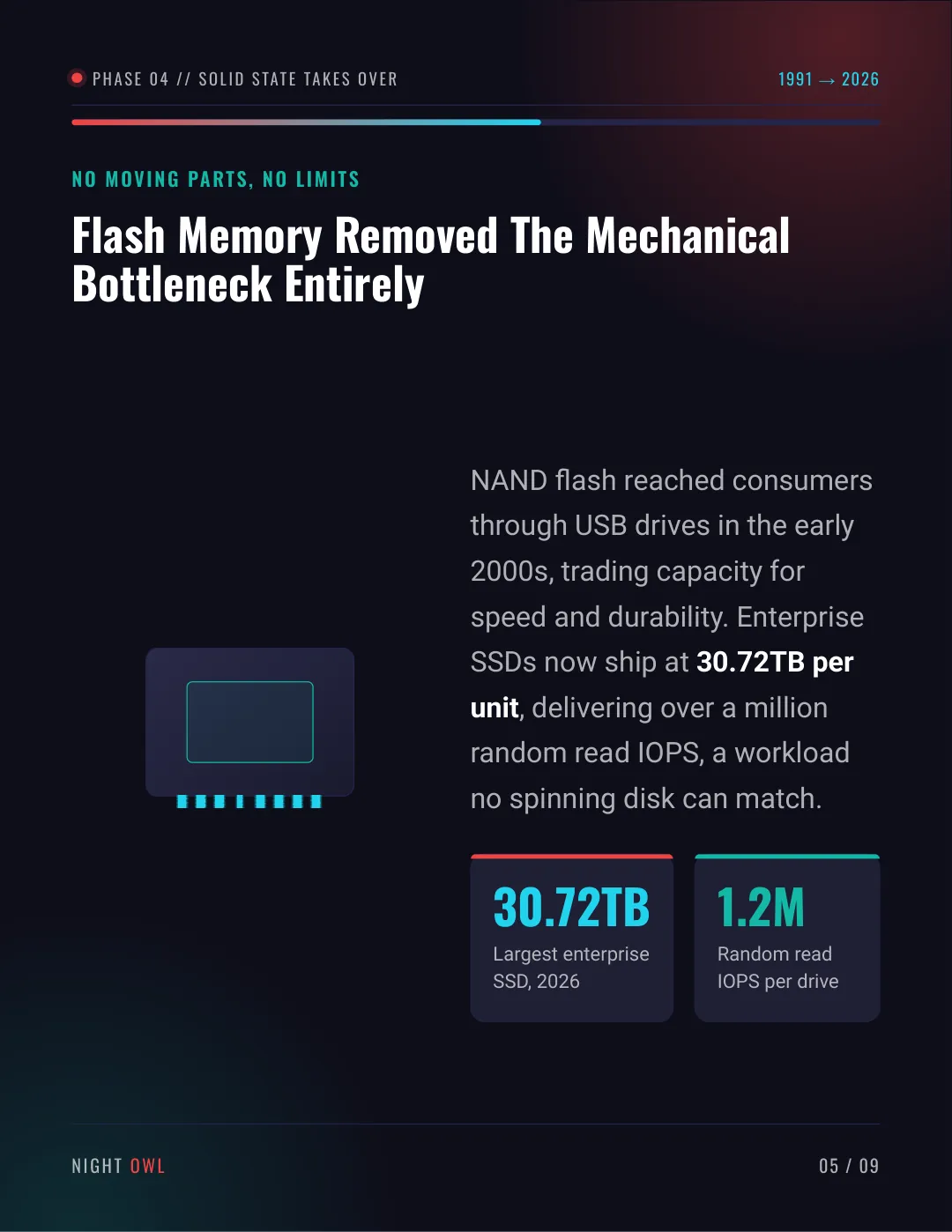
NAND flash reached consumers
through USB drives in the early
2000s, trading capacity for
speed and durability. Enterprise
SSDs now ship at 30.72TB per
unit, delivering over a million
random read IOPS, a workload
no spinning disk can match.
30.72TB
Largest enterprise
SSD, 2026
1.2M
Random read
IOPS per drive
NIGHT OWL
05 / 09
Slide 6
PHASE 05 // STORAGE BECOMES A UTILITY
2006 → Now
CLOUD STORAGE REVOLUTION
Storage Stopped Being A Device And
Became An API Call
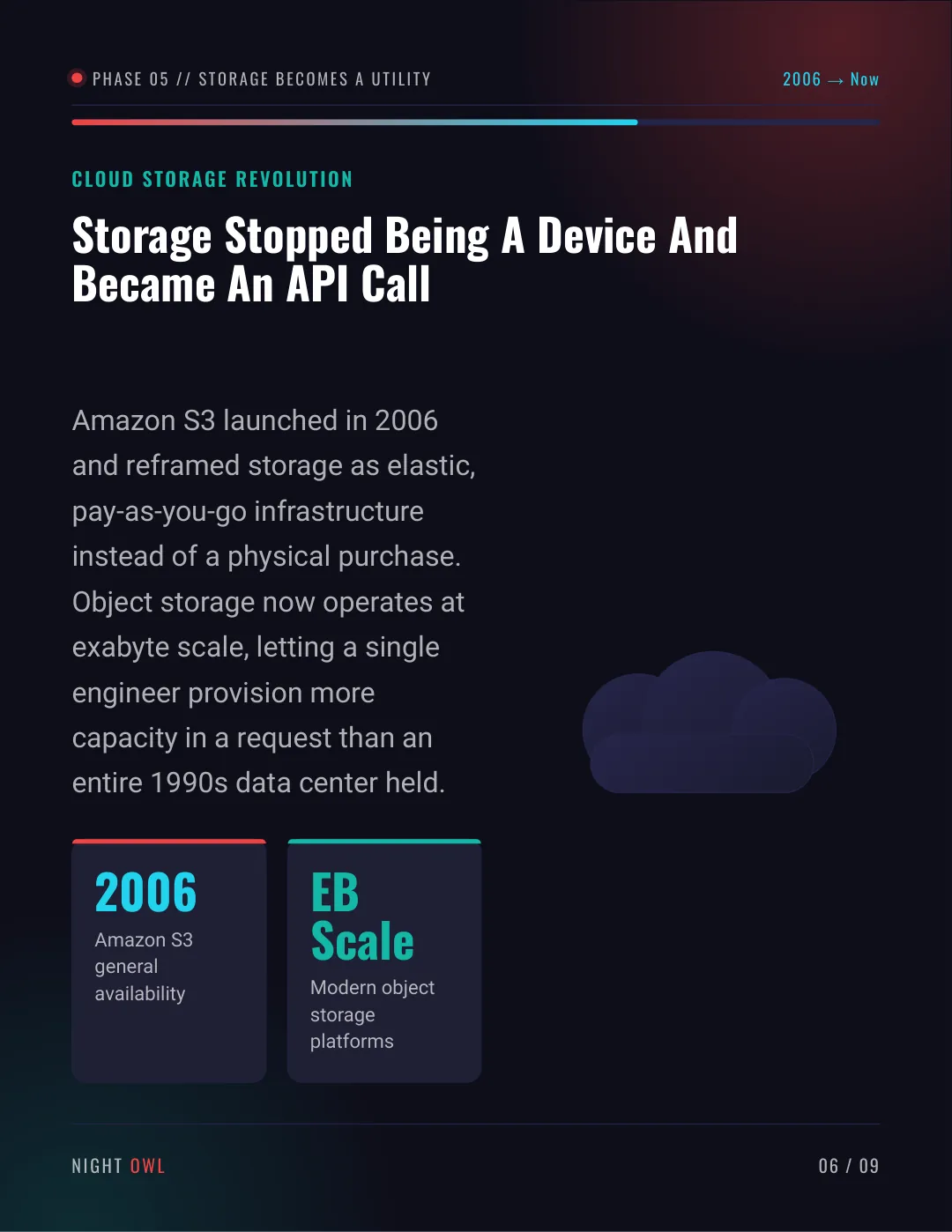
Amazon S3 launched in 2006
and reframed storage as elastic,
pay-as-you-go infrastructure
instead of a physical purchase.
Object storage now operates at
exabyte scale, letting a single
engineer provision more
capacity in a request than an
entire 1990s data center held.
2006
Amazon S3
general
availability
EB
Scale
Modern object
storage
platforms
NIGHT OWL
06 / 09
Slide 7
PHASE 06 // BIOLOGY BECOMES THE MEDIUM
2017 → Future
THE NEXT STORAGE FRONTIER
DNA Storage Compresses The Entire
Internet Into A Sugar Cube
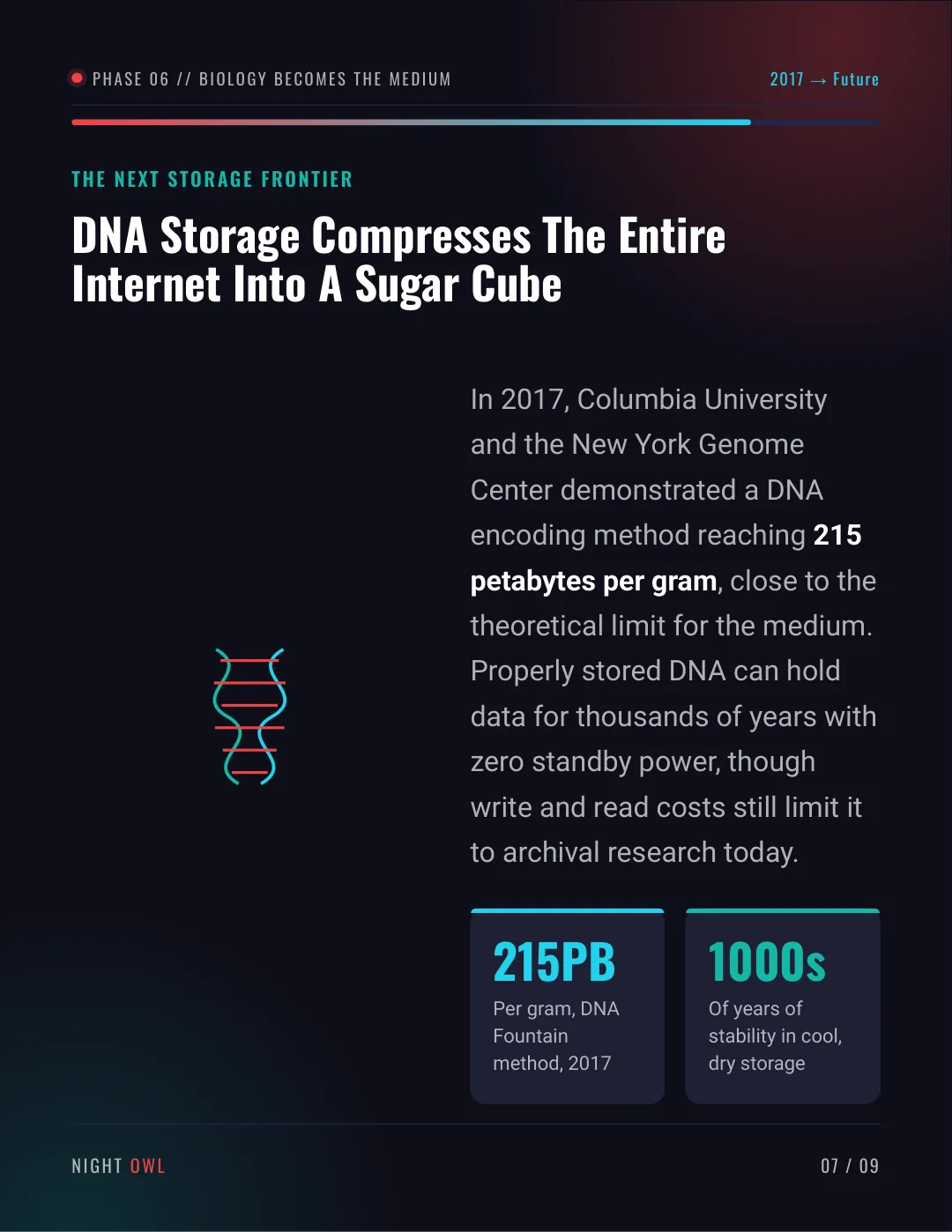
In 2017, Columbia University
and the New York Genome
Center demonstrated a DNA
encoding method reaching 215
petabytes per gram, close to the
theoretical limit for the medium.
Properly stored DNA can hold
data for thousands of years with
zero standby power, though
write and read costs still limit it
to archival research today.
215PB
Per gram, DNA
Fountain
method, 2017
1000s
Of years of
stability in cool,
dry storage
NIGHT OWL
07 / 09
Slide 8
DENSITY COMPARISON // LOG SCALE
1971 → 2026
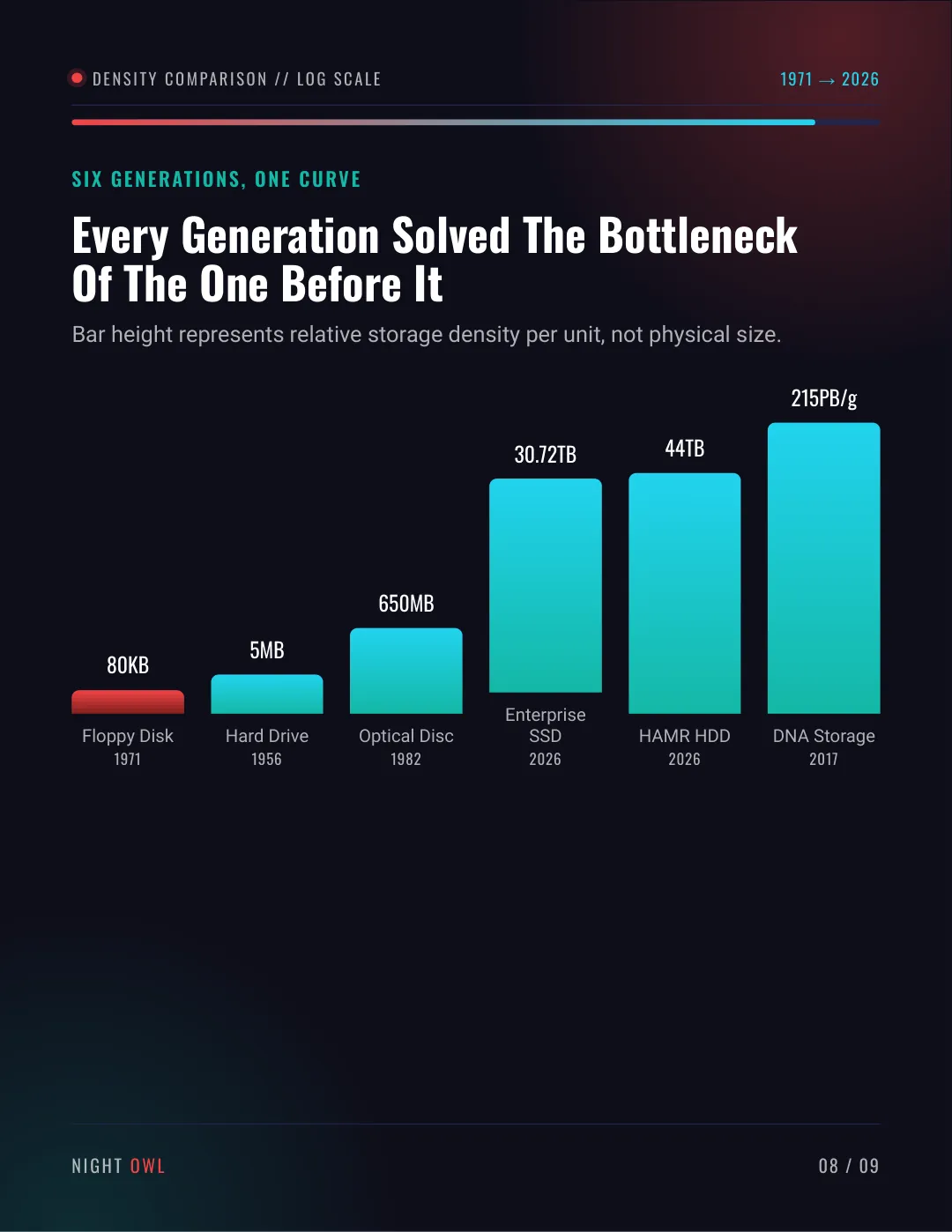
SIX GENERATIONS, ONE CURVE
Every Generation Solved The Bottleneck
Of The One Before It
Bar height represents relative storage density per unit, not physical size.
80KB
Floppy Disk
1971
5MB
Hard Drive
1956
650MB
Optical Disc
1982
30.72TB
Enterprise
SSD
2026
44TB
HAMR HDD
2026
215PB/g
DNA Storage
2017
NIGHT OWL
08 / 09
Slide 9
ENGINEERING TAKEAWAY
System Design Lens
WHAT THIS MEANS FOR SYSTEM DESIGN TODAY
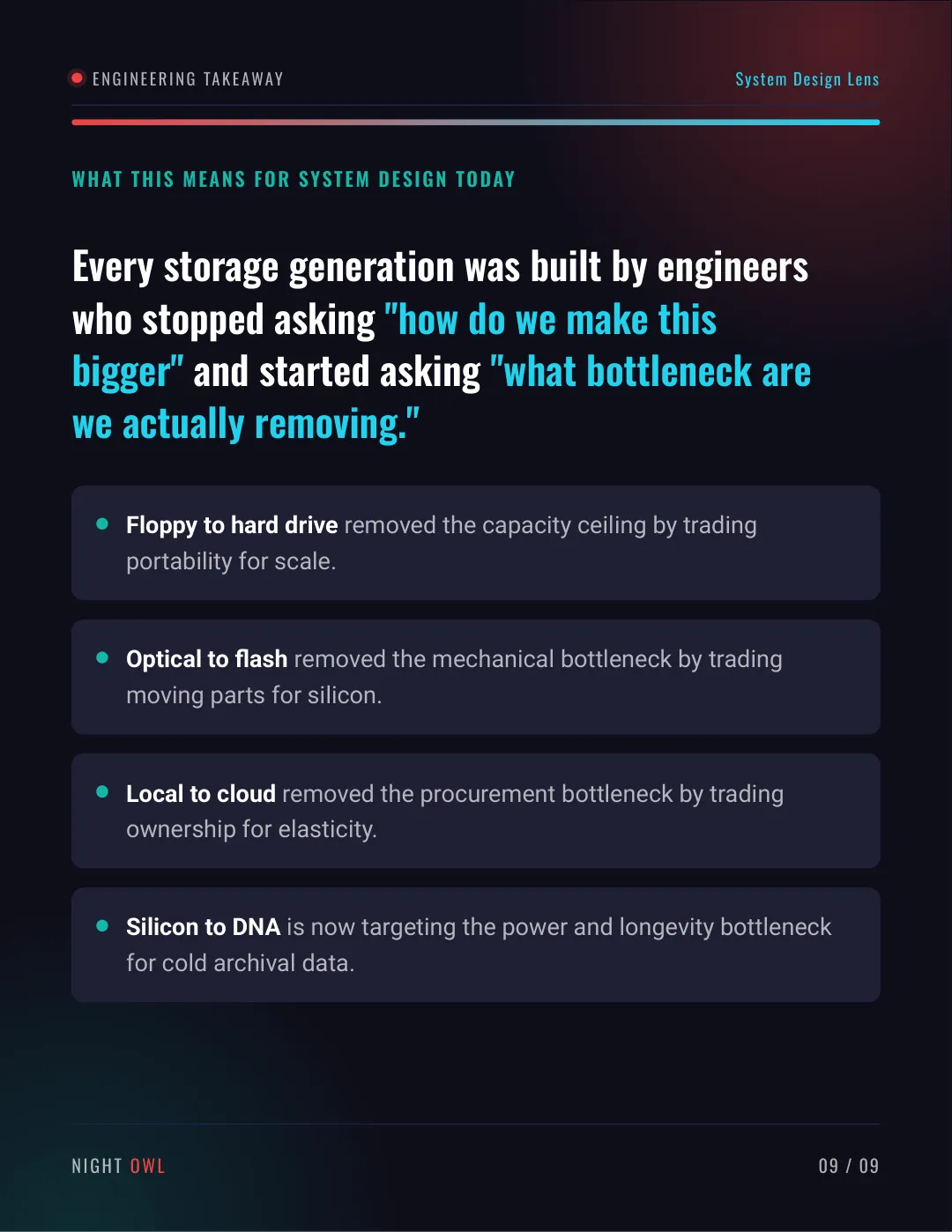
Every storage generation was built by engineers
who stopped asking "how do we make this
bigger" and started asking "what bottleneck are
we actually removing."
Floppy to hard drive removed the capacity ceiling by trading
portability for scale.
Optical to flash removed the mechanical bottleneck by trading
moving parts for silicon.
Local to cloud removed the procurement bottleneck by trading
ownership for elasticity.
Silicon to DNA is now targeting the power and longevity bottleneck
for cold archival data.
NIGHT OWL
09 / 09